
Competition Compliance for E-Commerce Platforms in India
Introduction Competition Compliance is an important part of legal and regulatory risk management for e-commerce platforms operating in India. Online marketplaces often connect sellers, brands, service providers, and consumers through complex digital ecosystems, which can create competition-law concerns relating to pricing, exclusivity, platform neutrality, preferential treatment, search rankings, data use, and access to markets. India’s […]
Securities Transmission Compliance for Indian Companies
Introduction Securities Transmission Compliance is an important part of corporate and securities-law compliance for Indian companies dealing with the transmission of shares and other securities following the death of a shareholder. Transmission is different from a transfer because it generally occurs by operation of law, such as when securities pass to a surviving joint holder, […]
Corporate Investigation and Internal Compliance Reviews in India
Introduction Corporate Investigation and Internal Compliance Reviews are important tools for Indian companies seeking to identify misconduct, strengthen internal controls, address regulatory concerns, and maintain effective corporate governance. Businesses may conduct internal reviews when they identify suspected fraud, financial irregularities, policy violations, conflicts of interest, employee misconduct, compliance gaps, or other issues that could expose […]
Related Party Transaction Compliance for Indian Companies
Introduction Related Party Transaction Compliance is an important part of corporate governance for Indian companies that enter into transactions with directors, key managerial personnel, promoters, group entities, subsidiaries, associates, or other related parties. Proper compliance helps companies ensure that such transactions are conducted transparently, on appropriate terms, and in accordance with applicable legal and regulatory […]
Tax Deducted at Source Compliance Risks for Indian Businesses
Introduction TDS Compliance Risks are an important part of tax compliance for Indian businesses. Companies making payments such as salaries, professional fees, commissions, interest, rent, and contractor payments need to correctly identify applicable TDS obligations, deduct tax at the appropriate rate, deposit it within the prescribed timelines, and maintain proper documentation. Effective TDS compliance requires […]
Tax Litigation Risk Management for Indian Companies

Introduction Tax Litigation Risk Management is an important part of corporate compliance for Indian companies dealing with tax assessments, notices, disputes, penalties, appeals, and regulatory proceedings. Effective tax litigation management helps businesses identify potential disputes early, maintain proper documentation, respond to tax authorities within prescribed timelines, and protect their financial and legal interests. With India’s […]
Sustainability Reporting and Corporate Legal Accountability
Introduction Sustainability Reporting India is becoming increasingly important as businesses face growing expectations for transparent environmental, social, and governance (ESG) disclosures. Sustainability reporting allows companies to communicate their environmental impact, social responsibilities, governance practices, and sustainability-related risks to investors, regulators, customers, employees, and other stakeholders. In India, the Business Responsibility and Sustainability Report (BRSR) framework […]
Social Security Code Compliance for Indian Employers
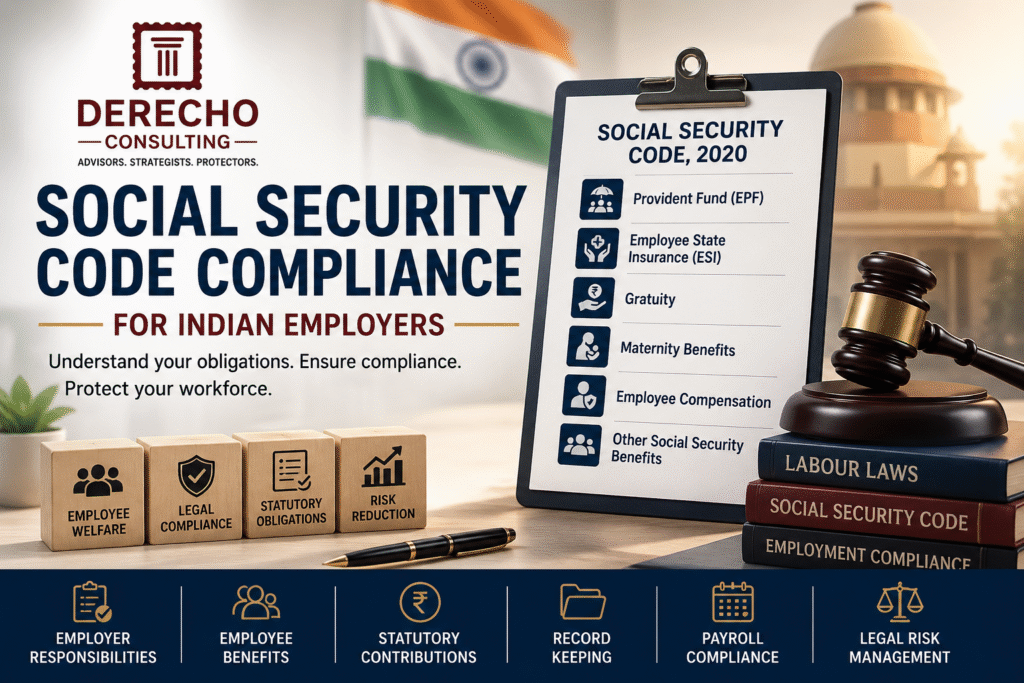
Introduction Social Security Code Compliance for Indian Employers has become increasingly important as India moves toward a consolidated labour-law framework. The Code on Social Security, 2020 came into force from 21 November 2025, replacing and consolidating provisions from several earlier social-security laws. The Code covers important areas such as Employees’ Provident Fund (EPF), Employees’ State […]
Legal Responsibilities of Online Gaming Platforms in India

Introduction Online Gaming Platforms India are facing a significantly evolving legal and regulatory environment as the government introduces stronger requirements for user safety, responsible gaming, transparency, grievance redressal, and regulatory oversight. The Promotion and Regulation of Online Gaming Act, 2025 establishes a framework for e-sports and online social games while prohibiting online money games, their […]
Legal Challenges of Automated Financial Decision-Making
Introduction Automated Financial Decision-Making is transforming the financial sector as banks, fintech companies, insurers, lenders, and other financial institutions increasingly use artificial intelligence, machine learning, and algorithmic systems to assess risk, evaluate customers, detect fraud, determine creditworthiness, and support financial decisions. These technologies can improve efficiency and enable faster decision-making, but they can also create […]