
Introduction
Securities Transmission Compliance is an important part of corporate and securities-law compliance for Indian companies dealing with the transmission of shares and other securities following the death of a shareholder. Transmission is different from a transfer because it generally occurs by operation of law, such as when securities pass to a surviving joint holder, nominee, or legal heir. SEBI describes transmission as the process through which securities of a deceased account holder are transmitted to the surviving joint holder, nominee, or legal heirs.
For companies, registrars and transfer agents, and other stakeholders, properly managing transmission requests requires accurate records, appropriate documentation, verification of the claimant, and compliance with applicable regulatory procedures. SEBI’s framework has increasingly focused on simplifying the transmission process and improving ease of doing business. In July 2026, SEBI issued a circular concerning the simplification and standardisation of the framework for transmission of securities.
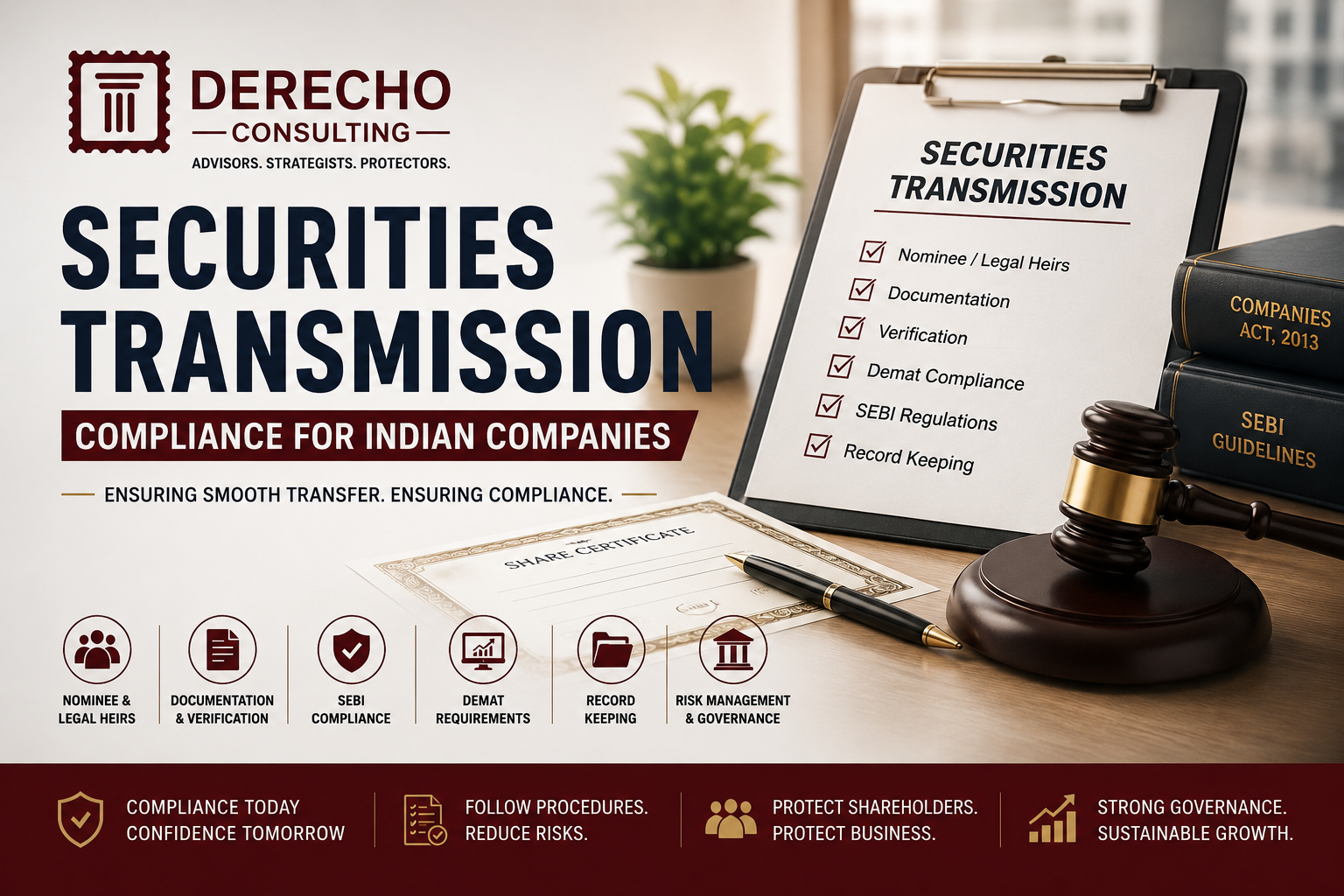
This guide explains Securities Transmission Compliance for Indian Companies, including transmission requests, nominees and legal heirs, documentation, dematerialisation, verification, regulatory requirements, record keeping, and practical compliance measures.
Why Securities Transmission Compliance Matters
Transmission-related matters can involve sensitive ownership, inheritance, documentation, and regulatory issues. Delays or errors in processing a transmission request may create difficulties for claimants and expose companies and intermediaries to compliance and grievance risks.
Effective Securities Transmission Compliance can help companies:
- Process transmission requests in accordance with applicable requirements.
- Verify the identity and entitlement of claimants.
- Maintain accurate shareholder records.
- Handle nominee and legal-heir claims appropriately.
- Ensure proper documentation.
- Reduce processing delays and compliance errors.
- Maintain appropriate communication with claimants.
- Strengthen regulatory and corporate governance controls.
- Reduce the risk of disputes relating to securities ownership.
Key Areas of Securities Transmission Compliance
1. Understanding Securities Transmission
Companies should distinguish transmission from a voluntary transfer of securities.
Transmission generally arises following events such as the death of a shareholder, where securities may pass to a surviving joint holder, nominee, or legal heir in accordance with the applicable legal and regulatory framework.
Understanding the nature of the transmission request helps determine the appropriate documentation and verification process.
2. Transmission to Nominees
Where securities are held in a single name with a valid nomination, the nominee may make a transmission claim by submitting the prescribed documents.
SEBI’s framework includes requirements such as a duly signed transmission request, death certificate, and PAN documentation, subject to the applicable procedure and circumstances.
Companies and relevant intermediaries should carefully verify the submitted information before processing the request.
3. Transmission to Legal Heirs
Where there is no nomination, transmission may involve legal heirs or other claimants.
Depending on the circumstances, supporting documents may include:
- Death certificate.
- Transmission request form.
- PAN documentation.
- Affidavit.
- Indemnity bond.
- Succession certificate.
- Probate of will.
- Letter of administration.
- Legal heirship certificate.
- Court decree or other applicable documentation.
The exact documentation can depend on the circumstances and value of the securities. SEBI’s framework provides specific documentation requirements for different situations.
4. Transmission of Jointly Held Securities
Where securities are jointly held and one of the joint holders dies, the securities may be transmitted to the surviving joint holder or holders subject to the applicable procedure and documentation.
Companies should verify the shareholder records, death certificate, transmission request, and other required information before updating the ownership records.
5. Dematerialisation and Transmission
Dematerialisation is an important consideration in securities transmission.
SEBI’s investor FAQs state that securities pursuant to transmission are issued in demat mode only under the applicable framework.
Companies and stakeholders should therefore ensure that transmission procedures are aligned with the applicable dematerialisation and depository requirements.
6. Documentation and Record Keeping
Proper documentation is essential for demonstrating that a transmission request has been processed appropriately.
Companies should maintain records relating to:
- Transmission request forms.
- Death certificates.
- Nomination records.
- PAN and identity documents.
- Legal-heir documentation.
- Succession certificates or probate documents where applicable.
- Indemnity bonds.
- Affidavits.
- No-objection documents where applicable.
- Correspondence with claimants.
- Internal verification and approval records.
Organised records can help companies respond to future queries, disputes, audits, and regulatory reviews.
7. Verification and Due Diligence
Companies and relevant intermediaries should establish appropriate verification procedures before processing securities transmission.
The review may include:
- Identity verification.
- Shareholding records.
- Nomination details.
- Death certificate verification.
- Legal-heir documentation.
- Demat account information.
- Claimant details.
- Applicable regulatory requirements.
Proper verification helps reduce the risk of incorrect transmission or competing ownership claims.
8. Regulatory Changes and Simplification
Securities transmission procedures continue to evolve as regulators seek to make the process easier for investors and legal heirs.
SEBI’s 2026 regulatory agenda includes measures aimed at simplifying and standardising the transmission framework. SEBI has also considered changes relating to documentation requirements and threshold limits for simplified transmission procedures.
Companies should therefore regularly review applicable SEBI circulars and related requirements rather than relying solely on older transmission procedures.
Common Securities Transmission Compliance Risks
Indian companies may face transmission-related risks due to:
- Incomplete documentation.
- Incorrect claimant information.
- Failure to verify legal-heir claims.
- Outdated shareholder records.
- Incorrect handling of nomination records.
- Delayed processing of transmission requests.
- Failure to follow applicable demat requirements.
- Inadequate communication with claimants.
- Competing claims over securities.
- Poor record keeping.
- Failure to monitor regulatory changes.
- Inadequate internal controls.
Best Practices for Securities Transmission Compliance
Companies should consider the following practices:
- Maintain accurate shareholder and nomination records.
- Establish a standard transmission-request checklist.
- Verify claimant documentation carefully.
- Track transmission requests and processing status.
- Maintain proper records of all submissions.
- Coordinate with the RTA and depository participants where applicable.
- Monitor regulatory changes issued by SEBI.
- Maintain clear communication with claimants.
- Escalate complex or disputed claims appropriately.
- Conduct periodic reviews of transmission procedures.
- Update internal policies when regulatory requirements change.
2026 Securities Transmission Compliance Considerations
2026 is particularly relevant for securities transmission compliance in India because SEBI has continued to focus on simplifying and standardising the transmission process. SEBI’s July 23, 2026 circular specifically addresses ease of doing investment and ease of doing business in relation to transmission of securities.
Companies should review their existing transmission procedures against the latest applicable regulatory requirements, particularly regarding documentation, verification, processing, dematerialisation, and communication with claimants.
Businesses should also ensure that internal teams, RTAs, and other relevant stakeholders are working with the latest applicable procedures.
How Derecho Consulting Can Help
Derecho Consulting can help Indian companies manage securities transmission and corporate compliance requirements through regulatory analysis, corporate legal advisory, documentation reviews, compliance-process assessments, governance support, risk identification, and regulatory updates.
A proactive approach to Securities Transmission Compliance can help companies strengthen their shareholder-record processes, identify documentation gaps, manage transmission-related risks, and maintain better regulatory compliance.
Conclusion
Securities Transmission Compliance for Indian Companies is an important part of effective corporate and securities governance. Transmission requests involving nominees, surviving joint holders, or legal heirs require careful attention to documentation, verification, shareholder records, and applicable regulatory requirements.
By maintaining accurate records, establishing clear transmission procedures, verifying claimant information, monitoring regulatory developments, and keeping appropriate documentation, companies can reduce processing errors and transmission-related compliance risks.
With the regulatory framework continuing to evolve in 2026, Indian companies should periodically review their transmission procedures and ensure that their internal processes remain aligned with the latest applicable SEBI requirements. A proactive and well-documented approach can help businesses provide more efficient transmission processing while strengthening regulatory compliance and shareholder confidence.