
Introduction
Competition Compliance is an important part of legal and regulatory risk management for e-commerce platforms operating in India. Online marketplaces often connect sellers, brands, service providers, and consumers through complex digital ecosystems, which can create competition-law concerns relating to pricing, exclusivity, platform neutrality, preferential treatment, search rankings, data use, and access to markets.
India’s competition framework is primarily governed by the Competition Act, 2002, which prohibits anti-competitive agreements and abuse of dominant position and regulates combinations that may adversely affect competition. The Competition Commission of India (CCI) specifically identifies vertical practices such as exclusive dealing, refusal to deal, tie-in arrangements, and resale price maintenance as areas that may require competition-law assessment.
The CCI’s market study on e-commerce in India also identified concerns around platform neutrality, preferred sellers, private labels, search rankings, discounts and deals, among other competition-related issues.
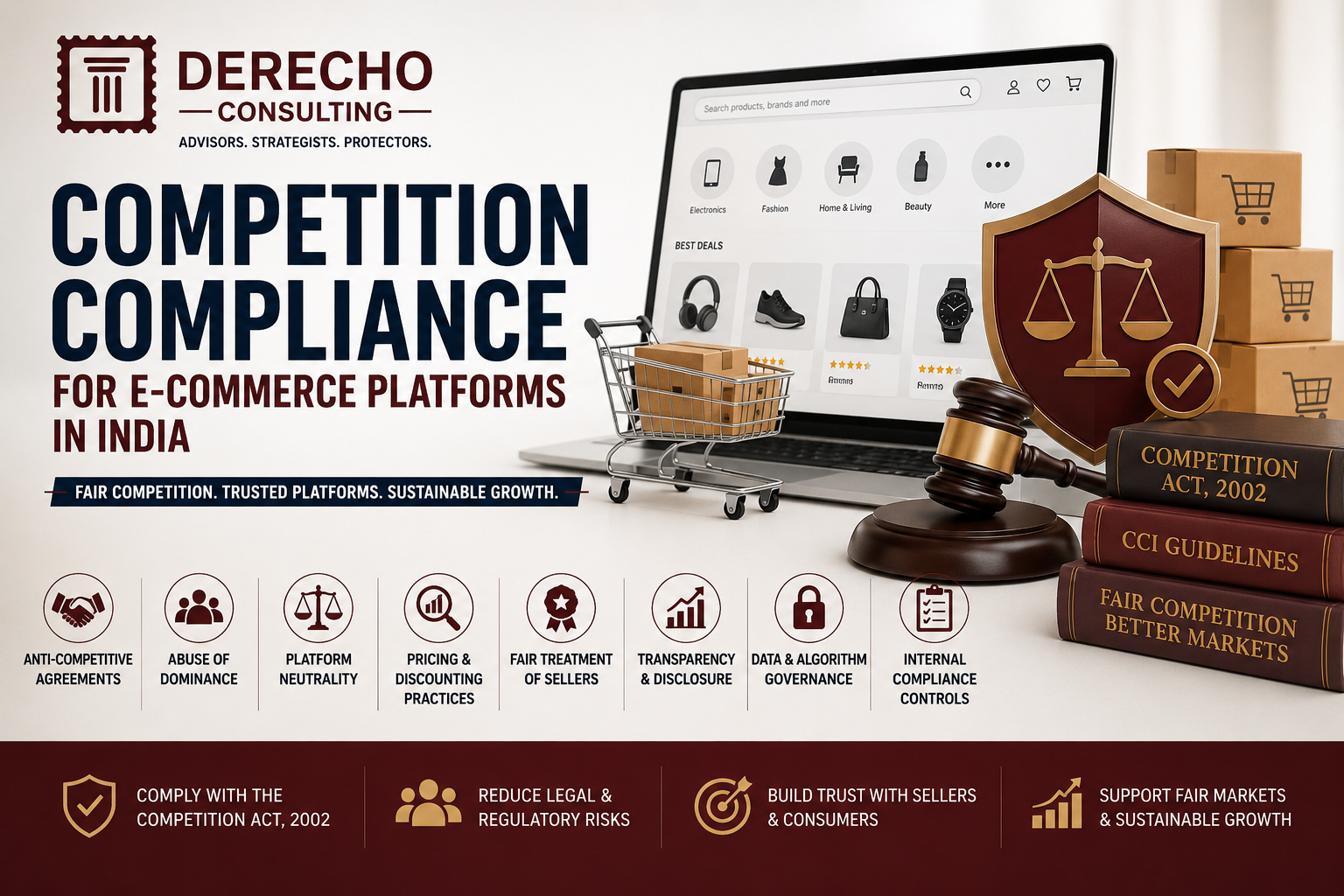
This guide explains Competition Compliance for E-Commerce Platforms in India, including anti-competitive agreements, abuse of dominance, platform neutrality, pricing practices, seller relationships, algorithms, data-related risks, internal controls, and practical compliance measures.
Why Competition Compliance Matters for E-Commerce Platforms
E-commerce platforms can operate simultaneously as marketplaces, technology providers, and sometimes competitors or sellers. This creates potential conflicts that may affect how sellers compete and how consumers access products and services.
Effective Competition Compliance can help e-commerce businesses:
- Identify potential competition-law risks at an early stage.
- Review commercial agreements with sellers and suppliers.
- Reduce the risk of anti-competitive practices.
- Assess pricing and discounting strategies.
- Maintain fair and transparent platform practices.
- Review preferential treatment of sellers.
- Strengthen internal competition-law controls.
- Reduce regulatory and litigation exposure.
- Improve corporate governance and compliance.
- Promote fair competition within digital marketplaces.
Key Areas of Competition Compliance for E-Commerce Platforms
1. Anti-Competitive Agreements
E-commerce platforms should carefully review agreements and commercial arrangements with sellers, suppliers, distributors, and other business partners.
Competition concerns may arise from arrangements involving:
- Exclusive supply.
- Exclusive distribution.
- Refusal to deal.
- Resale price maintenance.
- Tie-in arrangements.
- Market allocation.
- Price coordination.
- Restrictions on sellers.
The Competition Act addresses both horizontal and vertical agreements that cause or are likely to cause an appreciable adverse effect on competition.
2. Abuse of Dominant Position
Having a dominant position is not itself prohibited under Indian competition law. However, a dominant enterprise must avoid abusing that position in ways that harm competition.
Potential concerns can include:
- Unfair or discriminatory conditions.
- Unfair pricing.
- Predatory pricing.
- Restricting market access.
- Limiting technical or market development.
- Using dominance in one market to gain advantages in another.
The CCI explains that abuse of dominance can impede fair competition, exploit consumers, and make it difficult for competitors to compete effectively.
3. Platform Neutrality
Platform neutrality is a significant consideration for online marketplaces.
A platform may potentially face competition concerns where it operates both as a marketplace and as a participant selling competing products or services.
The CCI’s e-commerce market study identified concerns regarding platforms’ own private-label products and preferential treatment of selected sellers.
E-commerce businesses should therefore consider whether their platform policies provide fair and consistent treatment to participating sellers.
4. Search Rankings and Preferential Treatment
Search rankings can have a significant impact on the visibility and sales of sellers on an e-commerce platform.
Companies should maintain clear internal policies concerning:
- Search-ranking criteria.
- Sponsored listings.
- Preferred sellers.
- Promotional placements.
- Algorithmic recommendations.
- Product visibility.
- Seller performance metrics.
The CCI’s e-commerce study specifically identified search ranking and preferential treatment as competition-related concerns raised by marketplace participants.
5. Pricing, Discounts and Promotions
Pricing and discounting strategies should be reviewed carefully from a competition-law perspective.
Businesses should assess:
- Discount structures.
- Seller-funded promotions.
- Platform-funded discounts.
- Pricing restrictions.
- Promotional agreements.
- Minimum advertised pricing arrangements.
- Resale price restrictions.
- Potential predatory-pricing concerns.
Discounting itself is not automatically unlawful, but pricing practices may require competition assessment depending on the market position and surrounding circumstances.
6. Exclusive Arrangements
E-commerce platforms may enter into exclusive arrangements with sellers, brands, logistics providers, technology providers, or other business partners.
Before implementing exclusivity arrangements, businesses should assess:
- Market position.
- Duration of exclusivity.
- Scope of the restriction.
- Impact on competing businesses.
- Availability of alternative channels.
- Potential barriers to market access.
Exclusive supply and exclusive distribution arrangements are specifically recognised within the Competition Act’s framework for vertical agreements.
7. Data and Algorithmic Competition Risks
E-commerce platforms generate and process significant amounts of commercial data relating to sellers, products, pricing, demand, and consumer behaviour.
Companies should consider competition risks associated with:
- Use of seller data.
- Algorithmic pricing.
- Product recommendations.
- Search algorithms.
- Seller rankings.
- Access to commercially sensitive information.
- Use of marketplace data to compete with sellers.
Appropriate governance controls can help businesses reduce the risk of inappropriate use of commercially sensitive information.
8. Seller and Supplier Relationships
E-commerce platforms should establish clear competition-compliance standards for their relationships with sellers and suppliers.
Companies should review:
- Seller agreements.
- Supplier agreements.
- Pricing provisions.
- Exclusivity clauses.
- Commission structures.
- Termination provisions.
- Ranking policies.
- Promotional arrangements.
- Data-sharing provisions.
Regular legal review can help identify potentially problematic contractual provisions before they create regulatory concerns.
Common Competition Compliance Risks for E-Commerce Platforms
Indian e-commerce platforms may face competition risks due to:
- Preferential treatment of selected sellers.
- Unclear search-ranking practices.
- Anti-competitive agreements.
- Excessive exclusivity arrangements.
- Resale price restrictions.
- Potentially exclusionary pricing practices.
- Preferential use of marketplace data.
- Discriminatory platform conditions.
- Restrictions on seller access.
- Lack of internal competition-law policies.
- Insufficient employee training.
- Poor documentation of commercial decisions.
Best Practices for Competition Compliance
E-commerce platforms should consider the following practices:
- Establish a competition-compliance policy.
- Conduct periodic competition-risk assessments.
- Review seller and supplier agreements.
- Assess exclusivity arrangements before implementation.
- Monitor pricing and discounting practices.
- Maintain transparent platform policies.
- Review search-ranking and recommendation systems.
- Establish controls for commercially sensitive data.
- Train relevant employees on competition law.
- Maintain records of important commercial decisions.
- Conduct legal reviews of high-risk business practices.
- Establish escalation procedures for potential competition concerns.
- Monitor developments from the CCI and applicable competition-law framework.
The CCI itself provides competition-law guidance and compliance resources, including a competition advocacy toolkit.
2026 Competition Compliance Considerations
Competition regulation continues to be an important issue for India’s rapidly developing digital economy in 2026.
The CCI remains active in enforcement and competition advocacy, and its current activities include antitrust orders, market studies, regulatory consultations, and competition-law initiatives.
E-commerce platforms should therefore regularly review their commercial practices, particularly where they have significant market presence or operate as both marketplace intermediaries and competitors.
Businesses should also monitor developments relating to digital markets, platform practices, algorithmic decision-making, pricing strategies, seller relationships, and competition-law enforcement.
How Derecho Consulting Can Help
Derecho Consulting can help e-commerce businesses manage competition-law and regulatory risks through competition-compliance assessments, contract reviews, regulatory analysis, corporate legal advisory, risk identification, internal policy reviews, compliance training, and governance support.
A proactive approach to Competition Compliance can help e-commerce platforms identify potentially risky commercial practices, strengthen internal controls, review seller relationships, and make informed decisions when developing marketplace policies.
Conclusion
Competition Compliance for E-Commerce Platforms in India is an important component of responsible digital-business governance. As online marketplaces continue to expand, businesses need to consider how pricing, seller relationships, algorithms, search rankings, exclusivity, data use, and platform policies may affect competition.
By implementing effective competition-compliance policies, reviewing commercial agreements, monitoring potentially restrictive practices, training employees, and conducting periodic legal assessments, e-commerce platforms can better manage regulatory risks.
A proactive and well-documented approach to Competition Compliance can help Indian e-commerce businesses support fair competition, reduce legal exposure, strengthen platform governance, and build greater trust among sellers, consumers, and business partners.