
Introduction
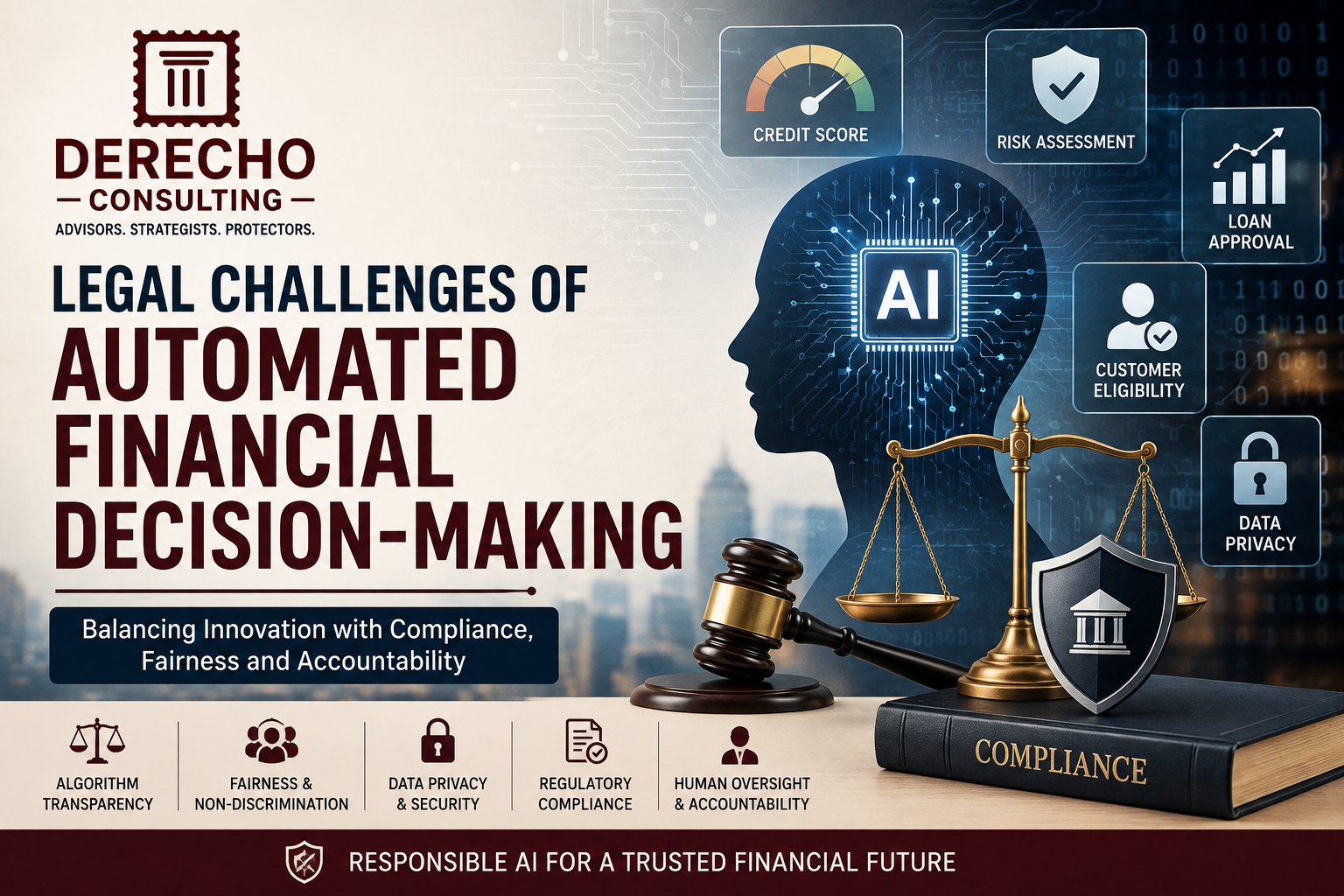
Automated Financial Decision-Making is transforming the financial sector as banks, fintech companies, insurers, lenders, and other financial institutions increasingly use artificial intelligence, machine learning, and algorithmic systems to assess risk, evaluate customers, detect fraud, determine creditworthiness, and support financial decisions.
These technologies can improve efficiency and enable faster decision-making, but they can also create important legal and regulatory challenges. Issues such as algorithmic bias, lack of transparency, data privacy, inaccurate outcomes, cybersecurity, consumer protection, and accountability must be carefully managed.
The Reserve Bank of India has highlighted risks associated with AI and machine learning in finance, including bias, explainability, data privacy, transparency, model risk, and financial stability. RBI has also developed the FREE-AI framework to support responsible and ethical AI adoption in the financial sector.
This guide explores the Legal Challenges of Automated Financial Decision-Making, including regulatory compliance, data protection, algorithmic accountability, consumer rights, liability, explainability, and practical measures businesses can adopt in 2026.
Why Automated Financial Decision-Making Matters
Financial institutions increasingly rely on automated systems for activities such as:
- Credit scoring.
- Loan approvals.
- Risk assessment.
- Fraud detection.
- Insurance decisions.
- Customer profiling.
- Transaction monitoring.
- Financial recommendations.
While automation can improve speed and consistency, businesses must ensure that automated systems do not create unfair, discriminatory, inaccurate, or legally non-compliant outcomes.
Responsible governance can help businesses:
- Reduce regulatory risks.
- Improve decision transparency.
- Protect customer information.
- Identify algorithmic bias.
- Strengthen financial consumer protection.
- Improve model governance.
- Build customer trust.
Key Legal Challenges
1. Algorithmic Bias and Discrimination
Automated financial models may produce biased outcomes when training data is incomplete, inaccurate, unbalanced, or reflects existing discriminatory patterns.
For example, an automated lending model could produce different outcomes for customers based on data characteristics that are not legally or commercially appropriate.
Businesses should regularly evaluate models for potential bias and establish appropriate testing and monitoring procedures.
RBI has highlighted the importance of accurate, diverse data and auditable algorithms to identify potential discrimination factors in financial decision-making.
2. Transparency and Explainability
Customers may not understand why an automated system rejected a loan application, changed a risk assessment, or produced a particular financial outcome.
Lack of explainability can create regulatory, consumer-protection, and reputational risks.
Financial institutions should maintain appropriate documentation explaining how important automated models operate and establish procedures for reviewing significant decisions.
3. Data Privacy
Automated financial decision-making can involve large amounts of personal and financial information.
Businesses should carefully consider how customer information is collected, processed, stored, shared, and used by automated systems.
India’s Digital Personal Data Protection Act, 2023 establishes a framework concerning the processing of digital personal data and the rights and obligations associated with such processing.
4. Consumer Protection
Automated decisions can directly affect customers through lending, financial products, pricing, insurance, and other services.
Businesses should ensure that automated systems do not result in misleading, unfair, or harmful customer outcomes.
Clear communication, complaint-handling mechanisms, and appropriate human review can help strengthen financial consumer protection.
5. Liability for Automated Decisions
Determining responsibility when an automated financial system makes an incorrect or harmful decision can be complex.
Businesses should clearly establish responsibility for:
- Model development.
- Model validation.
- Data quality.
- System monitoring.
- Decision review.
- Risk management.
- Regulatory compliance.
Human oversight can help ensure that important decisions are not treated as completely independent of organisational accountability.
6. Model Risk Management
Financial institutions can face risks when automated models are poorly designed, inadequately tested, or deployed without appropriate monitoring.
RBI has highlighted model-risk concerns and the need for governance, oversight, model development, deployment, and validation frameworks.
Businesses should therefore establish processes for model validation, performance monitoring, documentation, and periodic review.
7. Cybersecurity and System Security
Automated financial systems can become targets for cyberattacks, manipulation, unauthorised access, and data breaches.
Businesses should implement appropriate cybersecurity controls, access management, monitoring, incident-response procedures, and security testing.
8. Third-Party AI and Technology Providers
Financial institutions may rely on external technology providers for AI models, cloud infrastructure, data analytics, or automated decision-making systems.
Contracts should clearly address:
- Data protection.
- Security responsibilities.
- Confidentiality.
- Audit rights.
- Model performance.
- Incident reporting.
- Regulatory obligations.
- Business continuity.
Best Practices for Businesses
Businesses using automated financial decision-making should:
- Establish clear AI governance policies.
- Maintain appropriate human oversight.
- Test algorithms for bias and accuracy.
- Document important automated decisions.
- Monitor model performance.
- Protect customer data.
- Conduct regular compliance assessments.
- Maintain cybersecurity controls.
- Review third-party AI providers.
- Establish customer complaint and escalation procedures.
- Update systems when regulatory requirements change.
How Derecho Consulting Can Help
Derecho Consulting can help businesses address the Legal Challenges of Automated Financial Decision-Making through regulatory compliance, AI governance, data privacy advisory, risk assessment, technology law, consumer protection, contractual review, and corporate legal advisory.
A structured compliance framework can help organisations identify legal risks, improve AI governance, protect customer interests, and adopt automated financial technologies responsibly.
Conclusion
Legal Challenges of Automated Financial Decision-Making will become increasingly important as financial institutions expand their use of AI, machine learning, and automated systems.
Businesses must balance technological innovation with transparency, fairness, data protection, consumer rights, cybersecurity, accountability, and regulatory compliance.
By implementing strong AI governance, appropriate human oversight, model-risk management, data-protection measures, and regular compliance reviews, businesses can use automated financial decision-making more responsibly while reducing legal and regulatory risks.