
Fixed-Term Employment in India: Legal Rights and Employer Compliance

Introduction Fixed-Term Employment is an important part of India’s current employment framework. It allows an employer to engage an employee through a written employment contract for a specific period. This can be useful for project-based work, seasonal requirements, and other time-bound business needs. The Industrial Relations Code, 2020 recognises fixed-term employment and provides for benefits […]
POSH Compliance in 2026: What Employers Need to Review

Introduction POSH Compliance remains an important responsibility for employers in India. The Sexual Harassment of Women at Workplace (Prevention, Prohibition and Redressal) Act, 2013 provides the legal framework for preventing and addressing sexual harassment at the workplace. The Ministry of Women and Child Development continues to list the POSH Act and the 2013 Rules as […]
Employee Termination in India: Legal Compliance and Common Risks

Introduction Employee Termination requires careful planning because the legal requirements can differ based on the employee’s role, the reason for termination, the establishment, and the applicable employment laws. Employers may need to consider employment contracts, company policies, standing orders, labour laws, and state-specific requirements. India’s four Labour Codes came into force on 21 November 2025, […]
Global Expansion from India: Legal, Tax and Compliance Checklist

Introduction Global Expansion is becoming an important growth strategy for Indian businesses. Companies are entering foreign markets through subsidiaries, branches, joint ventures, distributors, partnerships, and cross-border digital services. Each structure can create different legal, tax, foreign-exchange, and reporting requirements. Before entering a new country, a business should understand the local market and its legal environment. […]
Labour Codes Compliance Checklist for Indian Companies in 2026

Introduction Labour Codes Compliance Checklist for Indian Companies is an important reference for businesses reviewing their employment and HR compliance in 2026. India’s four Labour Codes came into force on 21 November 2025, consolidating 29 existing central labour laws into four broader frameworks covering wages, industrial relations, social security, and occupational safety and working conditions. […]
Influencer Content and Copyright: Legal Risks for Brands in India

Introduction Influencer Content Copyright in India is an important legal consideration for brands using social media creators to promote their products and services. Influencers create Instagram posts, reels, YouTube videos, photographs, blogs, podcasts, and other digital content for brands. However, paying an influencer does not by itself answer the question of who owns the copyright […]
Employee Data Protection: Privacy Compliance for Indian Employers

Introduction Employee Data Protection in India is becoming an important compliance issue for employers. Businesses collect and process large amounts of employee information during recruitment, employment, payroll, benefits, performance management, and termination. Employee information can include names, contact details, identification documents, financial information, attendance records, employment records, and other personal data. Modern workplaces may also […]
Tokenised Securities in India: Who Owns the Digital Asset?

Introduction Tokenised Securities in India are becoming an important topic in the financial and technology sectors. Blockchain technology allows certain financial interests to be represented through digital tokens. These tokens can represent securities, investment interests, or contractual rights. Tokenisation can make the recording and transfer of assets more digital. It can also create new opportunities […]
Cybercrime Through AI Agents: New Legal Risks for Indian Companies

Introduction AI Cybercrime is becoming a growing concern for Indian companies as artificial intelligence systems become more capable of automating research, communication, software analysis, and other tasks. AI agents can carry out tasks with limited human input, which can also increase the speed and scale of cyberattacks when attackers misuse these systems. CERT-In reported in […]
Legal Governance of Autonomous AI Systems in India: 2026 Guide
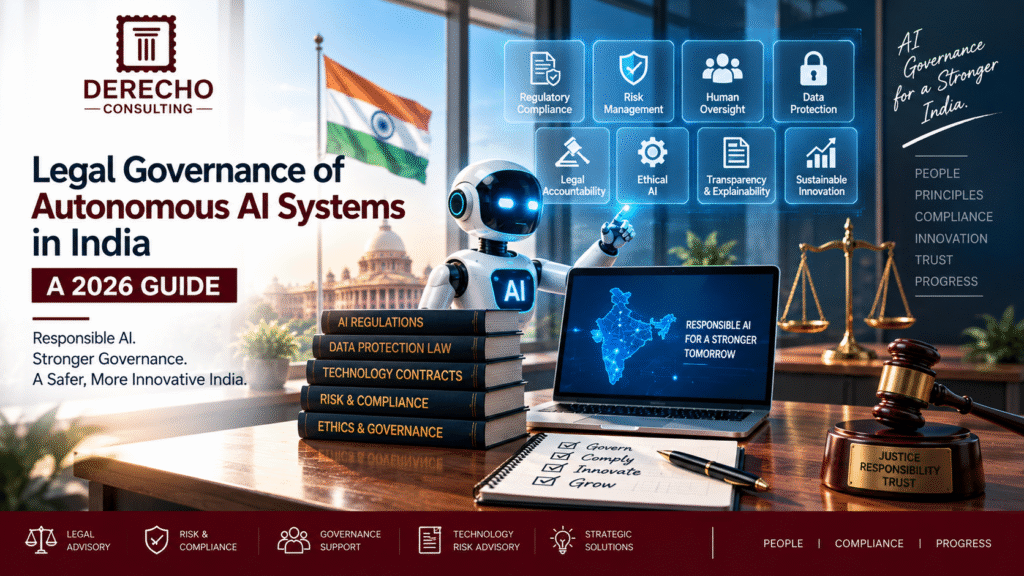
Introduction AI Governance is becoming an important issue as businesses move from simple AI tools to systems that can plan tasks, use software, make recommendations, and take actions with limited human involvement. These systems are often described as autonomous or agentic AI systems. An autonomous AI system may interact with customers, analyse information, use business […]