
Climate-Related Business Disclosures in India: Emerging Legal Issues

Introduction Climate Disclosure in India is becoming an important legal and compliance issue for businesses as investors, regulators, customers, and other stakeholders demand greater transparency about climate-related risks. Companies are increasingly expected to provide reliable information about sustainability, emissions, environmental impact, and climate-related business risks. In India, climate reporting is closely connected with ESG reporting, […]
Wages Under the New Labour Codes: What Employers Should Review

1. Introduction Wage Compliance is an important area for employers in 2026. India’s four Labour Codes came into effect on 21 November 2025. The Code on Wages, 2019 covers minimum wages, payment of wages, bonus, and related matters. Employers should now review their salary structures and payroll processes. 2. Understand the Definition of Wages The […]
Voice Cloning Fraud in India: Legal Risks for Businesses and Executives

1. Introduction Voice Cloning Fraud is becoming a growing cybersecurity and legal concern for businesses. AI tools can create synthetic audio that closely resembles a real person’s voice. Attackers may use it to impersonate executives, request payments, obtain confidential information, or support phishing and social-engineering attacks. CERT-In’s 2026 guidance specifically identifies deepfake voice and video […]
Overseas Direct Investment by Indian Companies: 2026 Compliance Guide

1. Introduction Overseas Direct Investment (ODI) allows Indian companies to invest in businesses outside India. Such investments may support international expansion, overseas subsidiaries, joint ventures, and strategic business activities. However, companies must follow India’s foreign exchange rules before making an overseas investment. The current RBI framework is based on the Foreign Exchange Management (Overseas Investment) […]
Digital Services and Indian Tax: Key Issues for Foreign Technology Companies
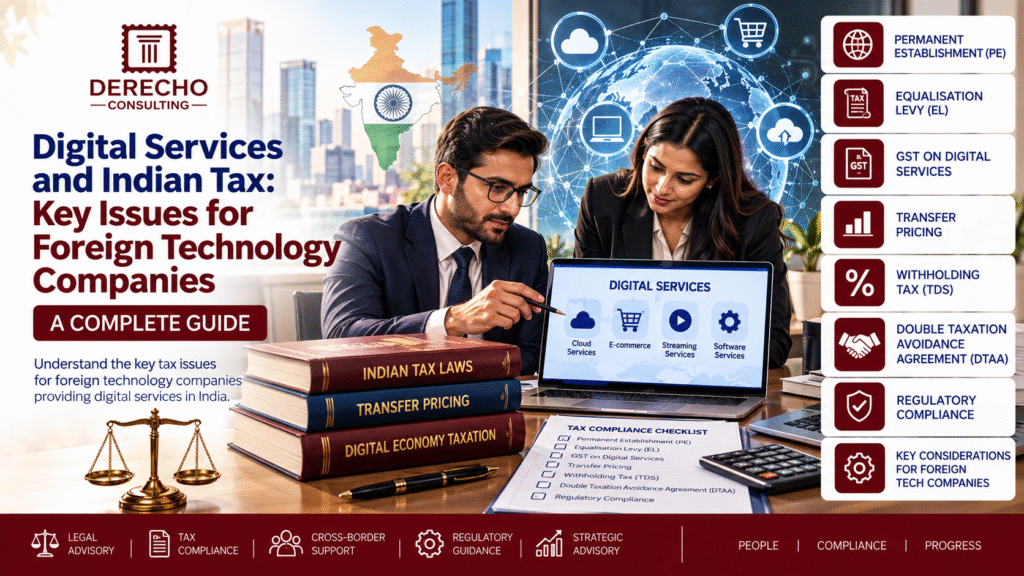
1. Introduction Digital Tax India is an important consideration for foreign technology companies serving customers in India. A company may provide software, cloud services, online platforms, digital advertising, data services, or technical services from outside India. The tax position can depend on the nature of the service, the Indian customer, the company’s business activities in […]
Platform Workers in India: Social Security and Legal Compliance in 2026

1. Introduction Platform Workers are an important part of India’s digital economy. They provide services through online platforms and usually work outside the traditional employer-employee relationship. The Code on Social Security, 2020 recognises gig workers and platform workers and provides a framework for social security measures. The Code came into force on 21 November 2025. […]
Domain Name Disputes in India: Legal Protection for Businesses

Introduction Domain Name Disputes can arise when another person or business registers or uses a domain name that is identical or confusingly similar to a business name, trademark, or service mark. In India, domain names can receive legal protection where their use creates confusion or supports a passing-off claim. The Supreme Court in Satyam Infoway […]
Startup Due Diligence: What Investors Check Before Funding

Introduction Startup Due Diligence is an important process before investors commit funds to a business. Investors generally review the startup’s corporate structure, financial records, ownership, contracts, intellectual property, employees, regulatory compliance, and potential liabilities. Preparing these areas in advance can help founders organise their records and address issues that may arise during the investment process. […]
Startup Exit Planning in India: Legal Issues Founders Should Consider

Introduction Startup Exit Planning is an important part of long-term business planning for founders, investors, and shareholders. A startup exit may involve a strategic acquisition, sale of shares, merger, buy-back, or another transaction that changes ownership or control. The legal process can involve corporate approvals, shareholder agreements, tax rules, regulatory filings, employee matters, intellectual property, […]
Fixed-Term Employment in India: Legal Rights and Employer Compliance

Introduction Fixed-Term Employment is an important part of India’s current employment framework. It allows an employer to engage an employee through a written employment contract for a specific period. This can be useful for project-based work, seasonal requirements, and other time-bound business needs. The Industrial Relations Code, 2020 recognises fixed-term employment and provides for benefits […]