
Introduction
POSH Compliance remains an important responsibility for employers in India. The Sexual Harassment of Women at Workplace (Prevention, Prohibition and Redressal) Act, 2013 provides the legal framework for preventing and addressing sexual harassment at the workplace. The Ministry of Women and Child Development continues to list the POSH Act and the 2013 Rules as the applicable legislation, and its publications page lists an updated Handbook on Sexual Harassment of Women at Workplace published on 12 May 2026.
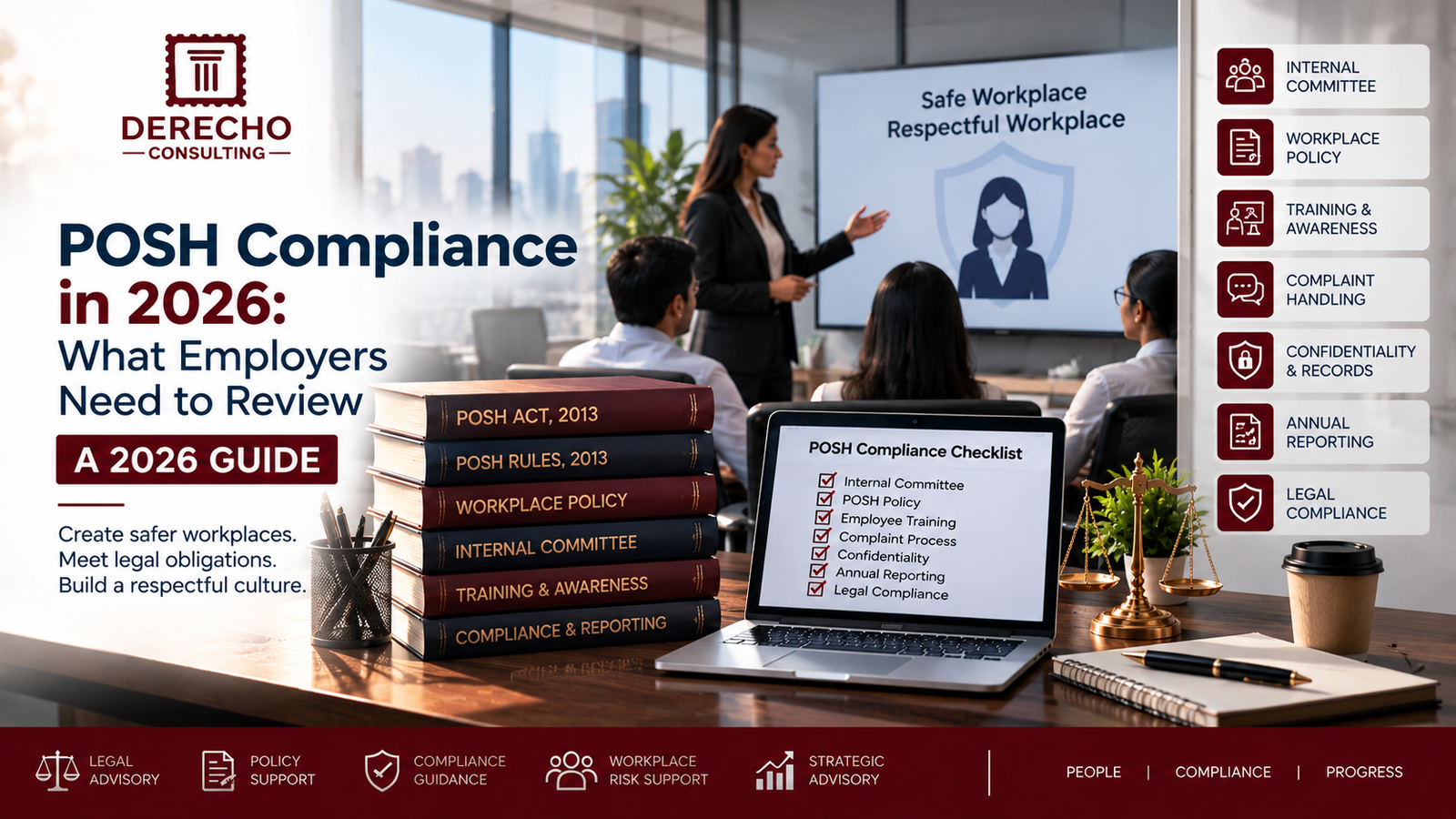
Employers should therefore review their POSH framework regularly. This includes the Internal Committee, workplace policy, employee awareness, complaint handling, confidentiality, records, and annual reporting. The Act also places specific duties on employers to create awareness and support the complaint process.
Why POSH Compliance Matters
A proper POSH Compliance framework helps employers create a workplace where complaints can be reported and handled through a defined process. It also helps organisations understand their responsibilities before a complaint arises.
Employers should review whether their current system is working in practice, not only whether a policy document exists. The POSH Act requires an Internal Committee in the circumstances covered by section 4, while the law also provides for a Local Committee mechanism in applicable cases.
Key Areas of POSH Compliance
1. Internal Committee
Employers should first check whether the Internal Committee has been properly constituted.
The committee should have the members required by the POSH Act, including a woman Presiding Officer, employee members, and an external member as prescribed. At least half of the committee members must be women, and members can hold office for a period of up to three years.
Employers should also check whether committee details are current and whether there have been changes in members, roles, or contact information.
2. POSH Policy
The organisation should maintain a clear workplace policy on prevention, prohibition, and redressal of sexual harassment.
The policy should explain:
- What conduct may amount to sexual harassment.
- How a complaint can be made.
- Who receives complaints.
- How the inquiry process works.
- Confidentiality requirements.
- Available escalation and appeal mechanisms.
The 2013 Rules require employers to formulate and widely disseminate an internal policy or similar instrument addressing prevention and redressal.
3. Employee Awareness and Training
POSH Compliance is not complete when a policy is uploaded to an employee portal.
Employees should understand:
- What the policy covers.
- How to raise a complaint.
- Who the committee members are.
- What protections are available.
- Why confidentiality matters.
The POSH Rules require employers to conduct employee awareness programmes. They also require orientation and capacity-building programmes for Internal Committee members.
4. Training for Internal Committee Members
Internal Committee members need a practical understanding of their responsibilities.
Training should cover:
- Complaint handling.
- Inquiry procedures.
- Evidence review.
- Confidentiality.
- Natural justice.
- Documentation.
- Reporting.
- Recommendations and follow-up.
Employers should also review whether members have received periodic training rather than relying on a single session conducted years earlier.
5. Complaint Handling and Inquiry
Employers should maintain a clear process for receiving and handling complaints.
The organisation should ensure that complaints are directed to the appropriate committee and handled according to the procedure prescribed under the Act and Rules.
The inquiry process should be documented carefully. Relevant records should be maintained securely, and the committee should follow the applicable timelines and procedural requirements.
The POSH Act contains separate provisions covering complaints, conciliation, inquiry, interim measures, inquiry reports, recommendations, and appeals.
6. Confidentiality and Record Protection
POSH matters involve sensitive personal information.
The law restricts publication or communication of the contents of complaints and inquiry proceedings. Employers should therefore take care when storing, sharing, and discussing POSH records.
Access to complaint files should be limited to authorised persons. Digital records should also be protected through appropriate access controls and security measures.
7. Employer Duties
Employers have responsibilities beyond constituting a committee.
The POSH framework requires employers to provide a safe working environment, assist the committee, support awareness activities, and treat sexual harassment as misconduct under applicable service rules. Employers must also monitor timely submission of committee reports.
A yearly review should therefore check whether these duties are actually being followed.
8. Annual Reports and Documentation
The Internal Committee or Local Committee must prepare an annual report in the prescribed manner. The employer also has reporting obligations concerning cases and their disposal.
The 2013 Rules specify that the annual report should include the number of complaints received, complaints disposed of, cases pending for more than 90 days, awareness programmes conducted, and the nature of action taken.
Employers should therefore maintain accurate records throughout the year rather than trying to prepare the information at the last minute.
9. Multi-Location, Remote and Digital Workplaces
Modern workplaces may include offices, remote employees, travel, client locations, and digital communication platforms.
Employers should review whether their POSH policy and complaint process clearly cover these working situations. The definition of workplace under the Act is broad and includes places connected with work, subject to the statutory framework.
Companies should also ensure that employees know how to contact the Internal Committee when they are working remotely or outside the main office.
10. 2026 POSH Compliance Review
In 2026, employers should review their POSH framework against the current Act, Rules, internal processes, and the latest government guidance. The Ministry of Women and Child Development’s publications page lists a Handbook on Sexual Harassment of Women at Workplace dated 12 May 2026, making it useful for organisations conducting a current compliance review.
Employers should check:
- Internal Committee composition.
- POSH policy.
- Committee contact details.
- Training records.
- Employee awareness.
- Complaint procedures.
- Confidentiality controls.
- Annual reporting.
- Record management.
- Follow-up on committee recommendations.
Common POSH Compliance Risks
Employers may face POSH Compliance risks when they:
- Have an improperly constituted Internal Committee.
- Fail to update committee members.
- Maintain an outdated POSH policy.
- Do not conduct regular awareness programmes.
- Do not train committee members adequately.
- Mishandle complaint records.
- Fail to protect confidentiality.
- Delay inquiry processes.
- Maintain incomplete annual records.
- Do not monitor implementation of committee recommendations.
Best Practices for POSH Compliance
Employers should review their POSH framework at least periodically.
A practical review should cover the committee, policy, training, complaint process, confidentiality, records, annual reporting, and management oversight.
The organisation should also keep evidence of training and awareness activities. The POSH Rules specifically require employers to conduct awareness programmes and committee training.
How Derecho Consulting Can Help
Derecho Consulting can help employers strengthen POSH Compliance through policy reviews, Internal Committee assessments, POSH training support, documentation reviews, complaint-process assessments, annual-report preparation support, confidentiality reviews, and compliance-gap assessments.
A structured review can help organisations identify procedural gaps and improve their workplace-harassment prevention and redressal framework.
Conclusion
POSH Compliance in 2026 is not only about having an Internal Committee. Employers also need a functioning policy, trained committee members, employee awareness, proper inquiry procedures, confidentiality controls, and accurate reporting.
The POSH Act and Rules continue to provide the core legal framework, while the Ministry of Women and Child Development’s 2026 handbook provides current guidance for employers reviewing their practices.