
Introduction
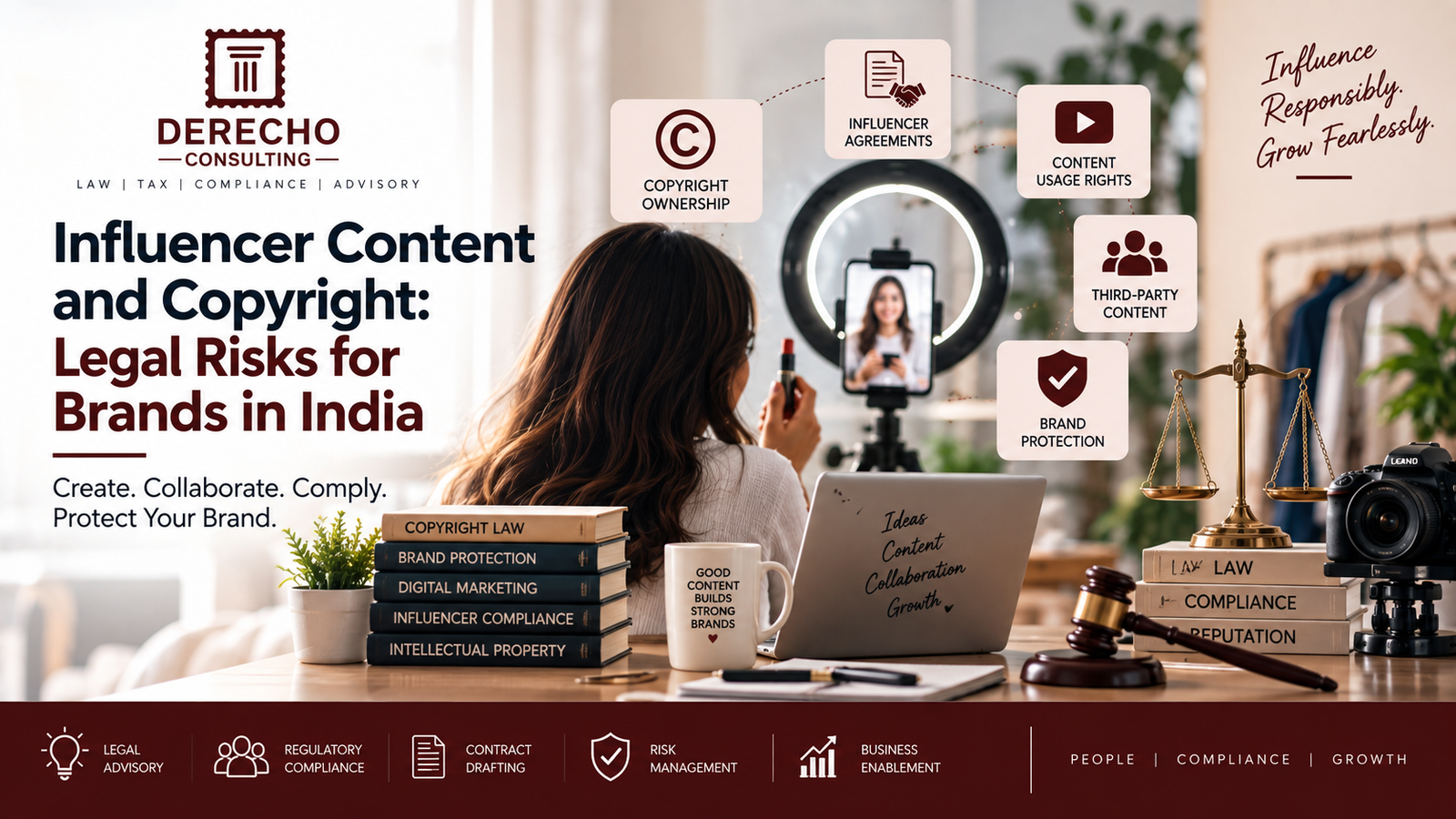
Influencer Content Copyright in India is an important legal consideration for brands using social media creators to promote their products and services.
Influencers create Instagram posts, reels, YouTube videos, photographs, blogs, podcasts, and other digital content for brands. However, paying an influencer does not by itself answer the question of who owns the copyright or what rights the brand can exercise.
Brands should clearly define ownership, licensing, usage rights, duration, territory, editing rights, and third-party content permissions in their influencer agreements.
Understanding Influencer Content Copyright in India can help brands reduce copyright disputes and manage influencer-created content more effectively.
Why Influencer Content Copyright Matters for Indian Brands
Influencer campaigns can generate different types of creative assets, including:
- Instagram posts and reels
- YouTube videos
- Product photographs
- Scripts and captions
- Blog articles
- Graphics and illustrations
- Music and sound recordings
- Short-form advertisements
- Product demonstrations
- Testimonials and reviews
Each asset can involve different copyright and contractual considerations.
A brand may have paid for the campaign but still need appropriate rights to reuse or modify the resulting content.
For example, an influencer may create a product video for Instagram. If the brand later wants to use the same video in a paid advertisement, on its website, or on a marketplace listing, the original agreement should clearly address those uses.
Key Legal Issues in Influencer Content Copyright in India
1. Who Owns the Influencer Content?
One of the first questions is whether the influencer or the brand owns the copyright in the content.
The Copyright Act provides rules concerning first ownership and permits copyright to be assigned. For commissioned photographs and certain other works, the statutory ownership rules can also depend on the circumstances and the agreement between the parties.
Therefore, brands should not rely only on statements such as:
“The influencer is being paid for the content.”
Payment alone should not be treated as a substitute for clearly drafted intellectual-property terms.
The contract should expressly address ownership or licensing.
2. Copyright Assignment vs Copyright Licence
Brands should understand the difference between an assignment and a licence.
An assignment transfers specified copyright interests to the assignee. Under Section 19 of the Copyright Act, an assignment must be in writing and signed by the assignor or an authorised agent. It must identify the work and specify the rights assigned, duration and territorial extent.
A licence, on the other hand, permits the brand to exercise specified rights without necessarily transferring ownership of the copyright. Section 30 provides for copyright licences in writing.
For influencer campaigns, the commercial requirement should determine whether the brand needs ownership or a defined licence.
3. Define the Exact Usage Rights
A good influencer agreement should specify where the brand can use the content.
For example, the agreement can address:
- Brand website
- YouTube
- Paid social media advertising
- Search advertising
- E-commerce marketplaces
- Email marketing
- Offline advertising
- Print materials
- Television or other media
- Internal corporate use
This is important because a campaign may begin as a social-media collaboration but later become part of a wider advertising campaign.
4. Duration and Territory of Copyright Rights
Influencer agreements should also specify how long the brand can use the content and where it can use it.
For example:
- India only
- Worldwide
- Campaign period only
- One year
- Three years
- Perpetual, where legally and commercially appropriate
The Copyright Act contains specific rules where an assignment does not state certain terms. For example, where the period of assignment is not stated, the Act provides a five-year statutory presumption; where territorial extent is not specified, it is presumed to extend within India.
Clear drafting can reduce uncertainty and disputes.
5. Can the Brand Edit Influencer Content?
Influencer content may need to be edited for different platforms.
A brand may want to:
- Crop a photograph
- Shorten a video
- Add subtitles
- Add a logo
- Change the format
- Create a shorter advertisement
- Combine clips
- Translate the content
- Add promotional text
The agreement should therefore address modification and adaptation rights.
This is especially important when content is created for multiple advertising formats.
6. Music, Images and Third-Party Content
Influencer content may contain materials that the influencer does not own.
Examples include:
- Background music
- Stock photographs
- Stock videos
- Graphics
- Fonts
- Templates
- Brand logos
- Film clips
- Other creators’ content
A brand that receives influencer content should not assume that all elements within the content are cleared for commercial use.
Copyright infringement can arise where protected works are used without appropriate permission or licence.
Brands should therefore include appropriate warranties and clearance obligations in influencer agreements.
7. Influencer Advertising Disclosure
Copyright is only one part of influencer campaign compliance.
Influencer advertising can also involve consumer-protection and advertising requirements.
The Department of Consumer Affairs’ Endorsements Know-hows! guidance states that material connections between influencers and advertisers should be disclosed clearly and prominently. It identifies terms such as “advertisement,” “ad,” “sponsored,” “collaboration,” and “partnership” for paid or barter endorsements.
ASCI’s influencer advertising guidance similarly requires disclosure of advertisements and provides requirements concerning how disclosures should appear across different formats.
Brands should therefore review both copyright rights and advertising disclosure requirements before launching campaigns.
8. Content Modification and Brand Approval
Brands should establish an approval process before content is published.
The agreement can specify:
- Who approves the final content
- Number of revisions
- Required brand guidelines
- Permitted claims
- Mandatory disclaimers
- Product information
- Disclosure requirements
- Approval timelines
- Content takedown procedures
This can help prevent disputes after publication.
9. Influencer Representations and Warranties
Influencer agreements should consider appropriate representations relating to the content.
For example, the influencer may be required to confirm that:
- The content is original or properly licensed.
- Third-party materials have appropriate permissions.
- The content does not knowingly infringe third-party rights.
- Required advertising disclosures will be followed.
- Product claims will be supported.
- The influencer will comply with applicable campaign requirements.
These provisions can help allocate contractual responsibility.
10. Moral Rights and Attribution
Copyright ownership is not necessarily the only intellectual-property issue.
The Copyright Act separately recognises certain special rights of authors, including the right to claim authorship and rights concerning certain prejudicial distortions or modifications.
Brands should therefore consider how content may be edited, attributed, credited, or repurposed.
The contract should address these matters carefully rather than assuming that a copyright transfer resolves every issue.
Common Copyright Risks for Brands
Brands working with influencers may face risks such as:
1. Unclear ownership
The contract does not clearly state whether copyright is assigned or licensed.
2. Limited usage rights
The brand receives permission for one social-media platform but later uses the content elsewhere.
3. Unauthorised third-party material
Music, photographs, videos or graphics may not have appropriate commercial rights.
4. Expired licences
The brand continues using content after the agreed licence period.
5. Unclear geographic rights
A campaign expands internationally even though the agreement only covers India.
6. Content modification disputes
The influencer objects to edits or adaptations that were not addressed in the contract.
7. Missing advertising disclosures
Sponsored content may not contain appropriate disclosure.
8. Inadequate record keeping
The brand cannot demonstrate what rights were granted for each asset.
Best Practices for Influencer Content Copyright in India
Brands can strengthen their influencer campaigns by following a structured process.
Before the Campaign
- Conduct an intellectual-property review.
- Identify the content that will be created.
- Decide whether ownership or licensing is required.
- Define permitted platforms and media.
- Establish the territory and duration.
- Review third-party content requirements.
In the Influencer Agreement
Clearly address:
- Copyright ownership
- Assignment or licence
- Scope of rights
- Duration
- Territory
- Platform usage
- Paid advertising
- Editing and adaptation
- Reposting
- Exclusivity, where relevant
- Content approval
- Third-party rights
- Advertising disclosures
- Warranties and indemnities
- Takedown requirements
- Termination
- Post-campaign usage
After the Campaign
Maintain records of:
- Signed agreements
- Final content
- Licences
- Approvals
- Disclosure requirements
- Usage periods
- Third-party permissions
- Campaign changes
This can make future content reuse easier to manage.
Influencer Content Copyright Checklist for Brands
Before publishing or repurposing influencer content, brands should ask:
Ownership
- Who owns the copyright?
Rights
- What rights has the brand received?
Platforms
- Where can the content be published?
Duration
- How long can the brand use it?
Territory
- Is use restricted to India or broader?
Editing
- Can the brand modify the content?
Third-party content
- Are music, images and other materials properly cleared?
Advertising
- Is the commercial relationship disclosed appropriately?
Documentation
- Is the agreement and rights documentation properly recorded?
Influencer Marketing and Copyright: 2026 Considerations
Influencer campaigns are increasingly being integrated into broader digital marketing strategies.
Brands may now use influencer content across:
- Social media advertising
- E-commerce platforms
- Brand websites
- Performance marketing
- Digital campaigns
- Search advertising
- Email campaigns
- Short-form video advertising
As content moves across multiple channels, rights that were sufficient for an original influencer post may not necessarily address every later use.
In 2026, brands should therefore review influencer agreements as commercial intellectual-property agreements, rather than treating them only as marketing contracts.
Brands should also keep advertising-disclosure requirements in mind. The Department of Consumer Affairs and ASCI provide guidance on transparent influencer advertising and material-connection disclosures.
How Derecho Consulting Can Help
Derecho Consulting can assist brands with the legal and compliance aspects of influencer marketing campaigns.
Support may include:
- Influencer agreement drafting
- Copyright ownership and licensing clauses
- Intellectual-property rights review
- Content usage-rights analysis
- Advertising and disclosure compliance
- Third-party content risk assessment
- Brand protection provisions
- Contract review and negotiation
- Digital-content compliance
- Intellectual-property risk management
A properly structured influencer agreement can help brands understand the rights they have before content is reused across different marketing channels.
Conclusion
Influencer marketing can create valuable content for brands, but the legal rights attached to that content should be clearly documented.
Influencer Content Copyright in India involves more than simply paying an influencer to create a post. Brands should consider ownership, licensing, usage rights, duration, territory, editing rights, third-party materials, advertising disclosures, and contractual protections.
Clear agreements and proper rights management can help brands reduce copyright disputes and use influencer-created content with greater legal clarity.