
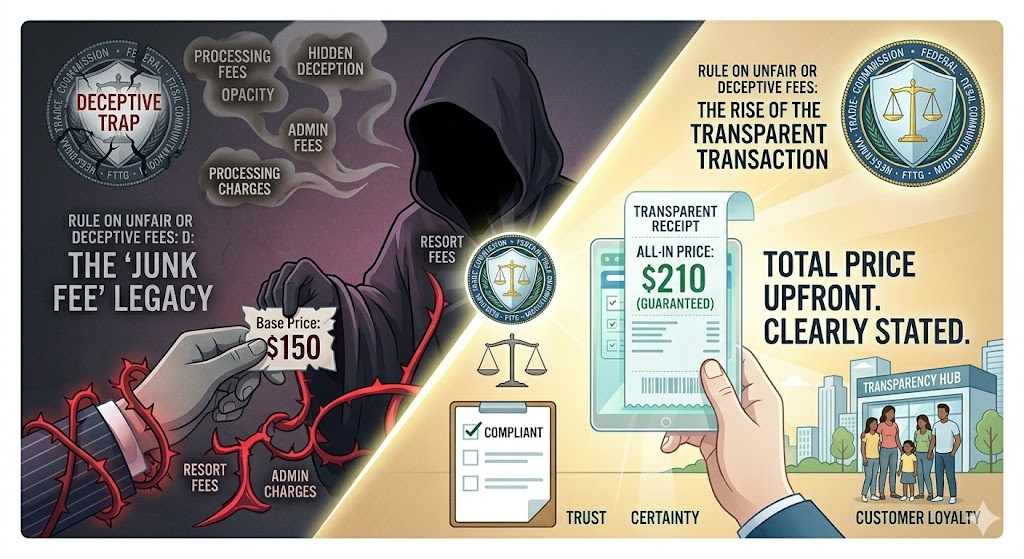
The Federal Trade Commission’s (FTC) crackdown on “junk fees” isn’t just a minor compliance update—it is a total overhaul of the digital sales funnel. As this rule takes hold, businesses that rely on “drip pricing” (revealing fees only at the end of a transaction) are facing a “comply or die” moment.
If you think this only applies to hotel resort fees or concert tickets, you’re missing the bigger picture. Here is a deeper dive into the points every executive and marketer needs to master.
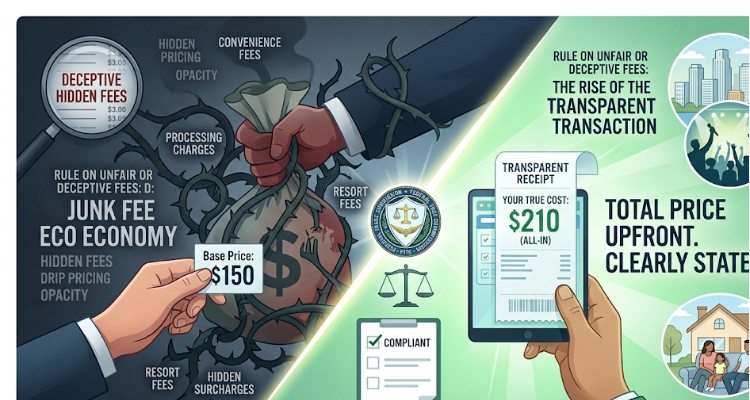
🚀 1. The Death of the “Lead-In” Price
For decades, marketing has been built on the “low-price hook.” Under the new rule, the Total Price must be the star of the show.
- The Shift: You can no longer advertise a $99 room rate if mandatory cleaning and resort fees bring it to $150.
- The Risk: If your Meta or Google ads lead with a “base price,” you are now inviting federal scrutiny and potential lawsuits from competitors who are playing by the rules.
⚖️ 2. Leveling the Competitive Playing Field
One of the most significant points of this rule is fairness between honest and deceptive actors.
- Market Distortion: Previously, honest businesses that showed the full price upfront looked “more expensive” in search results compared to deceptive competitors.
- The Correction: The FTC is effectively forcing a “fair fight.” This is a massive win for brands built on integrity, as it removes the artificial price advantage previously held by “fee-heavy” competitors.
🛠️ 3. Operational & Technical Overhaul
Compliance isn’t just a legal checkmark; it requires a Product and Engineering sprint:
- API Updates: If you aggregate data from third parties (e.g., travel sites, marketplaces), your APIs must now fetch and display the total cost in real-time.
- UX/UI Redesign: Your “Sort by Price” filters must be re-coded. Sorting by a “base price” that doesn’t include mandatory fees is now a deceptive practice.
📊 4. The Impact on “Dynamic Pricing”
If your business uses AI to fluctuate prices based on demand, the rule adds a layer of complexity:
- Real-Time Transparency: You cannot show a price on a landing page and then “add” a service fee at the final checkout screen because “demand increased.”
- Clarity in Volatility: The total price must be locked in as soon as the consumer engages with the specific offer.
🛡️ 5. Avoiding the “Reasonable Consumer” Trap
The FTC evaluates deception based on how a “reasonable consumer” interprets an ad.
- Don’t rely on Hyperlinks: You cannot bury mandatory fees behind a “Terms and Conditions” link or a hover-over “i” icon.
- Visual Hierarchy: If the $200 price is in 24pt font and the $50 mandatory fee is in 10pt font, you are likely in violation. Size and color prominence matter.
💡 Strategic Takeaway: Transparency as a Brand Asset
While some see this as “red tape,” savvy leaders see it as a trust-building exercise.
Pro Tip: Don’t just comply—brag about it. Update your checkout copy to say: “No hidden surprises. The price you see is exactly what you pay.” In a skeptical market, transparency is a premium feature.
Final Thought: The Shift from “Fine Print” to “First Impression”
As we move through 2026, the FTC’s Rule on Unfair or Deceptive Fees has proven to be more than a regulatory hurdle—it is a market re-set.
For decades, businesses operated on a “catch-me-if-you-can” model, where profit was often hidden in the friction of the checkout process. That era is over. Today, the most valuable currency isn’t just the dollar amount of a transaction; it’s customer certainty.