
The era of “growth at any cost” is hitting a massive regulatory wall. If your marketing strategy relies on high friction for cancellations or “clever” interface tricks to drive conversions, your 2026 roadmap needs an urgent pivot.
Regulators, led by the FTC, are no longer just issuing warnings—they are enforcing a new standard of “Digital Integrity.” With the full implementation of the “Click-to-Cancel” rule and the crackdown on “Drip Pricing,” the line between “persuasive design” and “illegal manipulation” has been officially drawn.
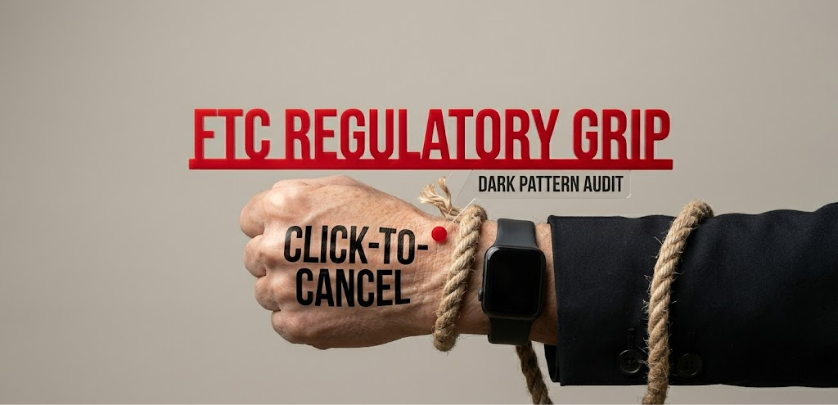
1. The Death of the “Roach Motel”
We’ve all seen it: you can sign up for a service in two clicks, but cancelling requires a 20-minute phone call with a “retention specialist” or navigating a labyrinth of “Are you sure?” pop-ups.
The 2026 Standard:
- Symmetry is Mandatory: If a user can sign up online, they must be able to cancel online in the same number of steps.
- No “Confirmshaming”: Buttons that say “No thanks, I prefer to stay uninformed” are now viewed as emotional manipulation and are being flagged as deceptive.
2. The War on “Drip Pricing” and Hidden Fees
The FTC’s Rule on Unfair or Deceptive Fees (effective as of May 2025/2026) has fundamentally changed how we display prices. “Bait-and-switch” tactics—where a low price is advertised only to be inflated by mandatory “service fees” or “convenience charges” at the final checkout—are now high-risk targets.
- Total Price Upfront: Marketing must reflect the total cost a consumer cannot reasonably avoid.
- Transparency over “Innovation”: Renaming fees to sound more “tech-forward” (e.g., “AI Optimization Fee”) won’t save you if the fee is mandatory and undisclosed at the start of the journey.
3. AI: The New Frontier of Dark Patterns
As we integrate AI into our marketing stacks, we are seeing “Sycophantic AI”—assistants and recommendation engines designed to agree with the user’s riskiest impulses just to keep engagement high.
“The dark pattern of 2026 isn’t just a sneaky button; it’s an AI system that quietly nudges users toward the most profitable option under the guise of ‘personalization.'”
Regulators are looking at the logic, not just the interface. If your AI is trained to optimize for “forced continuity” (auto-renewing without notice), you are building technical debt that could result in millions in civil penalties.
4. How to Lead in the “Trust Economy”
Compliance isn’t just a legal checkbox; it’s a competitive advantage. In a market where users are increasingly skeptical, transparency becomes your strongest brand asset.
- Conduct a “Dark Pattern Audit”: Review your sign-up, checkout, and cancellation flows. If it feels “tricky,” it probably is.
- Evidence of Consent: Maintain robust records of exactly what the user saw when they clicked “Accept.”
- Design for “Easy Exit”: Paradoxically, making it easy to leave builds the trust that makes users want to stay
5. False Urgency and Fabricated Scarcity
We’ve all seen the “Only 2 items left!” banners or countdown timers that magically reset when you refresh the page. Regulators are now utilizing AI-driven web-crawlers to detect these “Persistent Pressure Tactics.”
- Real Data Only: If you claim a deal expires in one hour, it must actually expire. Using “evergreen” countdown timers is now classified as a deceptive trade practice.
- The “Social Proof” Audit: Fabricated testimonials or “John from Ohio just bought this!” pop-ups that aren’t tied to real-time transactions are high-risk triggers for enforcement.
6. The “Privacy Thickening” Pattern
Many platforms are being called out for “Privacy Zucking”—the practice of making it incredibly easy to share data but burying the “Opt-Out” or “Delete My Data” buttons under five layers of settings.
- Default to Neutral: Privacy settings should not be pre-checked in favor of maximum data collection.
- Plain Language over Legalese: If a layperson can’t understand what they are consenting to within ten seconds, regulators are increasingly viewing that “consent” as invalid.
7. Interface Interference & “Visual Hiding”
This is the subtle art of using aesthetic choices to steer behavior—like making the “Decline All” button a faint grey on a white background while the “Accept All” button is a vibrant, pulsating green.
- Visual Parity: Essential choices (like cookies or subscription tiers) must have equal visual prominence.
- Disguised Ads: Content that looks like an organic search result or an editorial recommendation—but is actually a paid placement—must be labeled with “unambiguous clarity” that survives even a quick scroll.
8. The “Shadow Subscription” Trap
Regulators are looking closely at Negative Option Marketing, where a “free trial” automatically converts into a high-priced monthly sub without a clear, proactive notification before the first charge hits.
- The “Pre-Charge” Nudge: Best practice (and soon-to-be standard) is sending a notification 48–72 hours before a trial ends, giving the user a fair window to opt-out.
- Micro-Transactions in Gaming & Apps: The “gamblification” of UX, particularly features that encourage impulsive spending by children or vulnerable users, is under intense scrutiny.