
In the race to capture market share, the temptation to “stretch the truth” is real. We’ve all seen it: software marketed as “AI-driven” that’s actually just a series of complex if-then statements, or “instant” services that take three business days to process.
While over-promising might spike your initial conversion rates, it is a short-term strategy with long-term consequences. If your marketing copy writes checks that your product can’t cash, you aren’t just losing a sale—you’re losing your reputation.
Here is why radical honesty in your copy is your greatest competitive advantage.
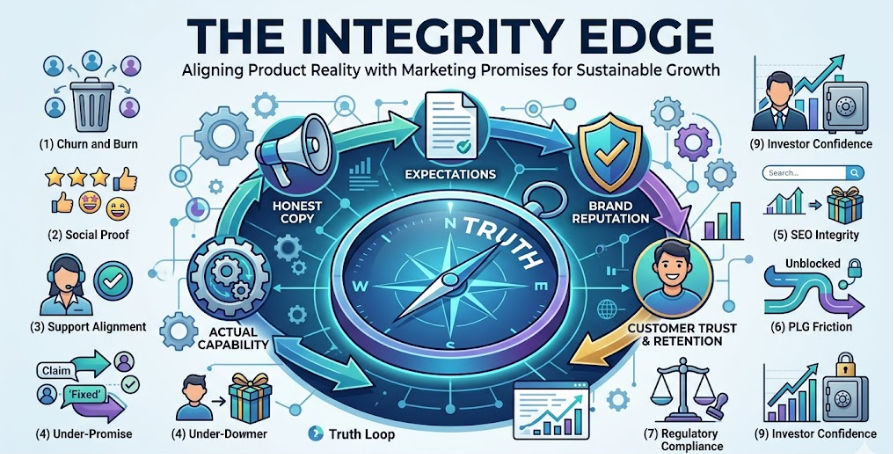
1. The Death of the “Churn and Burn” Model
Acquiring a new customer is significantly more expensive than retaining an existing one. When a user signs up based on a false promise, they don’t just leave; they leave frustrated.
- The Reality: High churn rates kill SaaS valuations and growth trajectories.
- The Fix: Aligning expectations ensures that the people who buy are the ones who actually need what you’ve built.
2. Guarding Your “Social Proof”
In 2026, every customer has a megaphone. One “Expectation vs. Reality” post on LinkedIn or Reddit can undo months of expensive brand building.
- Trust is Currency: Authentic testimonials only happen when the product delivers exactly what the ad promised.
- Damage Control: It is much harder (and more expensive) to fix a “liar” reputation than it is to build a “reliable” one from scratch.
3. Sales and Support Alignment
When marketing over-promises, your internal teams pay the price.
- Support Burnout: Your customer success team becomes a “complaint department,” spending all their time explaining why a feature doesn’t work as advertised.
- Sales Friction: Sales reps lose confidence in the product when they have to manage the “gap” between the website copy and the demo.
4. The Power of “Under-Promise, Over-Deliver”
There is a psychological “wow factor” when a product exceeds expectations.
- Delight: If your copy says the tool saves 5 hours a week, and it actually saves 7, you’ve created an advocate for life.
- Reliability: In a world of hype, being the brand that is “exactly what it says on the tin” is a rare and premium positioning.
5. SEO and “Search Intent” Integrity
Search engines are increasingly prioritizing user intent and engagement signals.
- The Bounce Rate Trap: If your copy promises a specific solution to rank for high-volume keywords, but your product doesn’t actually solve that problem, users will bounce immediately.
- The Penalty: High bounce rates and short session durations signal to Google that your page is irrelevant or misleading, tanking your organic rankings over time.
6. Protecting Product-Led Growth (PLG)
If you offer a “Free Trial” or “Freemium” model, your copy is essentially a contract.
- The Trial Friction: In a PLG world, the product is the salesperson. If a user enters a trial expecting Feature X (based on your copy) and finds it’s only available on the “Enterprise Plus” plan or doesn’t exist yet, they will abandon the trial before you can even send a nurture email.
- Alignment: Accurate copy ensures the trial experience confirms the marketing hype, leading to higher self-serve conversion.
7. Legal and Regulatory Compliance
We are entering an era of heightened scrutiny regarding AI-washing and deceptive tech claims.
- False Advertising: Regulators (like the FTC) are increasingly looking at “dark patterns” and misleading claims in tech marketing.
- The Risk: Misaligned copy isn’t just bad for PR; it can lead to “cease and desist” orders or heavy fines if you claim capabilities that are technically non-existent or experimental.
8. Improving the Product Feedback Loop
When your marketing is honest, the feedback you get from customers is actionable.
- Clean Data: If customers buy the product for what it actually does, their feedback will be about how to make those features better.
- Noise Reduction: If they buy based on a false promise, their feedback is just “it doesn’t do what you said,” which provides zero insight for your engineering team on how to actually evolve the product.
9. Investor and Stakeholder Confidence
Sophisticated investors look past the “top of funnel” metrics. They look at LTV (Lifetime Value) to CAC (Customer Acquisition Cost) ratios.
- The Red Flag: A marketing team that inflates capabilities to hit lead targets creates a “leaky bucket.” Investors will eventually spot the disconnect between high acquisition and low retention.
- Sustainable Growth: Showing that you can grow while maintaining high customer satisfaction proves you have a “Product-Market Fit,” not just a “Marketing-Market Fit.”
The Golden Rule of 2026 Marketing: If you have to use an asterisk (*) to explain why your headline is technically true, rewrite the headline.
Final Thought: Trust Doesn’t Scale, It Compounds
Marketing’s job isn’t just to get people in the door; it’s to set the stage for a successful relationship. When your copy matches your capability, you aren’t just selling a product—you’re building a brand that people can actually rely on.