
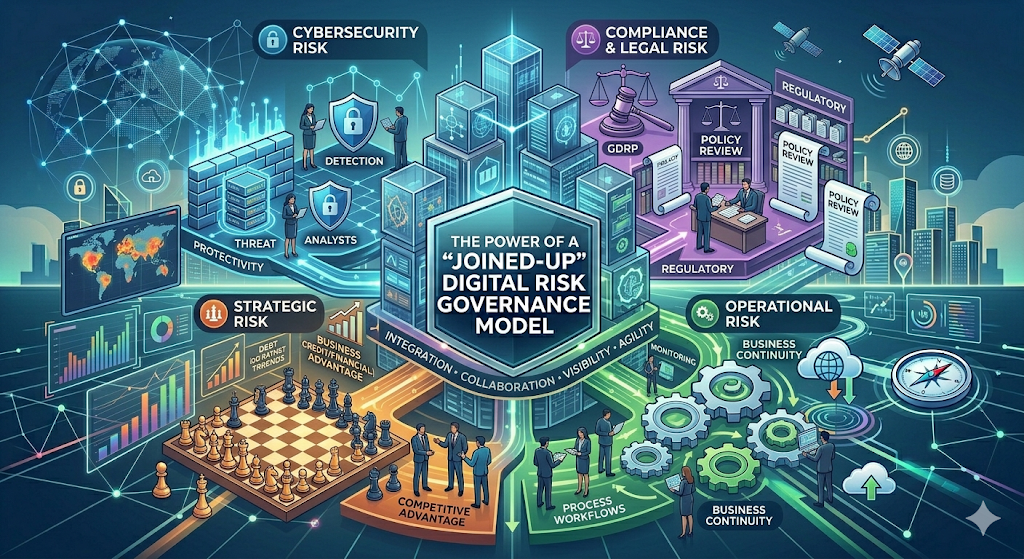
In today’s hyper-connected business landscape, organizations are rushing to adopt AI, migrate to the cloud, and automate operations. But this rapid digital evolution introduces a chaotic web of vulnerabilities. Traditional risk management—where cybersecurity, compliance, legal, and IT teams operate in isolated silos—is no longer cutting it.
To survive and thrive, modern enterprises must transition to a “joined-up” digital risk governance model.
What Does “Joined-Up” Digital Risk Governance Mean?
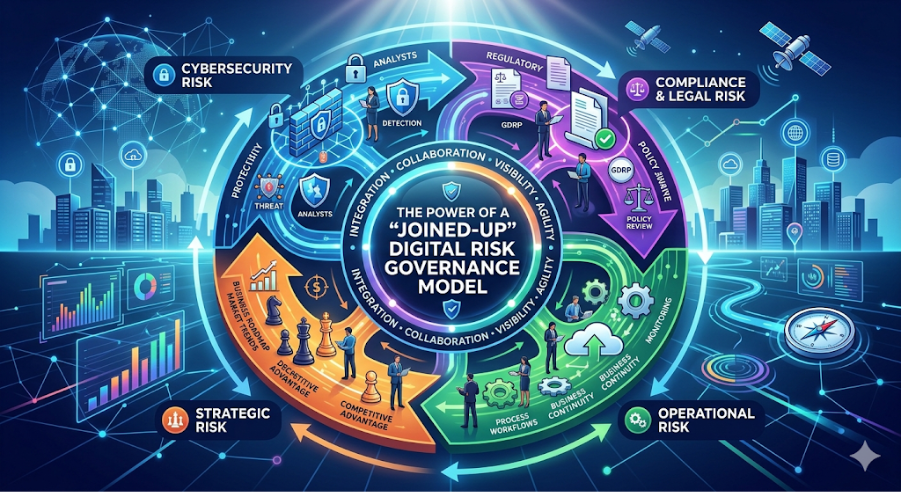
A joined-up digital risk governance model breaks down corporate silos to create a unified, real-time view of an organization’s digital risk profile. Instead of treating cyber threats, data privacy breaches, regulatory non-compliance, and operational downtime as separate issues, a joined-up approach views them as interconnected symptoms of the same digital ecosystem.
[Traditional Siloed Model] [Joined-Up Model]
IT Risk –> (Silo) IT Risk \
Cyber –> (Silo) Cyber –> Unified Digital Risk
Legal –> (Silo) Legal –> Governance
Privacy –> (Silo) Privacy /
By connecting the dots across departments, leadership can make faster, more informed decisions that protect both the company’s bottom line and its reputation.
The Core Pillars of a Unified Model
Building a joined-up model requires aligning three critical organizational components: People, Process, and Technology.
1. Cross-Functional Collaboration (People)
A joined-up model establishes a centralized risk committee or steering group. This group includes key stakeholders who rarely spoke in the past:
- CISO (Chief Information Security Officer): Highlights technical vulnerabilities and threat intelligence.
- Chief Privacy Officer / Legal Counsel: Ensures compliance with evolving global regulations (like GDPR or AI acts).
- Chief Risk Officer (CRO) / CFO: Aligns digital risks with corporate financial goals and risk appetite.
- Business Unit Leaders: Provide context on how security policies affect daily operations and customer experience.
2. Integrated Frameworks (Process)
Instead of forcing teams to use different risk assessment methodologies, a joined-up model uses a single, standardized language to measure risk. This involves mapping technical vulnerabilities directly to business outcomes.
Example: Instead of reporting “We have 50 unpatched servers,” the unified report states, “An unpatched vulnerability in our payment gateway poses a high risk of a data breach, potentially costing $2M in regulatory fines and 15% customer churn.”
3. Centralized Data and Analytics (Technology)
Trying to manage modern risk on fragmented spreadsheets is a recipe for disaster. Organizations need an integrated digital risk platform (like modern GRC or IRM software) that aggregates data from across the enterprise, offering real-time dashboards and predictive risk modeling.
Why Is a Joined-Up Approach Critical Now?
The stakes for managing digital risk have never been higher. A fragmented approach leaves dangerous blind spots. Here is why a unified model is essential:
- The AI Revolution: Deploying generative AI isn’t just an IT decision. It involves data privacy (Legal), intellectual property risks (Compliance), and prompt injection vulnerabilities (Cybersecurity).
- Regulatory Hyper-Inflation: Governments worldwide are cracking down on digital operations. Regulatory bodies now expect board-level oversight and strict accountability, which cannot be achieved through siloed reporting.
- Velocity of Threats: Cyberattacks happen in milliseconds. If your security team has to wait for a monthly meeting to alert the legal or operations team about a systemic breach, the damage is already done.
4. Navigating the Legal-Tech Paradox
A joined-up model bridges a massive traditional gap: the speed mismatch between engineering and law.
- Developers innovate in hours or days (especially with AI and low-code platforms), while legal risk assessments historically take weeks.
- A joined-up governance model embeds legal and compliance parameters directly into the software development lifecycle (SDLC) or enterprise architecture. By translating legal constraints into technical guardrails, organizations can achieve “compliance-by-design” without slowing down innovation.
5. Managing Third-Party and Ecosystem Dependencies
Modern enterprises don’t operate in a vacuum; they rely on a massive web of SaaS providers, APIs, and cloud vendors.
- Risk is rarely contained within your own firewall anymore. If a critical third-party vendor suffers an outage or a data breach, it instantly becomes your operational, legal, and reputational nightmare.
- A joined-up model treats vendor risk management as a continuous, dynamic process rather than a static annual checklist, syncing procurement, cybersecurity, and legal reviews.
6. The Shadow AI Dilemma
With the explosion of consumer-grade generative AI tools, employees are frequently uploading company data into unauthorized systems to increase their daily productivity.
- IT cannot solve this with blocklists alone; trying to block every tool harms employee efficiency and builds resentment.
- A joined-up model addresses “Shadow AI” by pairing IT security with HR and business leaders to provide safe, sanctioned alternatives and clear, empathetic usage policies that respect the workforce’s need for efficiency.
7. Shifting from Defense to Digital Resilience
Traditional governance focuses heavily on prevention (building higher walls). A joined-up model shifts the mindset toward resilience (assuming a breach or disruption will happen).
- It aligns technical disaster recovery plans with corporate crisis communication, legal reporting obligations, and customer success protocols.
- When a system goes down, the entire organization knows exactly how to maintain core business functions manually while the technical team rehabilitates the infrastructure.
8. Elevating Risk to Board-Level Literacy
Boards of Directors are legally and financially liable for digital oversight, yet they rarely understand deeply technical cybersecurity jargon.
- A joined-up approach acts as a translator. It converts technical metrics (like patch rates or firewall logs) into business metrics (like potential downtime cost, regulatory exposure, and impact on brand equity).
- This allows the board to make strategic capital allocation decisions rather than just viewing security as an expensive IT insurance policy.
Turning Strategy into Action: Next Steps
Transitioning to a joined-up digital risk governance model won’t happen overnight, but you can start with these practical steps:
- Conduct a Silo Audit: Identify where risk data is currently trapped within your organization.
- Define a Shared Risk Language: Agree on common definitions for risk appetite, impact, and likelihood across all departments.
- Appoint a Digital Risk Facilitator: Designate a leader or create a charter responsible for bridging the gap between technical teams and business executives.