
In many organizations, teams work hard — but not always together.
Sales has its own tools. Operations has separate processes. Customer service stores different data. IT builds systems no one fully understands outside the department.
This is how silos are created.
At first, silos may seem harmless. Teams become specialized, focused, and independent. But over time, silos slowly damage collaboration, customer experience, and business agility.
That’s why every organization should regularly conduct a Silo Audit.
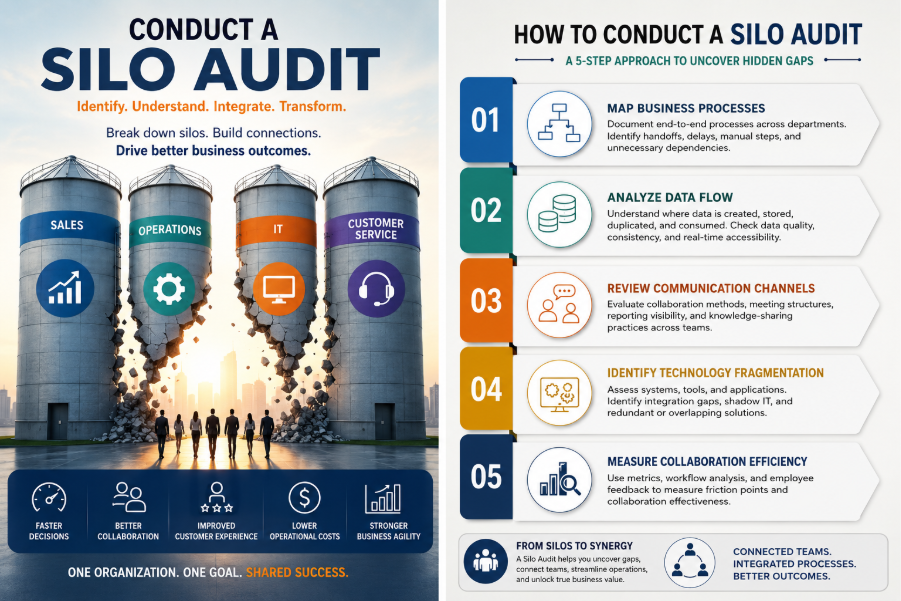
What is a Silo Audit?
A Silo Audit is a structured assessment used to identify:
- Communication gaps between teams
- Duplicate systems and processes
- Isolated data sources
- Knowledge bottlenecks
- Manual handoffs and inefficiencies
- Departments operating without shared visibility
The goal is simple: Understand where fragmentation exists and create a more connected organization.
Common Signs of Organizational Silos
If your organization experiences any of the following, silos may already be affecting performance:
✔ Teams using different versions of the same data ✔ Repeated work across departments ✔ Delays caused by approval dependencies ✔ “We didn’t know that team was doing this” conversations ✔ Customer information scattered across systems ✔ Heavy dependence on specific individuals for knowledge ✔ Poor collaboration between business and IT teams
Why Silo Audits Matter
Organizations today need speed, adaptability, and transparency.
But silos create:
- Slower decision-making
- Reduced innovation
- Higher operational costs
- Poor employee collaboration
- Inconsistent customer experiences
A Silo Audit helps organizations uncover hidden inefficiencies before they become major business risks.
How to Conduct a Silo Audit
1. Map Business Processes
Identify how work flows across departments.
Look for:
- Manual transitions
- Repeated approvals
- Disconnected systems
- Unnecessary dependencies
2. Analyze Data Flow
Understand where data is created, stored, and consumed.
Key questions:
- Is the same data duplicated?
- Are teams accessing real-time information?
- Are integrations reliable?
3. Review Communication Channels
Evaluate how teams collaborate.
Check:
- Meeting structures
- Reporting visibility
- Cross-functional workflows
- Knowledge-sharing practices
4. Identify Technology Fragmentation
Many silos originate from disconnected tools.
Review:
- Legacy systems
- Department-specific applications
- Shadow IT solutions
- Integration gaps
5. Measure Collaboration Efficiency
Use employee feedback, operational metrics, and workflow analysis to understand where friction exists.
The Role of Automation Platforms
Modern workflow and case management platforms like Pegasystems help organizations reduce silos by:
- Centralizing workflows
- Enabling real-time visibility
- Connecting systems through APIs
- Automating handoffs
- Improving collaboration between business and IT
When processes, data, and people are connected, organizations become significantly more agile.
Final Thought
Silos are rarely created intentionally.
They develop gradually through disconnected processes, isolated tools, and limited communication.
But organizations that proactively conduct Silo Audits gain a major advantage:
- Faster operations
- Better collaboration
- Improved customer experiences
- Stronger digital transformation outcomes
The question is no longer whether silos exist.
The real question is: How much are they costing your organization today?