

The question is no longer whether silos exist.
If we are being honest with ourselves, departmental walls are a natural byproduct of growth. As a company scales, specialization is inevitable. Engineers need to engineer; lawyers need to assess risk; sales teams need to close.
But left unchecked, specialization metastasizes into isolation.
We’ve tolerated silos for years as an annoying but harmless corporate quirk. That is a critical mistake. The real question we need to ask right now is: How much are they costing your organization today?
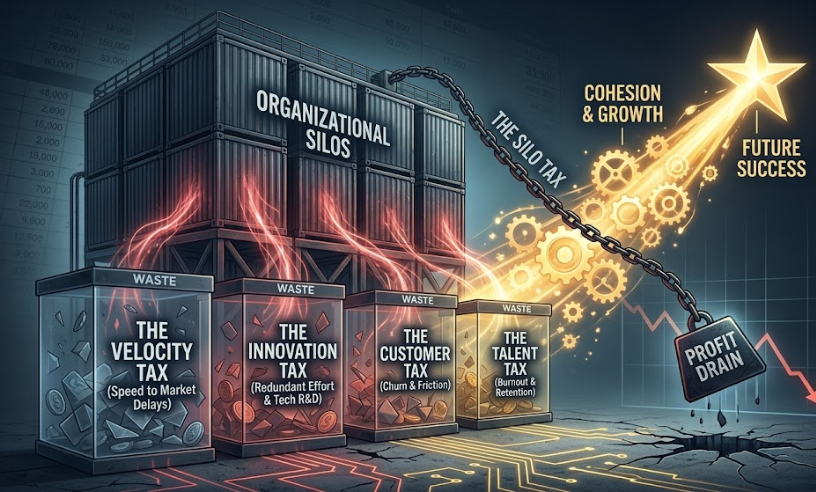
Silos don’t show up as a line item on your quarterly P&L statement, but they act as a heavy, invisible tax on your balance sheet, your culture, and your growth.
Let’s calculate the true cost of the “Silo Tax.”
1. The Velocity Tax (The Cost of Friction)
When departments operate as independent kingdoms, speed is the first casualty.
Think about a simple product launch. Product designs a feature, passes it over the wall to Engineering, who realizes it’s technically unfeasible. Meanwhile, Marketing has already drafted the copy, and Legal steps in at the eleventh hour to flag a regulatory risk.
- The Cost: Endless alignment meetings, defensive emails, and steering committees.
- The Reality: While your internal teams are busy playing political chess and passing memos back and forth, your nimbler, flatter competitors are already shipping updates and capturing market share. Friction is a competitor’s best friend.
2. The Innovation Tax (The Cost of Redundancy)
Silos breed a massive waste of intellectual and financial capital through duplicated efforts.
It is incredibly common in enterprise organizations for Team A to spend six months and hundreds of thousands of dollars building a custom data pipeline or internal tool—completely unaware that Team B, sitting on a different floor or in a different region, built the exact same solution a year ago.
- The Cost: Wasted R&D budgets, fragmented tech stacks, and redundant software licenses.
- The Reality: When information is hoarded or simply trapped within departmental boundaries, you pay twice (or thrice) for the same outcome.
3. The Customer Tax (The Cost of Churn)
Your customers do not care about your internal org chart. They view your company as a single entity.
Yet, when silos exist, the customer experience feels like a game of hot potato. Sales promises a seamless onboarding experience; the Account Management team has no record of those promises; the Support team is left in the dark when things break.
- The Cost: Broken trust, missed upsell opportunities, and ultimately, customer churn.
- The Reality: A siloed organization forces the customer to do the heavy lifting of connecting your departments. In a buyer’s market, they will simply leave for an organization that feels cohesive.
4. The Talent Tax (The Cost of Cognitive Burnout)
High performers do not leave companies because the work is hard; they leave because the bureaucracy is exhausting.
When your best engineers, legal minds, or managers spend 60% of their energy fighting internal boundaries, negotiating cross-departmental politics, and begging for data access rather than doing the actual work they were hired to do, cognitive fatigue sets in.
- The Cost: High turnover, recruiting costs, and a culture of quiet quitting.
- The Reality: Silos turn active innovators into passive observers. Your top talent will eventually take their cognitive capital elsewhere.
Moving Beyond the “We Need More Meetings” Fallacy
When leadership notices a silo problem, the knee-jerk reaction is almost always to schedule a recurring cross-functional sync.
Please, don’t. Adding more meetings to an already-crowded calendar doesn’t fix structural isolation—it just sanitizes it. True desiloing requires restructuring your strategic infrastructure:
1. Realign the Incentives (Shared KPIs)
If your Marketing team is incentivized solely on lead quantity and your Sales team is judged on revenue, they are structurally wired to clash. Marketing will pump in low-quality leads to hit their metrics, and Sales will complain.
- The Fix: Tie both teams to the same ultimate North Star metric—like Customer Acquisition Cost (CAC) payback period or net-new pipeline velocity. When people share a scoreboard, they play as a team.
2. Democratize the Data Stack
Data hoarding is the ultimate symptom of a silo. When different departments rely on completely separate data lakes and tools, they aren’t just working in different rooms—they are living in different realities.
- The Fix: Invest in a single source of truth. Ensure that cross-functional teams have immediate, frictionless access to the data required to make autonomous decisions without waiting for departmental gatekeepers.
3. Incentivize “Border Crossing”
In many corporate cultures, looking out for your own team is rewarded, while spending time helping another department is seen as a distraction.
- The Fix: Explicitly reward leaders who build bridges. Make cross-functional collaboration a non-negotiable prerequisite for leadership promotions.
Conclusion
Silos are not just an HR issue or a “culture problem” to be solved with a team-building retreat. They are a severe operational bottleneck draining your margin every single day.
Look closely at your strategic initiatives that are currently stalling. The bottleneck is rarely a lack of talent or capital. More often than not, it’s the invisible wall standing right between your teams.