
If you feel like your compliance, legal, and security teams are drowning in a multi-layered soup of acronyms—GDPR, NIS2, DORA, and the AI Act—you are not alone.
For years, organizations have treated data privacy, cybersecurity, and artificial intelligence as separate pillars. Each has its own reporting deadlines, risk assessment formats, and regulatory bodies. The result? Excessive administrative friction, duplicated audits, and skyrocketing compliance costs.
The European Commission noticed. Enter the EU Digital Omnibus Package.
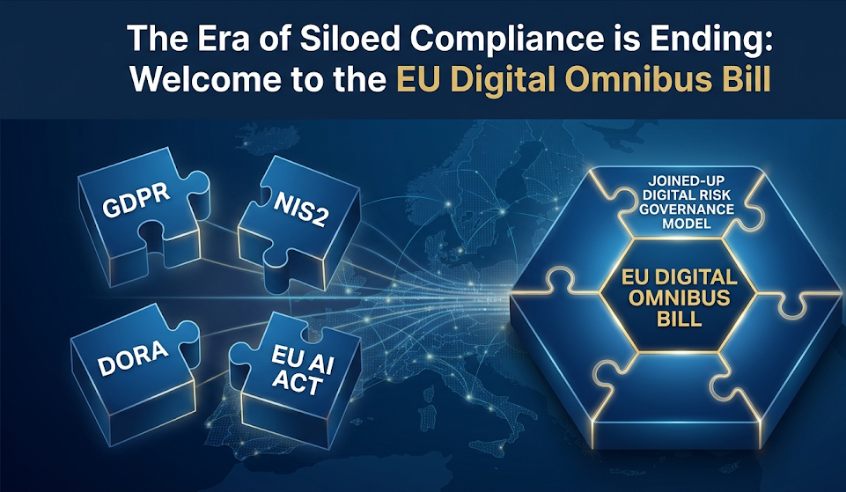
Rather than layering yet another new regulation onto the stack, the Omnibus Bill acts as a “horizontal clean-up.” It is a massive, structural recalibration designed to consolidate overlapping digital regulations into a single, “joined-up” digital risk governance model.
Here is what this means for businesses and leadership teams preparing for late 2026 and 2027.
1. Breaking Down the Silos
Under the new Omnibus framework, the EU is moving away from fragmented rulebooks. It is merging overlapping requirements into a cohesive governance layer.
Consider cybersecurity incident reporting as it stands today:
- NIS2 requires cyber incident notifications within 24 hours.
- GDPR mandates personal data breach notifications within 72 hours.
- The AI Act calls for serious incident reporting within 15 days.
The Digital Omnibus tackles this headache head-on by proposing a Single Entry Point (SEP) platform managed by ENISA. Instead of filing separate notifications to multiple national authorities, organizations will report a digital crisis once, through one platform, satisfying multiple regulatory frameworks at the same time.
2. Pragmatic Easements for AI and Data
The Omnibus Bill recognizes that over-regulation threatens European competitiveness. Key updates designed to spur innovation include:
- Legitimate Interest for AI Training: The bill explicitly recognizes the processing of personal data to develop and train AI models as a “legitimate interest” under GDPR, removing massive legal ambiguity.
- Timeline Relief: It introduces pragmatism into the AI Act, pushing back the deadlines for strict high-risk AI system obligations to 2027 and 2028, aligning compliance with the actual availability of harmonized technical standards.
- A “Relative” Approach to Personal Data: Pseudonymized data will not automatically be classified as personal data if the holding organization has no reasonable means of re-identifying the individual.
3. The Shift to “Joined-Up” Governance
What does a “joined-up” digital risk governance model look like in practice? It means your CISO, Chief Privacy Officer, and AI Product Leads can no longer operate in isolation. They must speak the same operational language.
Organizations will need to map a unified control framework that blends international standards like ISO 27001 (InfoSec), ISO 27701 (Privacy), and ISO 42001 (AI Management). When an employee shares a dataset with a third-party GenAI tool, that action must automatically trigger a single chain of custody that simultaneously satisfies your privacy, cyber-resilience, and AI compliance baselines.
How to Prepare Today
The legislative process is moving quickly, with political agreements solidifying and implementation targeted for early 2027. Forward-thinking companies shouldn’t wait for the final text.
- Build a Regulation-Agnostic Architecture: Stop building standalone compliance processes for every new law. Design integrated workflows that connect data protection impact assessments (DPIAs) directly with AI risk assessments.
- Consolidate Data & AI Inventories: Ensure your security and privacy teams are working off a single, shared inventory of data assets and AI use cases.
- Run Integrated Crisis Simulations: When testing your resilience, simulate a complex scenario—such as an AI model experiencing a data breach that compromises personal data—to test how seamlessly your teams can execute unified reporting.
The EU Digital Omnibus Bill is proof that the regulatory landscape is maturing. The organizations that embrace this integrated approach early will drastically cut administrative burdens (the EU projects up to €5 billion in systemic savings) while moving faster than their competitors.