
If you’re still operating on your 2023 or 2024 compliance playbook, you’re already behind.
As we move through 2026, the European Commission is executing a massive “regulatory deep clean.” The focus has shifted from creating new hurdles to building a lean, high-speed economic engine. Whether you are a tech founder, a supply chain leader, or a policy head, these five shifts are the new reality:
1. “Simplicity by Design” & The Regulatory Deep Clean
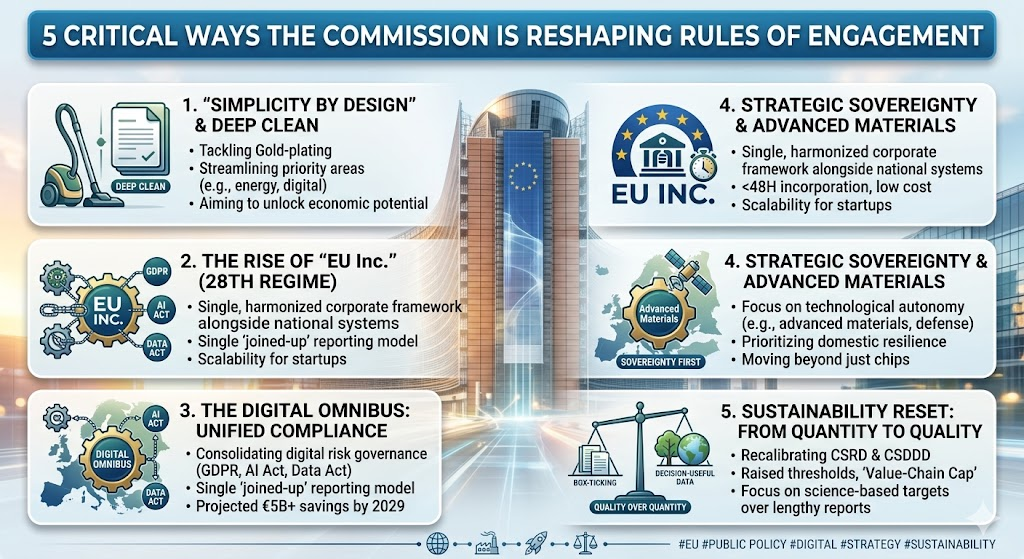
The Commission has launched a “one-in, one-out” policy on steroids. In April 2026, a new five-pillar plan was unveiled to tackle regulatory gold-plating (where member states add their own complex layers to EU law).
- The Impact: Over 12 priority areas—including digital, energy, and financial services—are undergoing a “deep cleaning” to remove overlapping and outdated rules.
- The Goal: To unlock economic potential by ensuring laws are easy to apply from day one.
2. The Rise of “EU Inc.” (The 28th Regime)
In a historic move to rival the ease of Delaware’s corporate filings in the U.S., the Commission introduced EU Inc.—a single, harmonized corporate legal framework that sits alongside the 27 national systems.
- The Rule Change: Companies can now incorporate as an “EU Inc.” in under 48 hours for less than €100.
- The Engagement: This bypasses the fragmented landscape of 60+ different company forms, allowing startups to scale across the Single Market without needing 27 different legal teams.
3. The Digital Omnibus: Unified Compliance
Tired of the “siloed” reporting of GDPR, the AI Act, and the Data Act? The EU Digital Omnibus Bill is currently consolidating these into a single “joined-up” digital risk governance model.
- The Shift: Instead of separate notifications for a cyber breach (under NIS2) and a data breach (under GDPR), companies now use a unified platform.
- The ROI: This convergence is expected to save businesses up to €5 billion in administrative costs by 2029.
4. Strategic Sovereignty & The “Advanced Materials” Push
With the 2026 Work Programme, the Commission is doubling down on “technological autonomy.” This isn’t just about chips anymore; it’s about the entire supply chain.
- What’s New: The Advanced Materials Act and the European Space Shield are rewriting procurement rules.
- The Engagement: If you are in the defense or high-tech sectors, the rules now prioritize domestic resilience and “sovereignty-first” sourcing over the lowest-cost global provider.
5. Sustainability Reset: From Quantity to Quality
The “Sustainability Omnibus” of 2026 has recalibrated the CSRD and CSDDD. The Commission realized that the reporting burden was suffocating mid-sized firms.
- The Change: Thresholds for due diligence have been raised, and the “Value-Chain Cap” has been introduced to protect smaller suppliers from excessive data requests.
- The Strategic Move: Compliance is moving from “box-ticking” to “decision-useful” data. Leaders are now focusing on science-based targets rather than a 500-page narrative report.
💡 The Bottom Line
The Commission is no longer just a “regulator”; it is acting as a “facilitator.” The rules of engagement have moved from complexity to convergence.
Are you streamlining your operations to take advantage of the Digital Omnibus, or are you still stuck in 2024’s silos?