
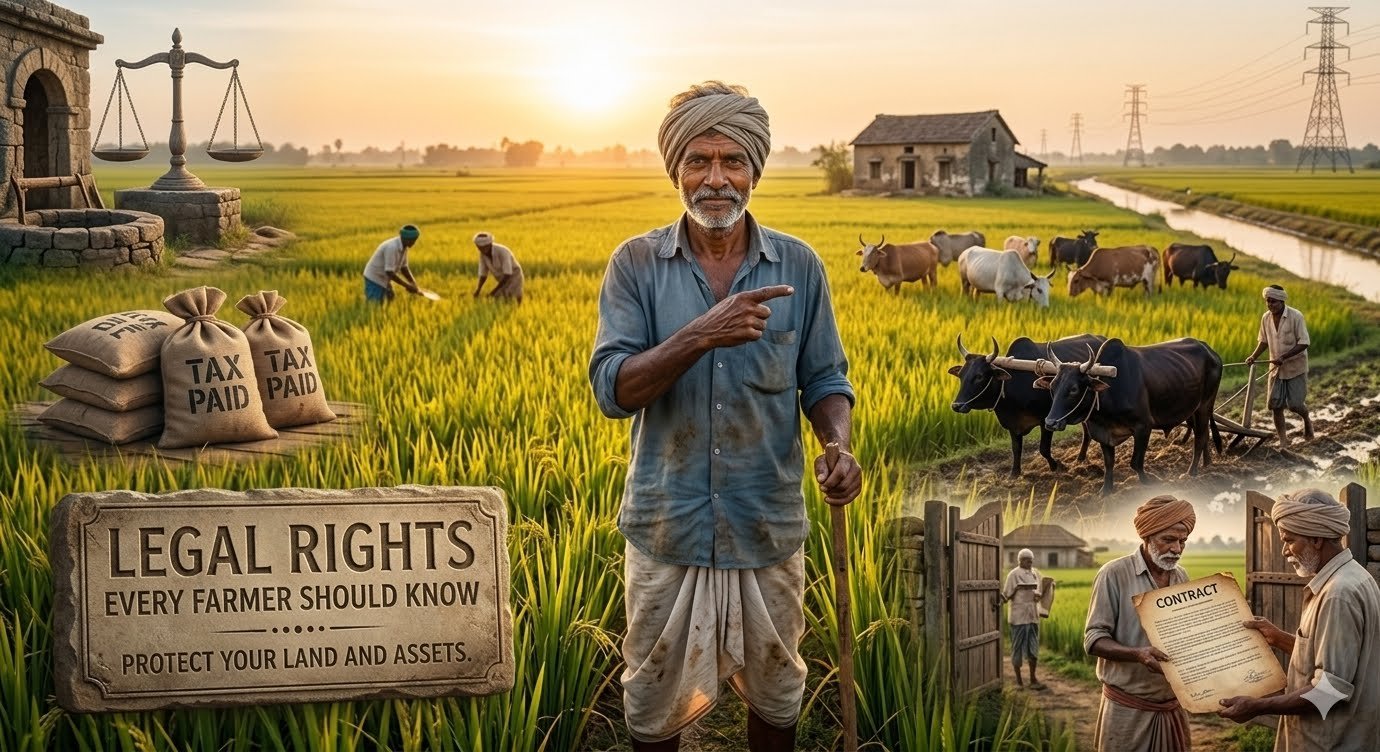
Understanding the Law Before Letting Go of Your Most Valuable Asset
Agricultural land is more than just property. For millions of farmers, it represents livelihood, heritage, identity, and financial security. Yet every year, countless farmers sell agricultural land without fully understanding their legal rights, often leading to disputes, financial losses, and long-term consequences.
Whether the sale is driven by urban expansion, infrastructure development, financial needs, or changing family circumstances, farmers must be aware that selling agricultural land is not merely a financial transaction—it is a legal process governed by various laws designed to protect their interests.
Understanding these rights can help farmers make informed decisions, receive fair compensation, and avoid legal complications.
Why Agricultural Land Transactions Require Special Attention
Unlike residential or commercial property, agricultural land is subject to special regulations.
Governments regulate agricultural land to:
- Protect food security.
- Prevent illegal land transfers.
- Safeguard farmers’ livelihoods.
- Ensure proper land use.
- Prevent exploitation by powerful interests.
Right to Verify Ownership and Title
The first and most fundamental right of every farmer is the right to establish clear ownership.
Before agreeing to sell land, farmers should verify:
- Title deeds
- Revenue records
- Pattadar passbooks (where applicable)
- Survey records
- Mutation entries
Any discrepancy in ownership documents can delay or invalidate the transaction.
A clear title not only protects the seller but also increases the value of the land during negotiations.
Right to Know the Market Value of the Land
Many farmers unknowingly sell land below its actual market value.
Every landowner has the right to:
- Access government guideline values.
- Obtain independent valuations.
- Compare nearby land transactions.
- Seek professional legal advice.
The price offered by a buyer is not always the true market value.
Infrastructure projects, industrial development, highways, and urban expansion can significantly increase land value.
A farmer should never finalize a sale without understanding the property’s actual worth.
Protection Against Coercion and Fraud
One of the most important legal protections available to farmers is protection against coercion.
A land sale is valid only when it is:
- Voluntary
- Informed
- Free from undue influence
- Supported by lawful consideration
Any sale obtained through:
- Threats
- Misrepresentation
- Fraud
- Forged documents
- False promises
can be challenged before competent authorities and courts.
No individual, company, broker, or institution can legally force a farmer to sell land.
Rights During Land Acquisition by the Government
When agricultural land is acquired for:
- Highways
- Railways
- Airports
- Industrial corridors
- Public infrastructure
farmers possess important legal rights under the Right to Fair Compensation and Transparency in Land Acquisition, Rehabilitation and Resettlement Act, 2013.
These rights include:
Fair Compensation
Compensation must reflect market value and applicable multipliers.
Rehabilitation and Resettlement
Affected families may be entitled to rehabilitation benefits.
Social Impact Assessment
Large projects often require assessment of their impact on local communities.
Opportunity to Raise Objections
Landowners have the right to participate in proceedings and challenge unfair acquisition processes.
Understanding these rights can significantly affect the outcome of land acquisition cases.
Rights of Family Members and Legal Heirs
Agricultural land often involves family ownership structures.
Before selling land, farmers should determine:
- Whether the property is ancestral.
- Whether co-owners exist.
- Whether legal heirs have claims.
- Whether family partitions have been completed.
Ignoring these issues can result in future litigation and cancellation of transactions.
In many cases, consent from all stakeholders may be necessary.
Rights of Women in Agricultural Land
Historically, women have faced challenges in asserting property rights.
However, modern laws increasingly recognize equal inheritance rights.
Women may possess:
- Ownership rights
- Co-ownership rights
- Inheritance rights
- Partition rights
Any agricultural land transaction should carefully consider the rights of female family members.
Ignoring legitimate claims can lead to legal disputes.
The Importance of a Registered Sale Deed
A verbal agreement is never enough.
The law requires proper documentation.
A valid agricultural land sale should include:
- Written sale agreement
- Verification of ownership documents
- Payment records
- Registered sale deed
- Mutation of records after sale
Registration creates legal certainty and protects both buyer and seller.
Failure to register properly can create serious future complications.
Understanding Tax Implications
Many farmers believe agricultural land transactions are entirely tax-free.
The reality is more nuanced.
Tax treatment may depend on:
- Location of the land
- Nature of the transaction
- Capital gains provisions
- Agricultural classification
Farmers should consult legal and tax professionals before finalizing a sale.
Proper planning can prevent unexpected tax liabilities.
Beware of Unauthorized Brokers and Middlemen
Land transactions often attract brokers and intermediaries.
While many operate legally, others may:
- Manipulate prices
- Conceal information
- Misrepresent buyers
- Create fraudulent documentation
Farmers should insist on:
- Written agreements
- Verified credentials
- Independent legal review
Professional advice can prevent costly mistakes.
Environmental and Land Use Restrictions
Certain agricultural lands may be subject to:
- Environmental restrictions
- Zoning regulations
- Protected area notifications
- Water resource regulations
A farmer has the right to know whether any such restrictions affect the property before entering into a sale transaction.
Failure to disclose relevant information can create legal complications later.
The Growing Importance of Legal Awareness
Modern agricultural land is increasingly valuable.
Rapid urbanization, industrial development, renewable energy projects, and infrastructure expansion have transformed farmland into a highly sought-after asset.
As land values rise, so do legal risks.
Farmers who understand their legal rights are better positioned to:
- Negotiate fair prices.
- Avoid exploitation.
- Protect family interests.
- Ensure lawful transactions.
- Preserve long-term financial security.
Legal awareness is no longer optional—it is essential.
Conclusion
Selling agricultural land may be one of the most significant decisions a farmer makes during a lifetime. The transaction affects not only the present generation but also future generations who may depend on that land for economic stability and livelihood.
Before signing any agreement, every farmer should understand:
✔ Ownership rights ✔ Compensation rights ✔ Family and inheritance rights ✔ Protection against fraud ✔ Land acquisition safeguards ✔ Registration requirements ✔ Tax implications
The law provides numerous protections, but these protections are effective only when farmers are aware of them.
A well-informed farmer is not merely a landowner—he or she is a legally empowered citizen capable of making decisions that secure both present prosperity and future security.
“Land can be sold in a day, but its value, history, and legal consequences can last for generations. Understanding your rights before selling is the best investment a farmer can make.”