
Understanding the Economic, Legal, and Social Case for Fair Transportation Taxation
Introduction
Transportation is the backbone of every modern economy. It connects people to jobs, businesses to markets, students to schools, and communities to opportunities. Yet, as cities grow and private vehicle ownership continues to rise, governments around the world face a difficult challenge: how to fund transportation infrastructure while ensuring fairness, sustainability, and accessibility.
One of the most debated questions in transportation policy today is:
Should private vehicle owners pay higher taxes than public transport users?
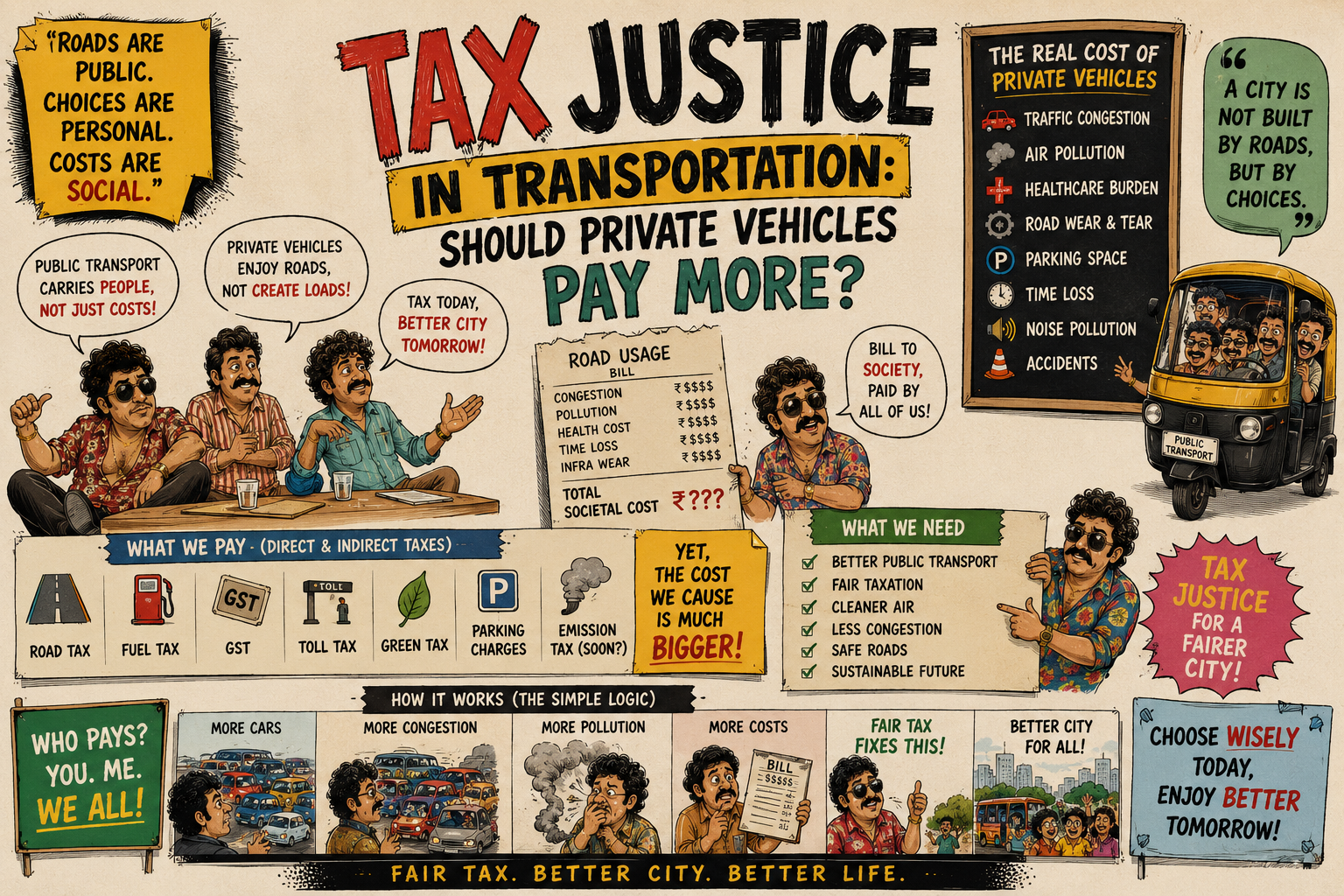
At first glance, the idea may seem controversial. After all, vehicle owners already pay registration fees, road taxes, fuel taxes, insurance charges, and tolls. However, economists, urban planners, environmental experts, and policymakers increasingly argue that private vehicles impose significantly greater costs on society than what their owners currently pay.
This debate is not merely about raising revenue. It is about tax justice, a principle that seeks to ensure that individuals and businesses contribute fairly according to the costs they impose on society and the benefits they receive.
Understanding Tax Justice in Transportation
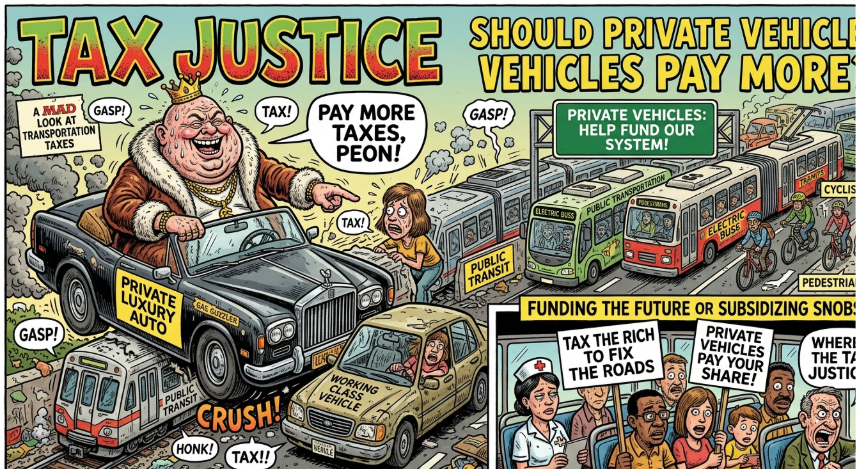
Tax justice refers to the equitable distribution of tax burdens among members of society.
In transportation, this means asking important questions:
- Who uses public infrastructure the most?
- Who contributes more to traffic congestion?
- Who causes greater environmental damage?
- Who benefits most from publicly funded road networks?
- Who should bear the costs of maintaining and expanding transportation systems?
The answers often reveal a significant imbalance.
While public transportation moves large numbers of people efficiently using limited road space, private vehicles consume substantially more infrastructure per passenger.
Consequently, many experts argue that taxation should reflect these differences.
The Hidden Costs of Private Vehicle Ownership
Most vehicle owners focus on direct expenses such as:
- Vehicle purchase cost
- Registration fees
- Fuel expenses
- Insurance premiums
- Maintenance costs
However, private vehicles generate several indirect societal costs that are often paid by taxpayers as a whole.
1. Traffic Congestion
Urban congestion costs economies billions annually.
Traffic jams result in:
- Lost productivity
- Increased fuel consumption
- Delayed deliveries
- Reduced economic efficiency
When one additional car enters an already crowded road, it creates delays for thousands of others.
This cost is rarely reflected in standard vehicle taxation.
2. Environmental Pollution
Private vehicles remain one of the largest contributors to:
- Carbon emissions
- Air pollution
- Greenhouse gases
- Climate change
Pollution contributes to:
- Respiratory diseases
- Cardiovascular conditions
- Premature deaths
- Increased healthcare spending
These costs are often borne by society rather than the individual polluter.
This principle has led many countries to adopt the “Polluter Pays Principle”, whereby those causing environmental damage should bear the associated costs.
3. Road Infrastructure Wear and Maintenance
Roads require:
- Construction
- Expansion
- Repair
- Maintenance
- Traffic management systems
Governments spend enormous amounts on transportation infrastructure.
Although heavy commercial vehicles create the most physical road damage, widespread private vehicle use drives demand for larger road networks, flyovers, parking facilities, and urban expansions.
Taxation is often necessary to recover these public investments.
4. Public Space Consumption
Private vehicles occupy significant public space.
Cities allocate vast areas for:
- Parking lots
- Road widening
- Intersections
- Vehicle storage
Land used for parking could otherwise support:
- Parks
- Affordable housing
- Schools
- Commercial development
The opportunity cost of dedicating valuable urban land to private vehicles is substantial.
Why Public Transportation Deserves Preferential Treatment
Public transportation offers numerous social benefits.
A single bus can replace dozens of private cars.
Similarly, metro systems can transport thousands of passengers while using far less space and energy.
Benefits include:
Reduced Congestion
More passengers per vehicle means fewer vehicles on roads.
Lower Emissions
Mass transit significantly reduces carbon emissions per passenger.
Improved Accessibility
Public transportation enables mobility for:
- Students
- Senior citizens
- Low-income families
- Persons with disabilities
Economic Productivity
Efficient transportation systems support business growth and labor mobility.
Because of these benefits, many governments provide:
- Tax incentives
- Subsidies
- Fuel concessions
- Reduced registration charges
for public transport operators.
The Legal Foundation for Transportation Taxation
Governments possess constitutional authority to impose taxes for public welfare.
Transportation taxes generally serve three purposes:
Revenue Generation
Funding roads, bridges, transit systems, and infrastructure.
Behavioral Regulation
Encouraging citizens to make transportation choices that benefit society.
Environmental Protection
Reducing pollution and promoting sustainable mobility.
Courts in many jurisdictions have repeatedly upheld transportation taxes when they serve legitimate public objectives.
The legal principle is simple:
Those who impose greater costs on public systems may reasonably be required to contribute more toward those systems.
Global Examples of Transportation Tax Justice
Singapore
Singapore operates one of the world’s most sophisticated transportation taxation systems.
Measures include:
- Vehicle quotas
- Congestion pricing
- High registration costs
- Electronic road pricing
The objective is not punishment but efficient management of limited urban space.
As a result:
- Traffic remains manageable.
- Public transport usage is high.
- Urban mobility remains efficient.
London
London introduced congestion charging to reduce city-center traffic.
Drivers entering designated zones pay a fee.
Benefits include:
- Reduced congestion
- Improved air quality
- Increased public transport usage
Revenue supports transportation improvements.
Norway
Norway combines:
- Carbon taxes
- Emission-based vehicle taxes
- Electric vehicle incentives
This approach has accelerated the transition toward cleaner transportation technologies.
Sweden
Sweden’s congestion tax demonstrates how targeted taxation can influence travel behavior while funding infrastructure projects.
Studies have shown measurable reductions in traffic volumes following implementation.
The Economic Argument for Higher Private Vehicle Taxes
Economists often refer to the concept of externalities.
An externality occurs when someone’s actions impose costs on others.
Examples include:
- Air pollution
- Noise pollution
- Traffic delays
Private vehicle usage creates numerous negative externalities.
Without taxation, these costs remain unpaid by those creating them.
Higher vehicle taxes can:
- Internalize social costs
- Encourage efficient transportation choices
- Generate infrastructure funding
- Reduce environmental damage
From an economic perspective, taxation becomes a corrective mechanism rather than merely a revenue tool.
Counterarguments: Why Some Oppose Higher Taxes
Despite strong arguments supporting transportation tax reform, critics raise valid concerns.
Impact on Middle-Class Families
Many households depend on personal vehicles for daily commuting.
Higher taxes could create financial pressure.
Limited Public Transport Availability
In many regions, public transportation remains inadequate.
Citizens may have no practical alternative to driving.
Tax increases without transportation alternatives may be unfair.
Rural Communities
Residents of rural areas often travel longer distances.
Public transportation options may be limited or nonexistent.
Uniform taxation could disproportionately affect these populations.
Economic Effects
Businesses relying on transportation could experience higher operating costs.
These costs may ultimately be passed on to consumers.
Finding the Right Balance
The question is not whether private vehicle owners should pay more.
The real question is:
How can taxation be designed fairly and effectively?
Potential solutions include:
Congestion-Based Pricing
Charge more only in heavily congested urban areas.
Emission-Based Taxation
Higher emissions lead to higher taxes.
Cleaner vehicles pay less.
Distance-Based Charges
Drivers pay according to actual road usage.
Incentives for Electric Vehicles
Reward environmentally friendly transportation choices.
Public Transport Investment
Use transportation tax revenue to improve transit systems.
Citizens are more willing to accept taxes when they see tangible benefits.
The Future of Transportation Tax Policy
The future of transportation taxation will likely focus on:
- Sustainability
- Fairness
- Technological innovation
Emerging technologies such as:
- Electric vehicles
- Autonomous transportation
- Smart road systems
- Real-time congestion monitoring
will enable more precise and equitable taxation models.
Rather than broad tax increases, governments may increasingly adopt usage-based systems that align costs with actual impacts.
Conclusion
Transportation taxation is not simply a financial issue—it is a question of fairness, sustainability, and public policy.
Private vehicles provide convenience and flexibility, but they also impose significant costs on society through congestion, pollution, infrastructure demands, and land consumption.
Public transportation, by contrast, delivers substantial social benefits while using resources more efficiently.
The principle of tax justice suggests that those who create greater societal costs should contribute proportionately toward addressing them.
However, fairness requires careful implementation. Higher taxes on private vehicles should be accompanied by:
- Better public transportation
- Cleaner transportation alternatives
- Rural exemptions where appropriate
- Transparent use of tax revenues
Ultimately, the goal should not be to punish vehicle ownership but to create a transportation system that is economically efficient, environmentally sustainable, and socially equitable.
As cities continue to grow and environmental concerns become increasingly urgent, transportation tax justice will remain one of the defining public policy debates of the 21st century.
A fair transportation system is not one where everyone pays the same—it is one where everyone pays according to the impact they have on society and the benefits they receive from public infrastructure.