
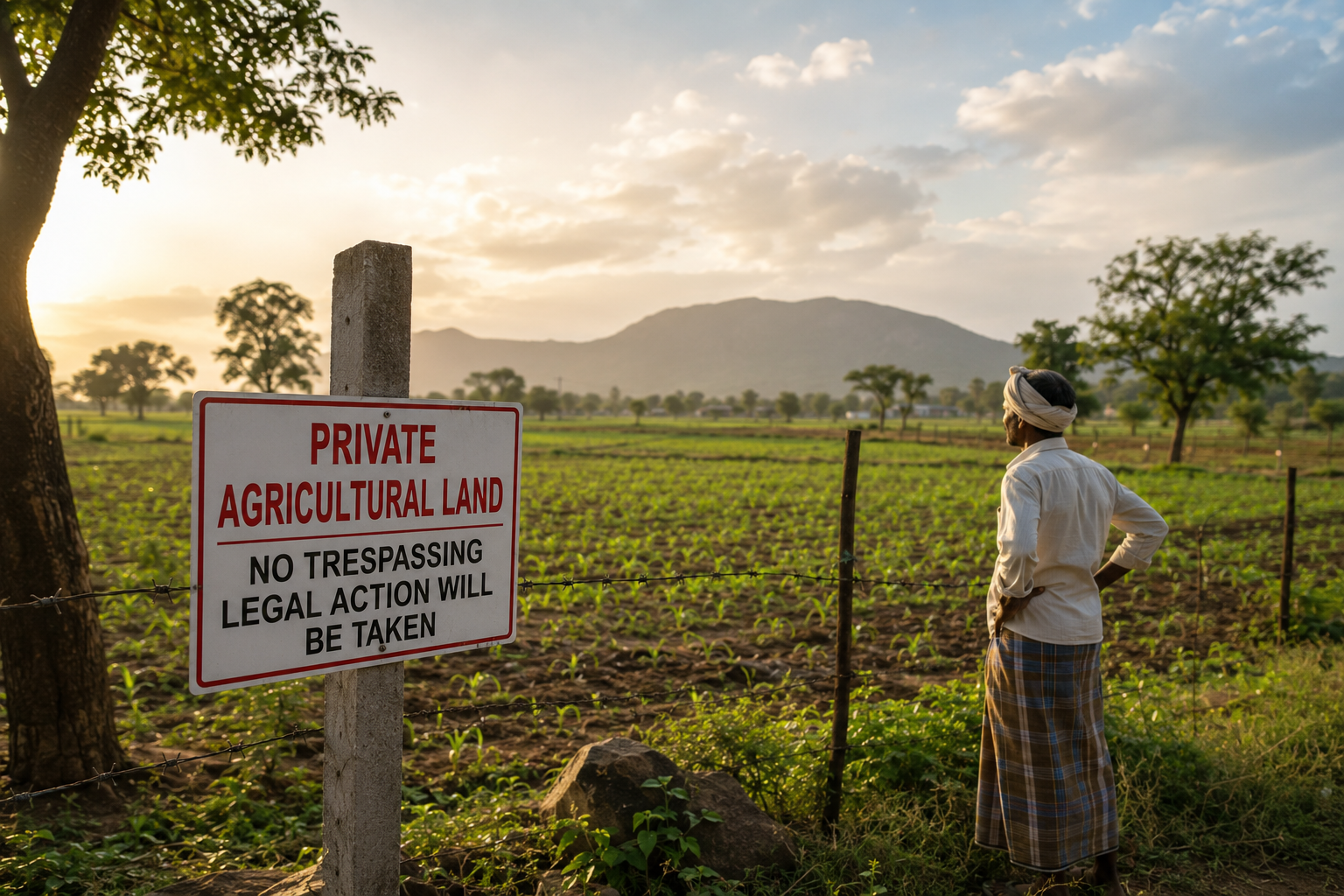
Introduction: When a Farmer’s Land Is More Than Just Property
For millions of farmers, agricultural land is far more than a physical asset. It is a source of livelihood, a family inheritance, a symbol of identity, and often the result of generations of hard work. The land sustains families, supports local economies, and contributes significantly to national food security.
Yet, despite its importance, agricultural land frequently becomes the subject of disputes, unauthorized occupation, boundary conflicts, and illegal encroachments. Across rural India, farmers often face situations where neighboring landowners, private individuals, developers, or even organized groups attempt to occupy land without lawful authority.
Illegal land encroachment is not merely a private dispute. It is a legal wrong that directly affects property rights, economic stability, and social justice. The law recognizes the seriousness of such conduct and provides several remedies to protect farmers and restore their rights.
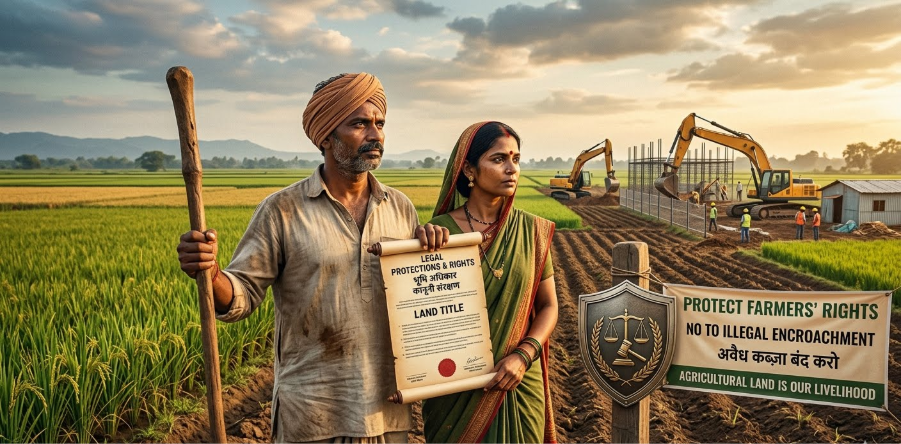
Understanding Illegal Land Encroachment
Illegal land encroachment occurs when a person occupies, uses, or claims possession of land without the consent of the lawful owner and without legal authorization.
Encroachment may take many forms:
- Unauthorized cultivation of agricultural land
- Extension of property boundaries beyond legal limits
- Construction of structures on another person’s land
- Illegal fencing of farmland
- Occupation of access roads leading to agricultural fields
- Fraudulent claims of ownership
- Alteration of survey boundaries
In many cases, encroachment begins gradually and may remain unnoticed until significant damage has occurred.
The law therefore places great importance on land records, surveys, and ownership documentation.
Why Agricultural Land Requires Special Protection
Agricultural land occupies a unique position within society.
Unlike many other forms of property, farmland directly contributes to:
- Food production
- Rural employment
- Economic development
- Environmental sustainability
- Community stability
When farmland is illegally occupied, the consequences extend beyond individual losses.
Farmers may lose:
- Crop income
- Access to irrigation
- Seasonal productivity
- Investment returns
- Long-term economic security
Therefore, protecting agricultural land is both a private and public interest.
Constitutional Protection of Property Rights
Although the right to property is no longer a Fundamental Right, it remains a valuable constitutional and legal right.
Article 300A of the Constitution of India
Article 300A provides:
“No person shall be deprived of his property save by authority of law.”
This constitutional provision establishes an important principle:
A person’s property cannot be taken, occupied, or interfered with unless authorized by law.
Illegal encroachment violates this principle because the encroacher lacks lawful authority.
The Constitution therefore supports legal mechanisms designed to protect property owners, including farmers.
The Importance of Land Records
One of the strongest defenses against encroachment is proper documentation.
Farmers should maintain:
- Title deeds
- Sale deeds
- Pattadar passbooks
- Revenue records
- Survey maps
- Mutation records
- Tax payment receipts
- Encumbrance certificates
Accurate documentation helps establish ownership and simplifies legal proceedings.
In many disputes, the party with reliable records possesses a significant advantage.
Criminal Remedies Against Encroachment
Illegal encroachment may constitute a criminal offense under certain circumstances.
Criminal Trespass
When a person unlawfully enters another person’s land with intent to occupy, intimidate, annoy, or interfere with lawful possession, criminal liability may arise.
Depending on the facts, authorities may initiate proceedings relating to:
- Criminal trespass
- Mischief
- Property damage
- Criminal intimidation
- Fraudulent occupation
Criminal proceedings can act as a deterrent and provide immediate protection against unlawful interference.
Civil Remedies Available to Farmers
While criminal law addresses unlawful conduct, civil law focuses on protecting ownership and possession rights.
Several remedies are available.
Suit for Permanent Injunction
A farmer may approach a civil court seeking a permanent injunction.
An injunction is a court order directing another person to:
- Stop entering the land
- Stop interfering with possession
- Stop construction activities
- Stop cultivation activities
The purpose is to prevent further violations before greater harm occurs.
Temporary Injunction
In urgent situations, courts may grant temporary protection while a dispute is being resolved.
This remedy is particularly useful when:
- Construction is underway.
- Crops are being damaged.
- Boundaries are being altered.
- Possession is under immediate threat.
Temporary injunctions preserve the status quo until final determination of rights.
Suit for Recovery of Possession
When encroachment has already occurred, a farmer may seek recovery of possession.
The court may order:
- Removal of encroachers
- Restoration of possession
- Demolition of unauthorized structures
- Enforcement through legal authorities
This remedy seeks to return the land to its rightful owner.
The Role of the Specific Relief Act, 1963
The Specific Relief Act plays a vital role in land dispute litigation.
Important provisions allow courts to:
- Protect lawful possession
- Restore possession
- Grant injunctions
- Prevent unlawful interference
The Act recognizes that property rights require practical enforcement mechanisms.
Without such remedies, ownership would become meaningless.
Revenue Authorities and Land Protection
Many agricultural disputes can also be addressed through revenue authorities.
Depending on state laws, farmers may approach:
- Tahsildars
- Revenue Divisional Officers
- District Collectors
- Survey Departments
Revenue authorities may:
- Conduct inspections
- Verify boundaries
- Correct records
- Remove unauthorized occupations
- Resolve survey disputes
Administrative remedies are often faster than lengthy civil litigation.
Survey and Boundary Verification
Boundary disputes are among the most common causes of encroachment claims.
Official surveys help determine:
- Exact land measurements
- Legal boundaries
- Encroached portions
- Ownership records
Modern technology such as GPS-based land surveys is increasingly used to improve accuracy and reduce disputes.
Regular verification of boundaries can prevent future conflicts.
Challenges Faced by Farmers
Despite legal protections, farmers often encounter significant obstacles.
These include:
- Lack of legal awareness
- Incomplete land records
- Delayed court proceedings
- Survey inaccuracies
- Financial limitations
- Administrative delays
Addressing these challenges requires both legal reforms and greater public awareness.
Knowledge of rights remains one of the most effective tools available to farmers.
The Economic Impact of Land Encroachment
Illegal occupation of agricultural land can produce substantial economic consequences.
Farmers may suffer:
- Loss of crop production
- Reduced market participation
- Lower agricultural investment
- Increased legal expenses
- Reduced access to credit
When land disputes persist for years, entire farming operations may become financially unsustainable.
Protecting land rights therefore contributes directly to rural economic development.
Social Consequences of Encroachment
Land disputes often affect more than property ownership.
They can create:
- Family conflicts
- Community tensions
- Social instability
- Long-term litigation
In rural communities, land represents both economic and emotional value.
Effective legal protection helps preserve social harmony while ensuring justice.
Preventive Measures Every Farmer Should Take
Prevention is often more effective than litigation.
Farmers should:
Maintain Updated Records
Keep all ownership documents current and secure.
Conduct Periodic Surveys
Verify boundaries regularly.
Install Visible Boundary Markers
Clear demarcation reduces disputes.
Monitor Land Frequently
Regular inspections help identify encroachments early.
Report Violations Promptly
Early action often prevents larger conflicts.
Seek Legal Advice
Professional guidance can prevent procedural mistakes.
Strengthening Farmers’ Property Rights
Protecting farmers from illegal land encroachment requires cooperation among:
- Government agencies
- Revenue authorities
- Courts
- Legal professionals
- Local communities
Digitization of land records, modern survey systems, and improved legal awareness can significantly reduce land disputes.
Strong property rights encourage investment, improve agricultural productivity, and strengthen rural economies.
Conclusion
Illegal land encroachment is not simply a dispute over boundaries. It is a challenge to the rights, livelihoods, and security of farmers who depend on agricultural land for survival and prosperity.
The legal system provides multiple remedies, including constitutional protections, civil actions, criminal proceedings, and administrative interventions. These mechanisms exist to ensure that lawful owners can protect their property and recover possession when unlawful occupation occurs.
For farmers, awareness of these rights is essential. A well-informed farmer is better prepared to defend land, protect future generations, and preserve the economic foundation upon which rural communities depend.
Agricultural land sustains the nation. Protecting the rights of those who cultivate it is not merely a legal obligation—it is a matter of justice, economic stability, and national interest.
“A farmer’s land is not just soil and boundaries; it is livelihood, heritage, and dignity protected by the rule of law.”