

When Land Is More Than Property
For millions of farming families across India, agricultural land represents far more than a financial asset. It is a source of livelihood, a symbol of family heritage, a foundation for economic security, and often a legacy passed down through generations.
Agricultural land sustains families, supports rural economies, and contributes significantly to the nation’s food security. Because of its immense importance, questions relating to inheritance, ownership, succession, and partition often become some of the most significant legal issues faced by farming communities.
Among the laws governing inheritance in India, one provision stands out as particularly transformative:
Section 6 of the Hindu Succession Act, 1956 (as amended in 2005).
This provision fundamentally changed the legal landscape by recognizing equal inheritance rights for daughters in ancestral property. Its impact extends far beyond legal doctrine, influencing social justice, gender equality, agricultural ownership, and rural development.
Understanding Section 6 is essential for farmers, landowners, legal professionals, and anyone interested in agricultural property rights.
The Importance of Agricultural Land Inheritance
Inheritance plays a critical role in determining how agricultural land is transferred from one generation to the next.
Without clear succession laws, disputes can arise involving:
- Ownership rights
- Family partitions
- Cultivation rights
- Revenue records
- Agricultural income
- Future land use
Inheritance laws provide certainty and stability by establishing legal rules that govern the transfer of property after death.
For farming families, this certainty is particularly important because agricultural activities often depend on uninterrupted access to land.
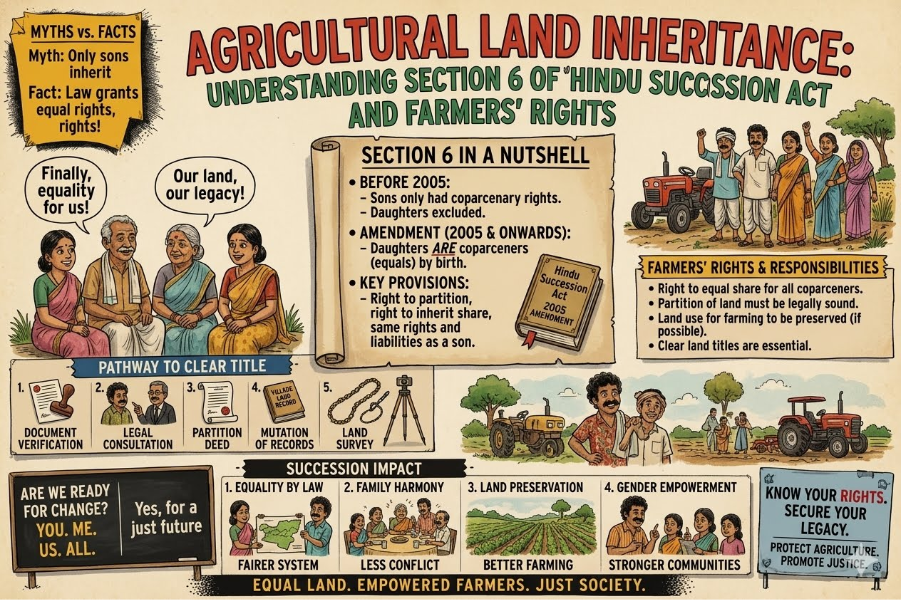
Understanding the Hindu Succession Act, 1956
The Hindu Succession Act was enacted to regulate succession and inheritance among Hindus.
The Act applies to:
- Hindus
- Buddhists
- Jains
- Sikhs
Its purpose is to create a uniform legal framework governing inheritance and property rights.
Before legislative reforms, inheritance practices often reflected traditional customs that favored male family members, particularly sons.
While these customs varied across regions, they generally limited the rights of daughters in ancestral property.
The law eventually evolved to address these inequalities.
What Is Coparcenary Property?
To understand Section 6, it is necessary to understand the concept of coparcenary.
Under traditional Hindu law, a coparcenary consists of family members who acquire an interest in ancestral property by birth.
Historically, coparcenary rights were largely restricted to male members of the family.
This meant that:
- Sons became coparceners by birth.
- Daughters generally did not enjoy equivalent rights.
- Property management often remained under male control.
As a result, many women faced significant disadvantages regarding inheritance and agricultural ownership.
The Historical Position Before the 2005 Amendment
Before the amendment, daughters often encountered limitations in claiming rights over ancestral agricultural land.
In many cases:
- Sons automatically became coparceners.
- Daughters had limited inheritance rights.
- Agricultural property frequently remained concentrated among male heirs.
This legal framework reflected historical social structures rather than modern principles of equality.
Over time, concerns emerged regarding:
- Gender discrimination
- Economic inequality
- Women’s financial dependence
- Unequal access to property ownership
These concerns ultimately led to legislative reform.
The Landmark 2005 Amendment
The Hindu Succession (Amendment) Act, 2005 introduced one of the most significant changes in Indian inheritance law.
The amendment transformed Section 6 by granting daughters equal coparcenary rights.
The law now provides that:
A Daughter Is a Coparcener by Birth
A daughter enjoys the same status as a son in ancestral property.
This means:
- Equal ownership rights
- Equal inheritance rights
- Equal rights to seek partition
- Equal rights in agricultural property
The law recognizes daughters as full participants in family property ownership.
Why Section 6 Matters to Agricultural Land
Agricultural land is often the most valuable asset owned by rural families.
The amendment significantly affects:
- Land ownership structures
- Family partitions
- Agricultural succession planning
- Rural property management
The law ensures that inheritance rights are determined by legal principles rather than outdated gender-based distinctions.
This represents a major advancement in property justice.
Equal Rights Mean Equal Responsibilities
Section 6 not only grants rights but also imposes responsibilities.
A daughter who becomes a coparcener:
- Shares ownership rights.
- Shares legal obligations.
- Participates in property decisions.
- May bear responsibilities associated with family property.
The amendment promotes equality by recognizing both rights and responsibilities.
Impact on Farmers and Rural Families
The amendment has profound implications for farming communities.
Increased Legal Certainty
The law provides clear guidance regarding inheritance rights.
This reduces ambiguity and strengthens property protection.
Greater Economic Security
Ownership rights contribute to financial independence and long-term security.
Improved Access to Resources
Property ownership often influences access to:
- Agricultural loans
- Government schemes
- Financial institutions
- Development programs
Equal inheritance rights expand opportunities for women in rural areas.
Agricultural Land and Women’s Empowerment
Property ownership is closely connected to empowerment.
When women possess legal ownership rights, they often gain:
- Greater economic independence
- Increased participation in decision-making
- Enhanced bargaining power
- Stronger social status
In agricultural communities, land ownership can significantly influence economic opportunities.
The amendment therefore contributes not only to legal equality but also to social transformation.
The Role of Revenue Records
Although legal rights arise through inheritance, documentation remains essential.
Farmers should ensure that:
- Mutation entries are updated.
- Revenue records are corrected.
- Ownership documents reflect legal succession.
- Survey records remain accurate.
Failure to update records may create complications in future transactions and disputes.
Proper documentation strengthens legal protection.
Partition Rights Under Section 6
One of the most significant aspects of the amendment is the recognition of equal partition rights.
A daughter may:
- Demand partition.
- Receive an equal share.
- Participate in family settlements.
- Protect inherited interests.
Partition rights ensure that ownership remains meaningful and enforceable.
Without the ability to seek partition, legal ownership may become difficult to realize in practice.
Judicial Interpretation and Legal Evolution
Indian courts have played an important role in interpreting Section 6.
Judicial decisions have reinforced the principle that:
Daughters possess equal coparcenary rights by birth.
These decisions have strengthened the amendment’s objective of achieving substantive equality within family property structures.
The judiciary has consistently emphasized the social purpose behind the reform.
Common Inheritance Disputes in Agricultural Land
Despite legal clarity, disputes still arise.
Common issues include:
Boundary Disputes
Unclear surveys may create conflicts regarding land extent.
Mutation Delays
Failure to update records often results in ownership disputes.
Informal Family Arrangements
Oral agreements may conflict with legal rights.
Exclusion of Legal Heirs
Some heirs may be omitted from succession proceedings.
Partition Disagreements
Family members may disagree regarding division of land.
Understanding legal rights helps prevent these disputes from escalating.
Why Awareness Matters
Many inheritance conflicts arise not because of legal complexity but because of lack of awareness.
Farmers should understand:
- Succession rights
- Documentation requirements
- Revenue procedures
- Partition mechanisms
- Legal remedies
Awareness empowers families to make informed decisions and avoid unnecessary litigation.
The Economic Significance of Secure Inheritance
Clear inheritance laws contribute to:
- Stable agricultural production
- Efficient land management
- Improved investment decisions
- Rural economic growth
When ownership rights are secure, families are more likely to invest in:
- Irrigation systems
- Farm equipment
- Soil improvement
- Agricultural innovation
Legal certainty therefore supports long-term development.
The Constitutional Perspective
The amendment reflects broader constitutional values.
India’s constitutional framework promotes:
- Equality before law
- Non-discrimination
- Social justice
- Equal opportunity
Section 6 advances these objectives by ensuring that inheritance rights are not determined by gender.
The law recognizes that equality must extend beyond public institutions into family property relationships.
Building a Fairer Agricultural Future
Agriculture remains one of the most important sectors of the Indian economy.
A fair inheritance system strengthens:
- Rural families
- Agricultural productivity
- Property security
- Economic inclusion
When legal rights are distributed fairly, communities become stronger and more resilient.
The amendment therefore contributes not only to individual justice but also to broader social progress.
Conclusion
Section 6 of the Hindu Succession Act represents one of the most important legal reforms affecting agricultural land inheritance in India. By recognizing daughters as equal coparceners, the law transformed traditional inheritance structures and strengthened the principles of equality and justice.
For farmers and rural families, the amendment provides greater clarity, fairness, and legal protection. It ensures that agricultural land—often the most valuable family asset—is governed by modern legal principles rather than outdated distinctions.
Understanding inheritance rights is essential for protecting property, preserving family harmony, and ensuring the sustainable transfer of agricultural assets across generations.
As India continues to modernize its agricultural and legal systems, Section 6 remains a powerful example of how law can promote both economic security and social equality.
“Agricultural land may be inherited through generations, but justice requires that inheritance be governed by equality, dignity, and the rule of law.”