
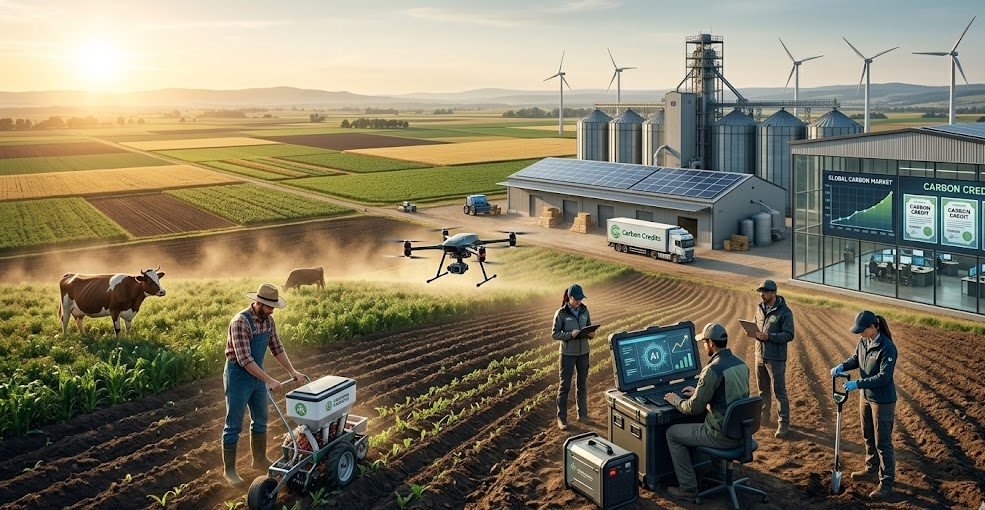
Introduction: The Next Gold Rush May Be Hidden Beneath Our Feet
For generations, farmers have been the backbone of economies, feeding billions while facing unpredictable weather, fluctuating market prices, rising input costs, and shrinking profit margins.
Today, a new opportunity is emerging—one that could fundamentally transform agriculture.
What if farmers could earn money not only from the crops they harvest but also from the carbon they capture?
What if healthy soil became as valuable as the produce grown on it?
What if the fight against climate change created a new income stream for the world’s farming communities?
Welcome to the era of carbon farming.
Carbon credits are opening a pathway for farmers to participate in global climate markets, turning sustainable agricultural practices into measurable financial assets.
While the phrase “carbon millionaire” may sound ambitious, the idea behind it is gaining momentum worldwide.
The question is no longer whether agriculture can play a role in climate action.
The real question is: Can farmers become the climate entrepreneurs of the future?
Understanding the Carbon Crisis
Climate change is no longer a distant concern.
Extreme weather events, prolonged droughts, floods, rising temperatures, and declining soil health are already impacting agricultural productivity across the globe.
Ironically, agriculture contributes significantly to greenhouse gas emissions through:
- Excessive use of chemical fertilizers
- Deforestation
- Livestock emissions
- Soil degradation
- Fossil fuel consumption
- Intensive land management practices
At the same time, agriculture possesses one extraordinary advantage.
Unlike many industries, farming has the ability to remove carbon dioxide from the atmosphere and store it naturally in the soil.
This process is known as carbon sequestration.
Healthy soils act as carbon sinks, capturing atmospheric carbon and storing it underground for years or even decades.
This unique capability positions farmers at the center of global climate solutions.
What Are Carbon Credits?
A carbon credit is a tradable certificate representing the reduction, removal, or avoidance of one metric ton of carbon dioxide equivalent emissions.
Organizations worldwide purchase carbon credits to offset their emissions and achieve sustainability goals.
These buyers include:
- Large corporations
- Airlines
- Manufacturing companies
- Technology firms
- Energy producers
- Governments
Carbon credits are generated through projects that demonstrably reduce or remove greenhouse gases.
Examples include:
- Reforestation
- Renewable energy
- Methane capture
- Soil carbon sequestration
- Regenerative agriculture
When farmers adopt practices that increase carbon storage in their soil, they may qualify to generate carbon credits.
These credits can then be sold in voluntary or compliance carbon markets.
In simple terms, farmers can get paid for improving environmental outcomes.
How Does Carbon Farming Work?
Carbon farming involves agricultural practices designed to capture and store carbon while improving soil health.
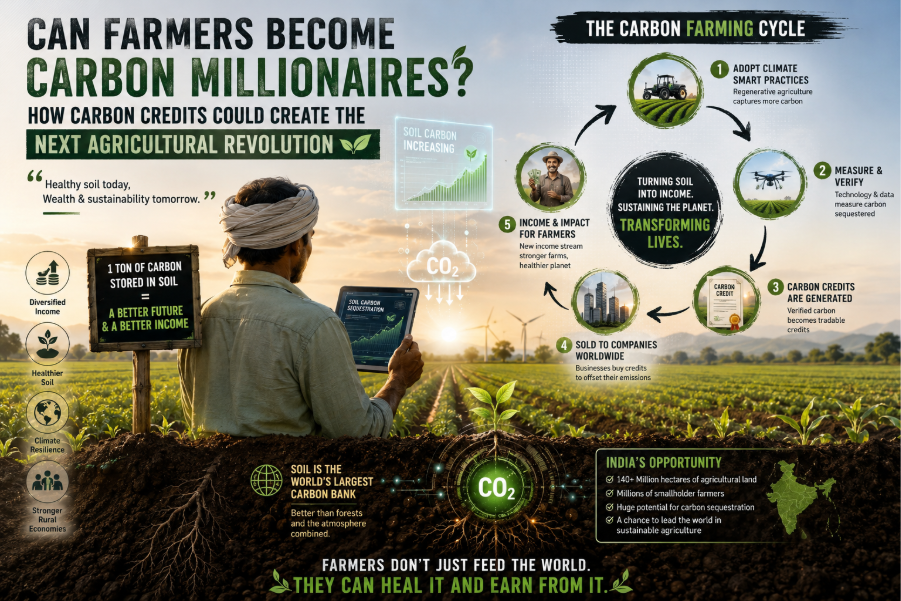
The process generally follows five stages:
1. Baseline Measurement
Soil conditions are assessed to determine current carbon levels.
This includes:
- Soil testing
- Satellite monitoring
- Historical farm data
- Field surveys
2. Implementation of Sustainable Practices
Farmers adopt climate-friendly techniques that increase carbon sequestration.
3. Monitoring and Verification
Independent organizations measure the amount of carbon captured over time.
4. Credit Issuance
Verified carbon reductions are converted into carbon credits.
5. Credit Sale
Credits are sold to companies seeking to offset emissions.
The revenue generated creates an additional income stream alongside traditional farming.
Regenerative Agriculture: The Foundation of Carbon Farming
Carbon farming relies heavily on regenerative agriculture practices.
These include:
No-Till or Reduced Tillage
Minimizing soil disturbance helps preserve organic matter and prevents carbon release.
Cover Cropping
Planting crops between harvest cycles protects soil and enhances carbon storage.
Crop Rotation
Diversified crop systems improve soil biodiversity and resilience.
Agroforestry
Integrating trees into farming systems increases long-term carbon capture.
Precision Agriculture
Technology-driven resource management reduces emissions and waste.
Organic Amendments
Using compost and natural fertilizers improves soil health.
Managed Grazing
Rotational grazing systems help restore grasslands and sequester carbon.
Beyond carbon storage, these practices deliver additional benefits:
- Improved water retention
- Reduced erosion
- Higher biodiversity
- Better resilience to drought
- Lower input costs
- Enhanced soil fertility
Farmers are not just growing crops.
They are rebuilding ecosystems.
Why Companies Are Willing to Pay Farmers
Across industries, sustainability commitments are intensifying.
Thousands of companies have announced net-zero targets.
However, reducing emissions internally can be expensive and time-consuming.
Carbon credits offer a practical solution.
By purchasing credits generated through agricultural projects, businesses can offset unavoidable emissions while supporting rural communities.
For companies, carbon credits provide:
- Progress toward climate goals
- Improved brand reputation
- Investor confidence
- Regulatory preparedness
- ESG compliance
For farmers, the benefits extend beyond financial gains.
Carbon markets recognize farmers as environmental stewards and key partners in climate action.
This shift could redefine agriculture’s role in the global economy.
Can Farmers Really Become Carbon Millionaires?
The answer depends on several factors.
Not every farmer will become a millionaire solely through carbon credits.
However, large-scale adoption combined with supportive policies and technological innovation could generate substantial income opportunities.
Income potential depends on:
- Farm size
- Soil type
- Geographic location
- Agricultural practices
- Carbon market prices
- Verification costs
- Project duration
For large landowners, carbon revenues can become significant.
For smallholder farmers, collective participation through cooperatives and farmer producer organizations may unlock similar opportunities.
The true revolution lies not in creating overnight millionaires but in diversifying farm income and reducing dependence on unpredictable commodity prices.
Even modest additional earnings can improve financial stability for millions of farming families.
India’s Carbon Farming Opportunity
India is home to more than 140 million hectares of agricultural land and millions of smallholder farmers.
This creates enormous potential for carbon sequestration.
Several factors position India as a future leader in agricultural carbon markets:
- Diverse agro-climatic zones
- Growing digital infrastructure
- Expanding satellite capabilities
- Government focus on sustainability
- Increasing adoption of precision agriculture
Potential high-impact regions include:
- Rice cultivation areas
- Dryland farming zones
- Agroforestry projects
- Regenerative cotton farming
- Natural farming initiatives
Programs promoting:
- Millets
- Organic farming
- Water conservation
- Soil health management
can integrate seamlessly with carbon credit frameworks.
If designed inclusively, carbon markets could strengthen rural economies while accelerating climate action.
However, accessibility for small farmers must remain a priority.
The Challenges That Cannot Be Ignored
Despite its promise, carbon farming is not without obstacles.
High Verification Costs
Soil testing, monitoring, and certification can be expensive.
Complex Methodologies
Carbon accounting requires technical expertise.
Market Volatility
Carbon credit prices fluctuate significantly.
Limited Awareness
Many farmers remain unfamiliar with carbon markets.
Data Ownership Concerns
Questions around who owns and controls farm data persist.
Small Land Holdings
Fragmented farms create scalability challenges.
Long-Term Commitments
Carbon projects often require multi-year participation.
Without careful implementation, carbon markets risk excluding the farmers who need support the most.
Strong governance and transparent systems are essential.
Technology Will Drive the Revolution
Emerging technologies are making carbon farming more accessible and efficient.
Key innovations include:
- Artificial intelligence
- Satellite imagery
- Remote sensing
- Internet of Things sensors
- Blockchain platforms
- Digital farm records
- Machine learning models
These technologies help:
- Measure soil carbon accurately
- Reduce verification costs
- Improve transparency
- Track environmental outcomes
- Simplify farmer participation
Digital agriculture is creating a bridge between small farms and global climate markets.
The future farm may produce food, data, and carbon credits simultaneously.
The Role of Governments and Policymakers
Carbon markets cannot thrive without strong policy support.
Governments have a critical role to play by:
- Establishing clear regulations
- Creating standardized methodologies
- Supporting farmer education
- Offering financial incentives
- Investing in rural technology infrastructure
- Encouraging public-private partnerships
Policies must ensure that carbon revenues reach farmers fairly and transparently.
Special attention should be given to:
- Smallholder inclusion
- Gender equity
- Data privacy
- Long-term sustainability
The goal should not simply be creating carbon markets.
It should be creating equitable carbon markets.
A New Identity for Farmers
For centuries, society has viewed farmers primarily as food producers.
That perspective is changing.
Farmers are becoming:
- Soil managers
- Biodiversity protectors
- Water stewards
- Climate solution providers
- Renewable energy producers
- Carbon custodians
This transformation represents one of the most significant economic shifts in modern agriculture.
The value of farming may increasingly depend not only on what grows above the ground but also on what is stored beneath it.
Healthy soil could become one of the world’s most valuable natural assets.
Conclusion: The Future of Farming Is Multi-Dimensional
Carbon credits are not a silver bullet.
They will not solve every challenge facing agriculture.
However, they offer a compelling vision for the future—one where environmental responsibility and economic opportunity go hand in hand.
The next agricultural revolution may not be driven solely by bigger machines, higher yields, or genetic innovation.
It may be driven by the invisible power of carbon.
If implemented responsibly, carbon markets could help farmers:
- Increase income
- Improve soil health
- Build climate resilience
- Reduce environmental impact
- Secure long-term sustainability
The farms of tomorrow will produce more than food.
They will produce climate solutions.
And perhaps, the world’s next generation of entrepreneurs will not emerge from technology hubs or financial centers.
They will emerge from fields, orchards, and villages.
The future of climate action may begin with the people who have always worked closest to the earth.
The question is no longer whether farmers can be part of the solution.
The question is whether we are ready to reward them for it.
What do you think?
Can carbon credits transform agriculture and create a new era of prosperity for farmers?
Share your thoughts, experiences, and perspectives in the comments below.
#CarbonCredits #CarbonFarming #RegenerativeAgriculture #ClimateAction #Sustainability #ESG #Agriculture #Farmers #ClimateTech #GreenFinance #NetZero #SoilHealth #AgriTech #RuralDevelopment #FutureOfFarming