
Introduction
Climate change, biodiversity loss, resource depletion, and environmental degradation have transformed sustainability from a corporate social responsibility initiative into a strategic business imperative. Governments, financial institutions, regulators, and investors increasingly recognize that achieving global climate targets requires a fundamental shift in how capital is allocated.
Green finance and sustainable investment policies have emerged as powerful mechanisms to direct financial resources toward environmentally responsible projects and businesses. By integrating environmental, social, and governance (ESG) considerations into financial decision-making, these frameworks are reshaping global markets and accelerating the transition to a low-carbon economy.
Regulatory frameworks now play a central role in defining sustainability standards, enhancing transparency, reducing greenwashing risks, and creating accountability across industries.
This article explores the evolution of green finance, key sustainable investment instruments, major regulatory frameworks worldwide, implementation challenges, and future opportunities for environmental transformation.
Understanding Green Finance
Green finance refers to financial activities, products, and services that support environmentally sustainable outcomes.
It encompasses investments that contribute to:
- Climate change mitigation
- Renewable energy development
- Energy efficiency improvements
- Sustainable agriculture
- Pollution prevention
- Biodiversity conservation
- Circular economy initiatives
- Sustainable transportation systems
Unlike traditional finance, green finance integrates environmental risks and opportunities into investment decisions.
Its primary objectives include:
- Mobilizing private and public capital for sustainability projects
- Reducing carbon emissions
- Enhancing climate resilience
- Supporting sustainable development goals
- Encouraging responsible corporate behavior
According to the United Nations Environment Programme (UNEP), trillions of dollars in annual investment are needed to achieve global climate goals, making sustainable finance an essential pillar of future economic development.
The Rise of Sustainable Investing
Investor priorities have evolved significantly over the past decade.
Modern investors increasingly seek both financial returns and measurable environmental impact.
Sustainable investing incorporates ESG factors into portfolio management and investment analysis.
The major approaches include:
1. Negative Screening
Investors exclude companies or sectors that negatively impact the environment.
Examples include:
- Coal mining
- Fossil fuel extraction
- Deforestation activities
- High-pollution industries
2. Positive Screening
Capital is allocated to companies demonstrating strong sustainability performance.
Examples include:
- Renewable energy firms
- Green technology companies
- Sustainable agriculture enterprises
3. ESG Integration
Environmental, social, and governance factors are systematically incorporated into financial analysis.
This approach evaluates:
- Carbon emissions
- Water management
- Supply chain sustainability
- Board diversity
- Corporate governance practices
4. Impact Investing
Investments are made with the intention of generating measurable environmental or social outcomes alongside financial returns.
Examples include:
- Clean energy projects
- Green infrastructure
- Conservation initiatives
5. Thematic Investing
Investors focus on specific sustainability themes such as:
- Clean energy
- Electric mobility
- Water security
- Circular economy solutions
As sustainable investing gains momentum, regulators increasingly require standardized reporting and disclosure mechanisms to ensure transparency and comparability.
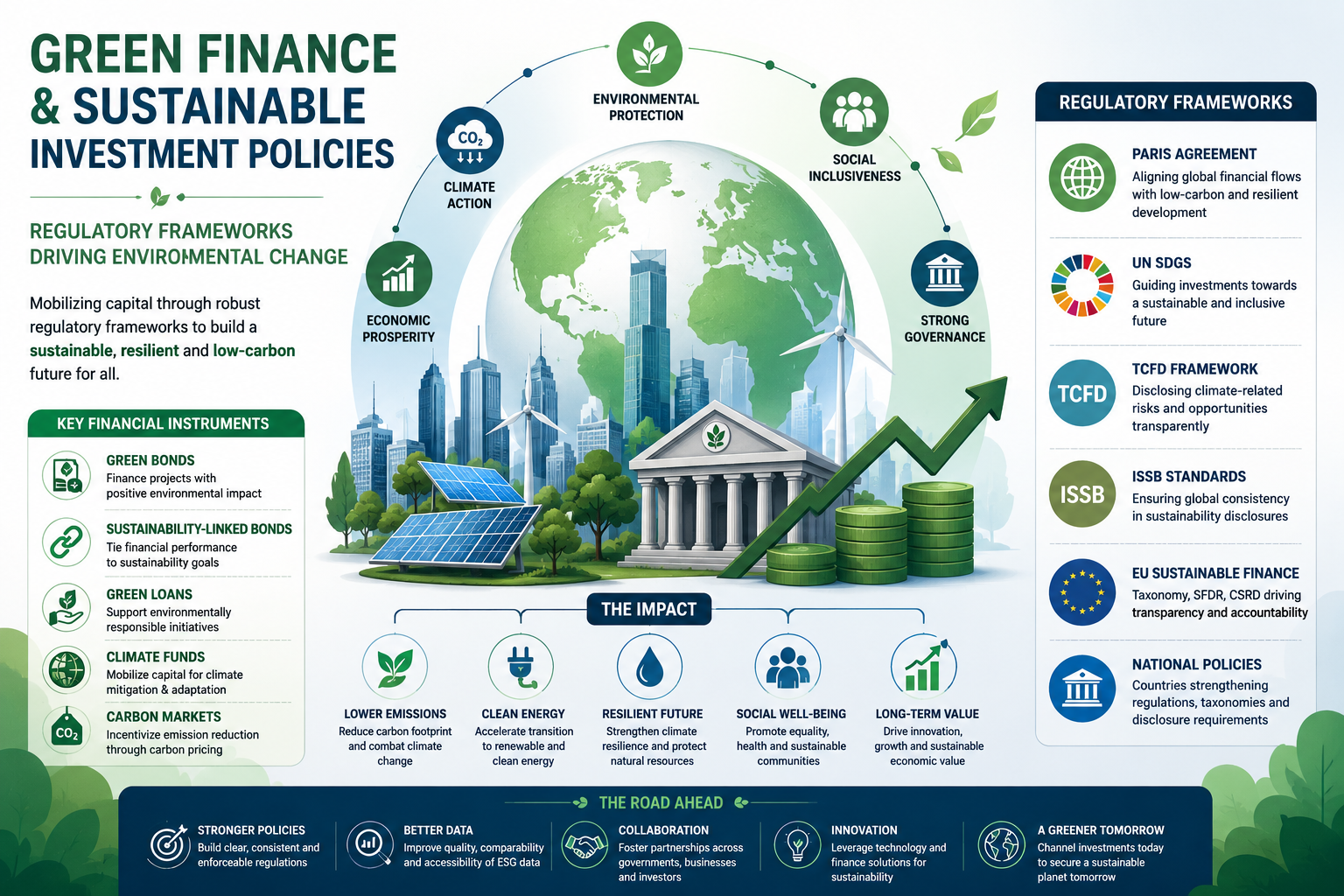
Key Financial Instruments Driving Sustainability
Green finance utilizes a variety of innovative instruments to channel capital toward environmental objectives.
Green Bonds
Green bonds are debt securities issued to finance environmentally beneficial projects.
Common funding areas include:
- Renewable energy installations
- Energy-efficient buildings
- Clean transportation
- Waste management systems
The global green bond market has experienced substantial growth due to increasing investor demand for sustainable assets.
Sustainability-Linked Bonds
Unlike green bonds, sustainability-linked bonds are tied to specific sustainability performance targets.
Organizations may face financial penalties if they fail to achieve predetermined environmental objectives.
Green Loans
Financial institutions provide green loans to businesses and individuals undertaking sustainable projects.
Examples include financing for:
- Solar energy systems
- Energy-efficient equipment
- Sustainable construction
Climate Funds
Public and private climate funds mobilize capital for environmental projects, particularly in developing economies.
These funds often support:
- Adaptation strategies
- Carbon reduction initiatives
- Resilience-building projects
Carbon Markets
Carbon trading mechanisms create financial incentives for emissions reduction.
Companies can buy and sell carbon credits based on their emissions performance.
Effective carbon markets encourage businesses to invest in cleaner technologies and operational efficiency.
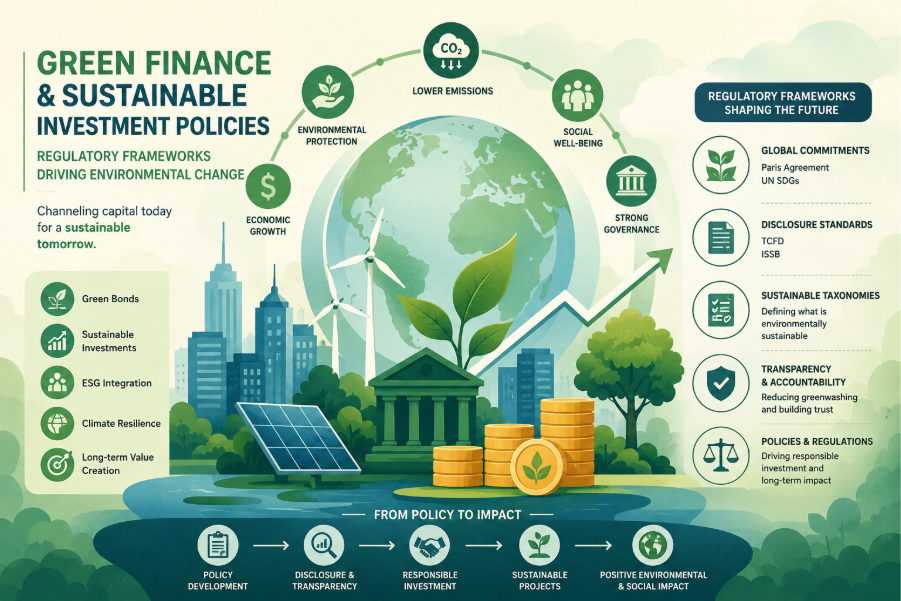
Regulatory Frameworks Shaping Green Finance
Strong regulatory frameworks are essential for building investor confidence and ensuring the integrity of sustainable finance markets.
Several international and national initiatives are driving this transformation.
The Paris Agreement
Adopted in 2015, the Paris Agreement established a global commitment to limit temperature increases to well below 2°C above pre-industrial levels.
Article 2.1(c) specifically emphasizes aligning financial flows with low-carbon and climate-resilient development.
This agreement has become the foundation for sustainable finance policies worldwide.
United Nations Sustainable Development Goals (SDGs)
The 17 SDGs provide a comprehensive framework for sustainable economic development.
Financial institutions increasingly align investment strategies with goals such as:
- Affordable and clean energy
- Sustainable cities and communities
- Responsible consumption and production
- Climate action
Task Force on Climate-Related Financial Disclosures (TCFD)
The TCFD framework encourages organizations to disclose climate-related risks and opportunities.
It focuses on four key pillars:
- Governance
- Strategy
- Risk management
- Metrics and targets
Many jurisdictions have adopted or integrated TCFD recommendations into mandatory reporting requirements.
International Sustainability Standards Board (ISSB)
The ISSB was established to create globally consistent sustainability disclosure standards.
Its standards aim to improve:
- Transparency
- Comparability
- Reliability of sustainability information
Global adoption of ISSB standards is expected to reduce reporting fragmentation.
Regional Regulatory Developments
Different regions have developed unique sustainable finance frameworks.
European Union
The European Union is considered a global leader in sustainable finance regulation.
Key initiatives include:
EU Taxonomy Regulation
The EU Taxonomy defines which economic activities qualify as environmentally sustainable.
It provides a common language for investors and businesses.
Sustainable Finance Disclosure Regulation (SFDR)
SFDR requires financial institutions to disclose sustainability risks and impacts.
The regulation aims to reduce greenwashing and improve investor protection.
Corporate Sustainability Reporting Directive (CSRD)
CSRD expands sustainability reporting requirements for companies operating within the EU.
Organizations must disclose detailed information regarding environmental performance and climate risks.
United States
The United States has increased its focus on climate-related disclosures and clean energy investments.
Key developments include:
- Enhanced ESG reporting expectations
- Climate risk guidance from financial regulators
- Incentives under the Inflation Reduction Act
The regulatory landscape continues to evolve as investor demand for sustainability information increases.
Asia-Pacific Region
Several Asia-Pacific countries are strengthening sustainable finance policies.
China
China has introduced:
- Green bond standards
- Mandatory environmental disclosures
- Carbon trading systems
India
India is rapidly expanding its sustainable finance ecosystem through:
- Sovereign green bonds
- ESG disclosure requirements
- Renewable energy investment initiatives
The Securities and Exchange Board of India (SEBI) has introduced Business Responsibility and Sustainability Reporting (BRSR) requirements for listed companies.
Japan and Singapore
Both countries are developing regional sustainable finance hubs through:
- Green taxonomies
- Climate disclosure frameworks
- Sustainable investment incentives
The Challenge of Greenwashing
As sustainable finance markets grow, concerns regarding greenwashing have intensified.
Greenwashing occurs when organizations exaggerate or misrepresent environmental claims.
Examples include:
- Misleading ESG labels
- Unsupported carbon neutrality claims
- Inaccurate sustainability disclosures
Greenwashing undermines investor confidence and slows progress toward environmental goals.
Regulators are responding through:
- Standardized disclosure requirements
- Independent verification processes
- Enhanced auditing mechanisms
- Stronger enforcement actions
Transparency and accountability remain critical to maintaining trust in sustainable finance markets.
Opportunities and Benefits of Green Finance
Effective sustainable investment policies generate significant benefits for businesses, investors, and society.
Economic Benefits
- Increased capital access
- Long-term value creation
- Enhanced market competitiveness
- Innovation and job creation
Environmental Benefits
- Reduced greenhouse gas emissions
- Improved resource efficiency
- Biodiversity protection
- Increased climate resilience
Social Benefits
- Better public health outcomes
- Sustainable community development
- Improved stakeholder trust
- Enhanced corporate reputation
Organizations that proactively integrate sustainability into their strategies often demonstrate greater resilience against emerging environmental and regulatory risks.
Challenges Hindering Progress
Despite rapid growth, several barriers continue to limit the effectiveness of green finance.
Lack of Standardization
Different ESG frameworks create confusion and increase reporting complexity.
Data Quality Issues
Reliable sustainability data remains difficult to obtain across industries.
Regulatory Fragmentation
Diverse regulations across jurisdictions increase compliance costs.
Limited Expertise
Many organizations lack the technical capabilities required for effective sustainability reporting.
Transition Risks
Industries dependent on fossil fuels face significant economic and operational challenges during the transition to low-carbon business models.
Addressing these obstacles requires coordinated efforts among governments, regulators, investors, and businesses.
The Future of Sustainable Finance
The future of finance will increasingly be shaped by sustainability considerations.
Several trends are expected to accelerate this transformation.
Expansion of Mandatory ESG Reporting
Climate-related disclosures will become standard practice across global markets.
Growth of Transition Finance
Financial products supporting high-emission sectors in their transition toward sustainability will gain prominence.
Technological Innovation
Artificial intelligence, blockchain, and advanced analytics will improve sustainability measurement and reporting.
Increased Investor Activism
Shareholders will continue demanding stronger environmental accountability.
Nature-Based Investments
Growing attention will focus on biodiversity protection and ecosystem restoration.
As regulations mature and sustainability data improves, green finance will become an integral component of mainstream financial systems.
Conclusion
Green finance and sustainable investment policies are reshaping the relationship between capital markets and environmental responsibility.
Regulatory frameworks have moved beyond voluntary guidelines to become essential tools for directing financial resources toward sustainable outcomes.
From green bonds and ESG investing to climate disclosure mandates and sustainable taxonomies, governments and regulators are creating the foundation for a more transparent, accountable, and resilient financial ecosystem.
While challenges such as greenwashing, regulatory fragmentation, and data limitations persist, the momentum behind sustainable finance continues to strengthen.
Achieving global climate goals will require unprecedented collaboration between policymakers, investors, businesses, and communities.
The future of environmental change depends not only on technological innovation but also on the financial systems that determine where capital flows.
Ultimately, green finance represents more than an investment trend—it is a fundamental transformation in how economic value is created, measured, and sustained for future generations.
What are your thoughts?
How can regulators, businesses, and investors collaborate more effectively to accelerate the transition toward a sustainable economy?
Share your perspectives in the comments below.