
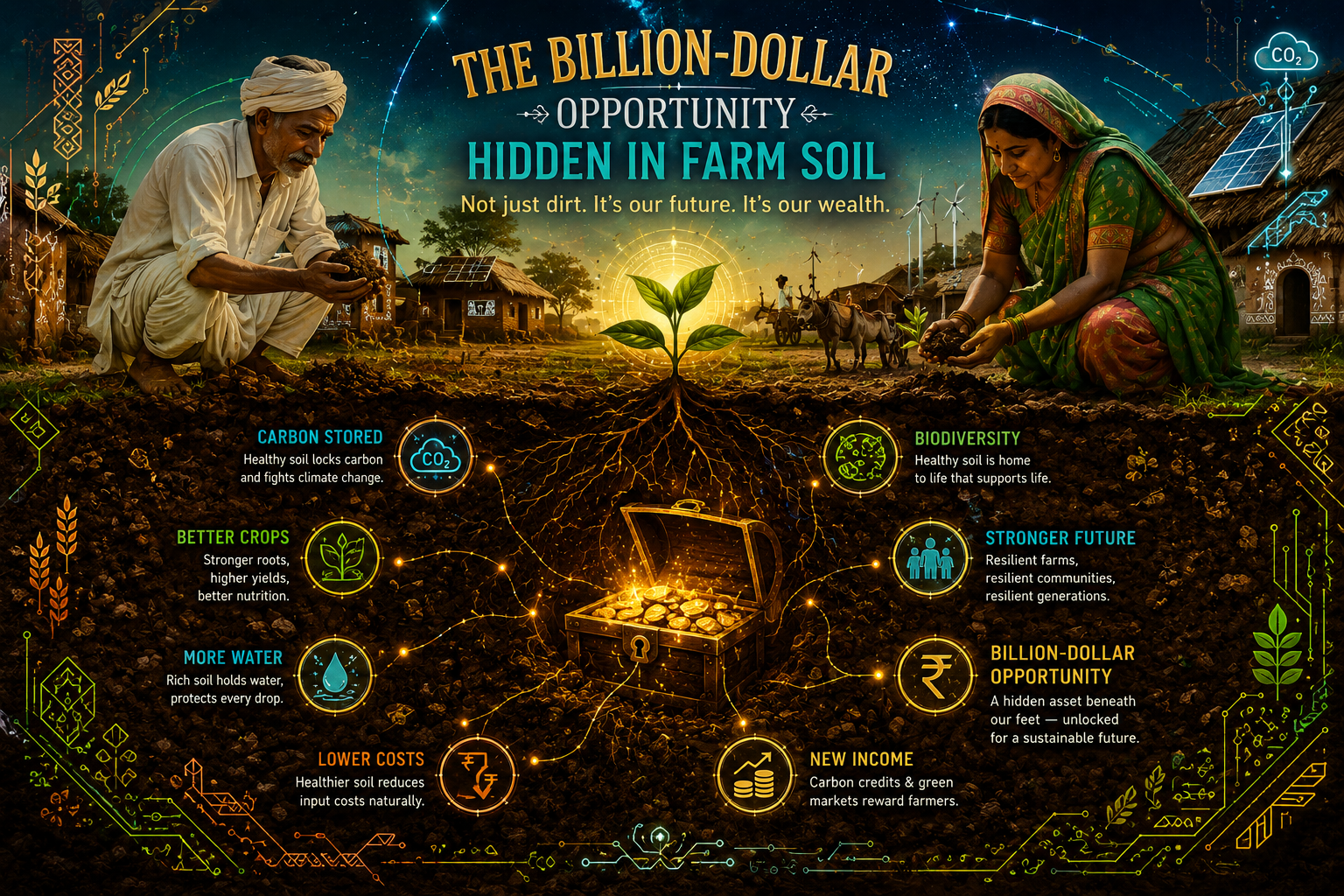
Why the Future of Wealth, Climate Action, and Food Security Lies Beneath Our Feet
For decades, conversations about wealth creation have centered around technology, real estate, manufacturing, and financial markets.
Meanwhile, one of the world’s most valuable assets has remained largely overlooked.
It does not trade on stock exchanges.
It is not mined from the earth.
It cannot be manufactured in factories.
Yet it has the potential to reshape economies, fight climate change, improve food security, and generate billions of dollars in new income.
That asset is healthy soil.
Beneath every farm lies an invisible economy waiting to be unlocked.
For generations, soil has been viewed primarily as a medium for growing crops. Today, scientists, investors, policymakers, and corporations are beginning to recognize something extraordinary:
Healthy soil stores carbon.
And stored carbon has value.
As global demand for climate solutions accelerates, farm soil is emerging as one of the most promising natural assets of the twenty-first century.
The next billion-dollar opportunity may not come from a technology startup.
It may come from the ground beneath a farmer’s feet.
The Hidden Crisis Beneath Modern Agriculture
Modern agriculture has achieved remarkable productivity gains.
However, this success has often come at a cost.
Decades of intensive farming practices have contributed to:
- Soil degradation
- Loss of organic matter
- Water scarcity
- Biodiversity decline
- Increased greenhouse gas emissions
- Reduced resilience to climate shocks
According to global estimates, a significant portion of agricultural land has experienced some level of degradation.
Healthy topsoil is disappearing faster than it can naturally regenerate.
The consequences are already visible:
- Lower crop yields
- Increased fertilizer dependency
- Higher production costs
- Greater vulnerability to droughts and floods
As soil health declines, farmers face mounting economic pressure.
But what if restoring soil could become profitable?
What if conservation created new revenue streams?
This is where the story changes.
Soil: Nature’s Largest Carbon Vault
Carbon exists everywhere.
It is found in the atmosphere, forests, oceans, and soil.
While conversations about climate change often focus on reducing emissions, removing existing carbon from the atmosphere is equally important.
Healthy soil plays a critical role in this process.
Through photosynthesis, plants absorb carbon dioxide from the atmosphere.
A portion of that carbon travels through roots into the soil, where it can remain stored for years or even decades.
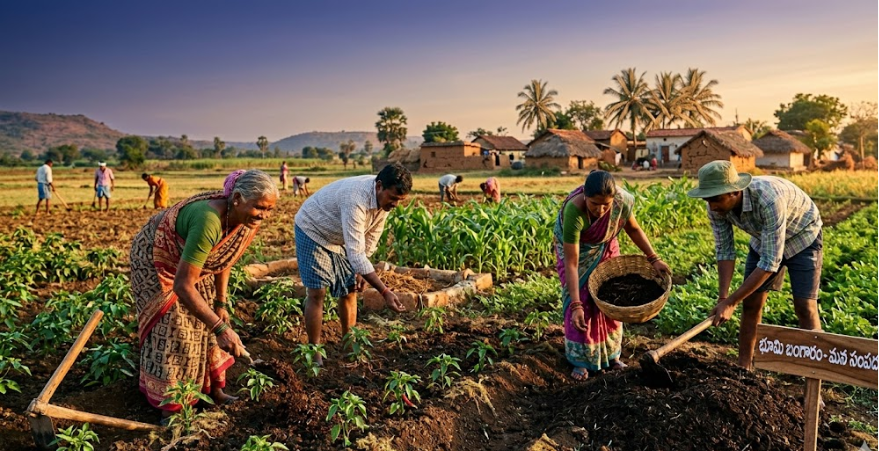
This process is known as soil carbon sequestration.
When agricultural practices improve soil health, carbon storage increases.
When soils are degraded, stored carbon is released back into the atmosphere.
In simple terms:
Healthy soil captures carbon.
Degraded soil releases it.
This makes farmers essential partners in addressing climate change.
Every field has the potential to become a carbon sink.
Every acre represents an opportunity.
Turning Carbon Into Currency
Carbon markets have created a mechanism for assigning economic value to emissions reductions.
A carbon credit typically represents one metric ton of carbon dioxide removed or prevented from entering the atmosphere.
Organizations purchase these credits to offset emissions they cannot yet eliminate.
Buyers include:
- Technology companies
- Airlines
- Manufacturers
- Energy firms
- Financial institutions
- Consumer brands
As demand for carbon offsets grows, agriculture is emerging as a major source of high-quality carbon credits.
Farmers who adopt climate-smart practices can generate measurable environmental benefits.
These benefits can be converted into tradable carbon credits.
In other words, farmers can potentially earn income from improving soil health.
For the first time in history, environmental stewardship is becoming financially rewarding.
The Rise of Carbon Farming
Carbon farming refers to agricultural practices designed to increase carbon storage in soil while improving ecosystem health.
Common practices include:
Reduced Tillage
Minimizing soil disturbance helps preserve organic matter and prevents carbon loss.
Cover Crops
Planting crops between growing seasons protects the soil and enhances carbon capture.
Crop Rotation
Diversified farming systems improve soil structure and nutrient cycling.
Agroforestry
Integrating trees with agricultural production increases long-term carbon storage.
Precision Agriculture
Technology enables efficient use of water, fertilizers, and energy.
Organic Soil Amendments
Adding compost and natural fertilizers improves microbial activity.
Managed Grazing
Rotational grazing systems can restore grasslands and increase carbon sequestration.
These approaches offer benefits beyond carbon capture.
Farmers often experience:
- Improved soil fertility
- Lower input costs
- Better water retention
- Reduced erosion
- Increased biodiversity
- Greater resilience to extreme weather
Healthy soil creates healthier economics.
Why Investors Are Paying Attention
The global transition toward net-zero emissions is creating unprecedented demand for carbon removal solutions.
Companies worldwide are setting ambitious sustainability targets.
Investors are allocating capital toward climate technologies.
Governments are introducing new environmental regulations.
Against this backdrop, agriculture presents a unique opportunity.
Unlike many industries, farming can simultaneously:
- Produce food
- Restore ecosystems
- Capture carbon
- Generate income
This combination has attracted significant interest from:
- Climate-focused investment funds
- Agritech startups
- Food companies
- Carbon marketplaces
- Financial institutions
The soil economy is rapidly evolving into a major investment category.
What was once considered an environmental issue is becoming a business opportunity.
The Economics of Soil Health
Traditional farm revenue depends heavily on crop yields and commodity prices.
Both are highly unpredictable.
Weather events, supply chain disruptions, and market volatility create significant financial uncertainty.
Carbon revenue introduces diversification.
Instead of relying solely on harvest income, farmers gain access to additional revenue streams.
The financial equation shifts from:
Food production only.
To:
Food production plus ecosystem services.
Future revenue opportunities may include:
- Carbon credits
- Biodiversity credits
- Water quality incentives
- Regenerative agriculture premiums
- Sustainable supply chain partnerships
Soil becomes more than a productive asset.
It becomes a financial asset.
This transformation could fundamentally reshape agricultural economics.
India’s Untapped Soil Wealth
India possesses one of the world’s largest agricultural ecosystems.
Millions of farmers cultivate diverse crops across varied climatic zones.
This creates enormous potential for soil-based climate solutions.
Several factors strengthen India’s position:
- Large agricultural land area
- Growing digital infrastructure
- Expanding satellite capabilities
- Government support for sustainability
- Increased interest in natural farming
Programs promoting:
- Soil health management
- Organic agriculture
- Water conservation
- Agroforestry
- Millet cultivation
can align naturally with carbon market opportunities.
However, success will depend on inclusion.
Most Indian farmers operate on small landholdings.
To unlock soil wealth at scale, collaboration will be essential through:
- Farmer producer organizations
- Cooperatives
- Digital platforms
- Public-private partnerships
The goal must be to ensure that smallholders benefit alongside large landowners.
Technology Is Unlocking the Invisible Economy
Historically, measuring soil carbon was expensive and time-consuming.
Today, technology is changing that.
Innovations include:
- Satellite imagery
- Artificial intelligence
- Remote sensing
- Internet of Things devices
- Geographic information systems
- Blockchain verification platforms
These technologies help:
- Measure carbon accurately
- Reduce verification costs
- Improve transparency
- Track environmental outcomes
- Simplify farmer participation
Data is becoming the bridge between farms and climate finance.
The future farm will generate more than crops.
It will generate environmental intelligence.
The Challenges Ahead
Despite its promise, the soil economy faces important challenges.
Measurement Complexity
Soil carbon levels vary across locations and seasons.
Verification Costs
Certification remains expensive for many farmers.
Market Volatility
Carbon prices fluctuate significantly.
Knowledge Gaps
Many farmers lack access to information and technical support.
Data Ownership
Questions remain regarding who controls agricultural data.
Equity Concerns
Smallholder farmers may struggle to participate without support.
Addressing these issues requires collaboration among:
- Governments
- Researchers
- Agritech companies
- Financial institutions
- Farmer organizations
The opportunity is enormous, but implementation matters.
Redefining the Role of Farmers
For centuries, farmers have been recognized primarily as food producers.
That definition is expanding.
Farmers are increasingly becoming:
- Climate solution providers
- Carbon managers
- Biodiversity protectors
- Water stewards
- Ecosystem restorers
This shift represents one of the most important economic transformations in agriculture.
The future value of a farm may depend not only on what grows above the ground but also on what is stored below it.
The next generation of agricultural success stories may be built on soil regeneration.
A Future Where Soil Creates Shared Prosperity
Imagine a world where:
- Healthier soils produce more nutritious food.
- Farmers earn multiple streams of income.
- Rural communities become more resilient.
- Businesses meet sustainability goals.
- Climate change mitigation accelerates.
This future is possible.
But achieving it requires a change in mindset.
We must stop treating soil as an unlimited resource.
We must start recognizing it as natural capital.
The health of our soil influences:
- Food security
- Economic growth
- Water resources
- Biodiversity
- Climate stability
Investing in soil is not simply an agricultural decision.
It is an economic strategy.
It is a climate strategy.
It is a human development strategy.
Conclusion: The Wealth Beneath Our Feet
The world’s next billion-dollar opportunity may not come from the next mobile app, cryptocurrency, or financial innovation.
It may come from restoring the very foundation of our food systems.
Healthy soil has the power to:
- Capture carbon
- Increase farm productivity
- Improve resilience
- Generate new income
- Support climate goals
The transition to a low-carbon economy is creating new markets.
Farmers have the potential to become central players in this transformation.
The soil beneath our feet is no longer just dirt.
It is infrastructure.
It is natural capital.
It is a climate solution.
And it may become one of the most valuable assets of the twenty-first century.
The question is not whether this opportunity exists.
The question is who will seize it first.
What are your thoughts?
Could soil become the next major asset class in the global economy?
How can governments, businesses, and farmers collaborate to unlock this hidden opportunity?
Share your perspective in the comments.
#SoilHealth #CarbonCredits #RegenerativeAgriculture #ClimateAction #Sustainability #Farmers #AgriTech #ESG #ClimateFinance #CarbonFarming #NetZero #FutureOfFarming #GreenEconomy #Agriculture #RuralDevelopment