
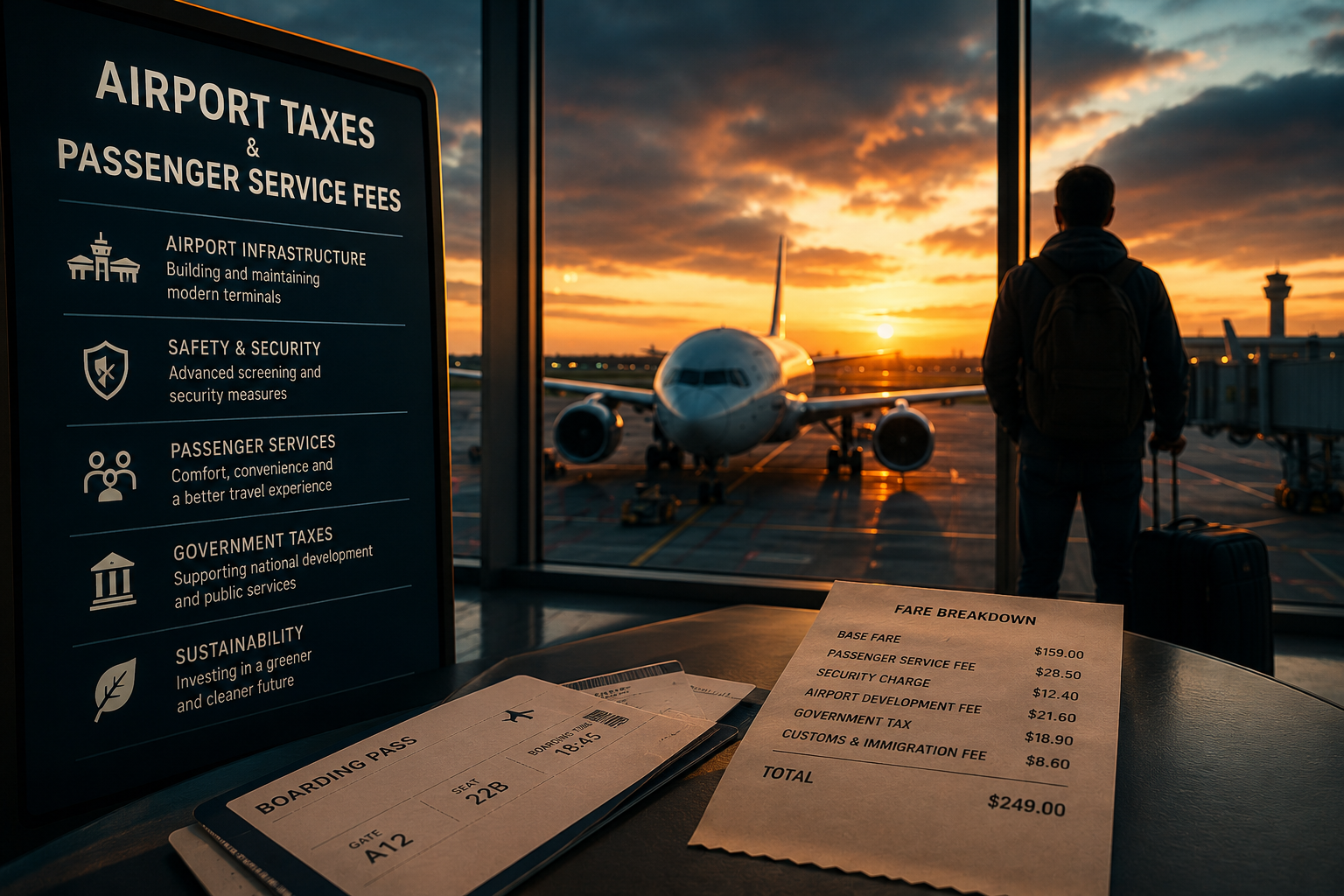
Introduction: The Price Beyond the Fare
When travelers search for flight tickets, they often focus on the base fare displayed by airlines. However, the amount paid at checkout frequently exceeds the advertised price by a significant margin.
A substantial portion of this difference comes from airport taxes, passenger service fees, security charges, and government-imposed levies.
For many passengers, these charges remain confusing. Why does a short domestic flight sometimes include higher taxes than the airfare itself? Why do fees vary between airports and countries? What exactly are travelers paying for?
Understanding the structure behind airport taxes and passenger service fees is essential for passengers, airlines, regulators, airports, and travel businesses alike.
These charges play a critical role in funding aviation infrastructure, ensuring passenger safety, improving airport facilities, and supporting national transportation systems.
As air travel continues to expand globally, transparency around these costs has become increasingly important.
What Are Airport Taxes and Passenger Service Fees?
Airport taxes and passenger service fees are mandatory charges added to the base airfare.
They are collected by airlines during ticket purchase and transferred to airports, governments, regulatory authorities, and service providers.
Unlike airline fares, which are determined by market competition, these charges are typically regulated or fixed by authorities.
Broadly, these costs fall into four categories:
- Government taxes
- Airport-imposed charges
- Security and safety fees
- Passenger service fees
The combination of these charges can account for a significant percentage of the total ticket price.
For low-cost carriers, taxes and fees may sometimes exceed the actual airfare.
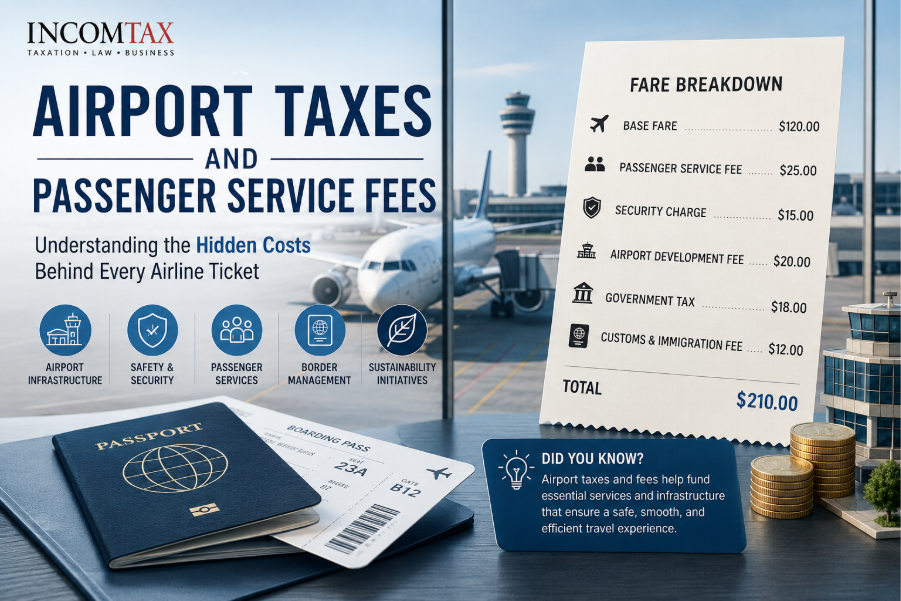
Breaking Down Common Airport Charges
1. Passenger Service Fee (PSF)
Passenger Service Fees are among the most common charges added to airline tickets.
These fees are collected to support airport operations and improve passenger facilities.
Revenue generated through PSFs is used to fund:
- Terminal maintenance
- Check-in infrastructure
- Boarding gates
- Passenger lounges
- Baggage handling systems
- Restroom maintenance
- Information displays
- Airport technology upgrades
In many countries, airports are authorized to establish PSF levels under the supervision of aviation regulators.
The amount varies depending on:
- Domestic versus international travel
- Airport category
- Passenger traffic volume
- Infrastructure investment requirements
Major international hubs generally charge higher fees due to their larger operational costs.
2. Security Charges
Modern aviation security requires significant investment.
Following major global security incidents, airports worldwide introduced dedicated security fees to fund enhanced screening measures.
These charges support:
- Passenger screening equipment
- Baggage scanning systems
- Security personnel
- Surveillance technology
- Access control systems
- Cybersecurity measures
- Emergency response capabilities
Security fees ensure compliance with international aviation standards established by organizations such as the International Civil Aviation Organization (ICAO).
As threats evolve, security investments continue to increase, making these charges a permanent component of airline tickets.
3. Airport Development Fees (ADF)
Many airports impose Airport Development Fees to finance infrastructure expansion projects.
These fees help fund:
- New terminals
- Additional runways
- Air traffic management systems
- Sustainability initiatives
- Digital transformation programs
- Capacity expansion projects
Rapid growth in passenger traffic requires airports to continuously invest in infrastructure.
Rather than relying solely on government funding, airports often recover these costs directly from users through ADFs.
Passengers using newly modernized airports frequently contribute to the repayment of infrastructure investments through these fees.
4. Government Aviation Taxes
Governments impose aviation-related taxes for various purposes.
Examples include:
- Value Added Tax (VAT)
- Goods and Services Tax (GST)
- Tourism taxes
- Environmental levies
- Departure taxes
- Customs and immigration fees
Unlike airport charges, these taxes generate government revenue and may not necessarily be reinvested into aviation infrastructure.
Tax rates differ significantly across jurisdictions.
Some countries promote tourism by reducing aviation taxes, while others use higher taxes to generate revenue or support environmental initiatives.
5. Customs, Immigration, and Border Control Fees
International passengers often pay fees associated with border management services.
These charges help fund:
- Immigration officers
- Customs inspections
- Border security systems
- Biometric verification technologies
- Health screening procedures
These fees ensure efficient and secure cross-border movement of passengers.
As travel volumes increase, governments continue investing in digital border management technologies funded partly through these charges.
Why Do Airport Taxes Differ Between Countries?
One of the most common questions travelers ask is why taxes vary dramatically across destinations.
Several factors influence airport charges.
Infrastructure Investment Levels
Airports undergoing expansion or modernization often impose higher fees to recover capital expenditures.
Regulatory Models
Some countries tightly regulate airport charges, while others allow airports greater flexibility.
Passenger Volume
High-traffic airports can spread costs across larger passenger numbers, potentially reducing per-passenger fees.
Smaller regional airports may charge higher fees to cover operating expenses.
Economic Policies
Governments may use aviation taxes to:
- Promote tourism
- Generate public revenue
- Encourage sustainable travel
- Support regional connectivity
Security Requirements
Airports facing elevated security risks typically incur higher operational costs.
These costs are often reflected in passenger fees.
The Impact on Airlines and Ticket Pricing
Airlines act primarily as collection agents for airport charges and government taxes.
Most fees are outside the airline’s control.
When passengers compare fares, it is important to distinguish between:
- Base airfare
- Carrier-imposed surcharges
- Government taxes
- Airport fees
Low-cost carriers often advertise very low base fares, but mandatory taxes and airport charges can substantially increase the final ticket price.
For example:
- Promotional fare: $20
- Airport taxes: $35
- Security charges: $10
- Passenger service fee: $15
Final ticket price: $80
This pricing structure frequently creates confusion among travelers.
Greater transparency in fare breakdowns helps passengers understand exactly where their money goes.
The Debate Around Transparency
Consumer advocacy groups have long argued for clearer disclosure of taxes and fees.
Passengers deserve visibility into:
- Which charges are imposed by airlines
- Which charges are mandated by governments
- Which charges are collected on behalf of airports
Transparent pricing helps consumers:
- Compare travel options effectively
- Make informed decisions
- Understand refund eligibility
- Identify non-refundable charges
Regulators in many jurisdictions now require airlines to display the total ticket price upfront.
However, the complexity of aviation charges continues to create confusion.
Improved standardization and clearer terminology could enhance consumer trust.
Are Airport Taxes Refundable?
Many passengers are unaware that certain airport taxes may be refundable if they do not travel.
When a passenger cancels a flight before departure, some unused taxes and fees can potentially be reclaimed.
Refund eligibility depends on:
- Airline policy
- Local regulations
- Type of charge
- Timing of cancellation
Generally, refundable items may include:
- Passenger service fees
- Airport taxes
- Security charges
- Departure taxes
Non-refundable amounts often include:
- Airline service charges
- Booking fees
- Administrative fees
Passengers should carefully review fare rules and applicable regulations before requesting refunds.
In some cases, refund processing fees may reduce the amount recovered.
Sustainability and the Future of Aviation Charges
Environmental concerns are reshaping aviation economics.
Many governments are introducing environmental taxes aimed at reducing carbon emissions.
Examples include:
- Carbon offset charges
- Sustainable aviation fuel contributions
- Emissions trading costs
- Green airport initiatives
Airports are increasingly investing in:
- Renewable energy systems
- Electric ground vehicles
- Energy-efficient terminals
- Sustainable infrastructure
Funding for these initiatives may increasingly come from passenger fees.
The challenge for policymakers lies in balancing sustainability goals with affordable air travel.
Excessive taxation could reduce accessibility, while insufficient funding may delay environmental progress.
The future of airport charges will likely focus on achieving both objectives.
Digital Transformation and Fee Modernization
Technology is changing how airport charges are managed and collected.
Digital innovations include:
- Automated fee collection systems
- Biometric passenger processing
- Smart airport infrastructure
- Real-time cost analytics
- Contactless payment platforms
Advanced data analytics allow airports to optimize resource allocation and improve operational efficiency.
As airports become smarter, fee structures may evolve toward more dynamic pricing models.
Future charges could potentially vary based on:
- Peak travel periods
- Terminal usage
- Passenger preferences
- Environmental impact
Digital transformation will likely improve transparency and provide travelers with clearer insights into ticket costs.
Recommendations for Travelers
Passengers can better manage travel costs by following several practical strategies.
Review Fare Breakdowns Carefully
Always examine the detailed fare summary before completing a booking.
Compare Nearby Airports
Different airports may have significantly different fee structures.
Understand Refund Policies
Review airline cancellation policies and determine which taxes may be refundable.
Book Early
Early bookings often provide greater flexibility and lower overall costs.
Monitor Regulatory Changes
New environmental taxes and airport development fees can affect ticket prices.
An informed traveler is better equipped to make cost-effective decisions.
Conclusion
Airport taxes and passenger service fees are essential components of the global aviation ecosystem.
While these charges can increase ticket prices, they serve critical purposes.
They fund:
- Airport infrastructure
- Passenger services
- Security operations
- Border control systems
- Environmental initiatives
As airports evolve and passenger expectations rise, these fees will continue to play an important role in maintaining safe, efficient, and sustainable air transportation.
However, transparency remains equally important.
Passengers deserve a clear understanding of what they are paying for and why.
For airlines, airports, and regulators, building trust through transparent pricing and effective communication will be essential in the future of air travel.
The next time you book a flight, remember that the fare is only part of the story.
Behind every ticket lies a complex network of taxes, fees, infrastructure investments, and services that make modern aviation possible.
What are your thoughts?
Do you believe airport taxes and passenger service fees are justified, or should airlines and governments simplify the fee structure for travelers?
Share your perspective in the comments.
#Aviation #AirTravel #AirportTaxes #PassengerServiceFee #TravelIndustry #Airports #AirlineIndustry #PassengerRights #AviationEconomics #TravelManagement #AviationLaw #Infrastructure #DigitalTransformation #SustainableAviation #ConsumerProtection