
In every constitutional democracy, taxation is far more than a financial mechanism used by governments to raise revenue. It is one of the most powerful expressions of state authority over citizens. Through taxation, the state gains access to the wealth, labor, earnings, property, and economic activities of individuals and businesses. Because this power directly affects the lives, freedoms, and economic stability of the people, democratic societies insist upon one fundamental principle:
Decisions regarding taxes must originate from elected representatives who are accountable to the public.
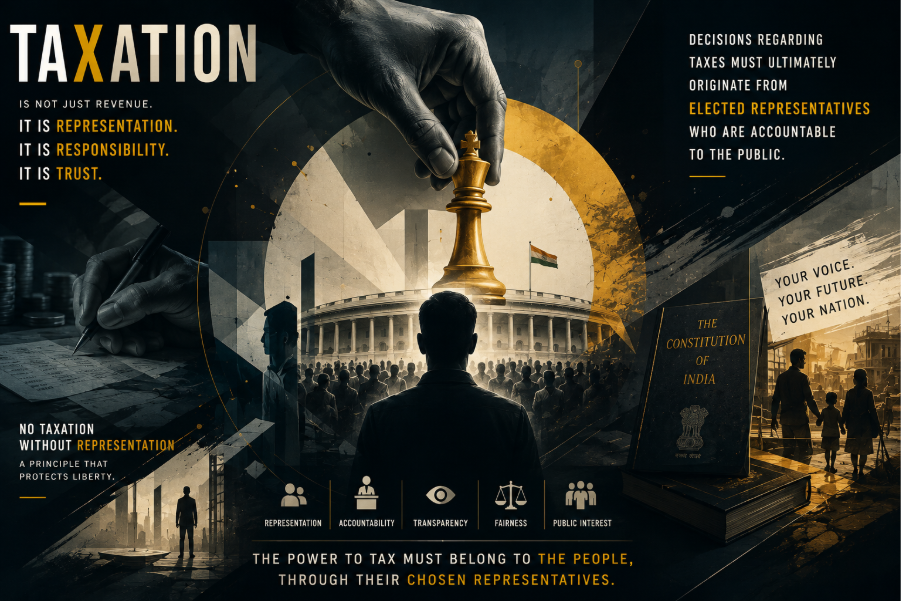
This principle is not merely procedural—it is foundational to democracy itself. It ensures that governments remain servants of the people rather than financial rulers over them. It preserves constitutional order, limits arbitrary state power, protects economic liberty, and strengthens public trust in governance.
Without democratic accountability in taxation, the relationship between citizens and the state can quickly become exploitative. History repeatedly demonstrates that unchecked taxation often leads to political unrest, economic inequality, abuse of power, and erosion of liberty.
Taxation: The Most Sensitive Power of the State
Governments possess many powers:
- The power to regulate
- The power to enforce laws
- The power to punish crimes
- The power to administer public services
But among all governmental powers, taxation occupies a unique position because it directly extracts resources from citizens.
Every tax imposed affects:
- Household savings
- Business growth
- Investments
- Consumption
- Employment
- Property ownership
- Entrepreneurship
- Economic mobility
When the government imposes taxes, it essentially claims a portion of the citizen’s earnings or wealth for public purposes. Because this involves compulsory contribution, constitutional democracies require strict legal and democratic safeguards.
The state cannot simply decide to collect money because it desires additional revenue. Taxation must derive legitimacy from the consent of the governed, expressed through elected institutions.
Democracy and Consent in Taxation
The idea that citizens must consent to taxation lies at the heart of democratic governance.
In democratic systems:
- Citizens elect representatives
- Representatives debate fiscal policies
- Legislatures approve tax laws
- Governments implement those laws
- Citizens retain the power to vote governments out
This cycle creates accountability.
Taxation becomes legitimate not because the government is powerful, but because the people, through their representatives, have authorized it.
This distinction is critical.
An authoritarian government may impose taxes through sheer force. A constitutional democracy imposes taxes through public consent expressed via representative institutions.
That is the difference between power and legitimacy.
“No Taxation Without Representation”: A Principle That Changed the World
One of history’s most influential constitutional principles emerged from opposition to unjust taxation.
The phrase:
“No Taxation Without Representation”
became a revolutionary political doctrine during the 18th century when American colonists opposed taxes imposed by the British Crown without representation in Parliament.
The colonists argued that:
- Taxes imposed without representation violate liberty
- Citizens must have a voice in financial governance
- Economic burdens require democratic approval
This idea eventually transformed constitutional systems across the world.
Today, democratic nations universally recognize that tax laws must originate from representative legislative bodies rather than unilateral executive authority.
The historical lesson remains relevant:
When governments tax people without democratic accountability, conflict and instability follow.
Constitutional Foundations of Taxation
Modern constitutions impose strict limitations on the taxation power of the state.
In constitutional democracies, taxation generally requires:
- Legislative authorization
- Clear statutory basis
- Defined procedures
- Public accountability
- Judicial oversight
For instance, constitutional principles such as Article 265 in India establish:
“No tax shall be levied or collected except by authority of law.”
This sentence may appear simple, but it contains enormous constitutional significance.
It means:
- Taxes cannot arise from administrative wishes
- Executive authorities cannot create taxes arbitrarily
- Revenue collection requires legislative approval
- Citizens are protected from unauthorized financial burdens
The Constitution therefore acts as a shield between citizens and arbitrary fiscal power.
Why Elected Representatives Matter in Tax Policy
Elected representatives serve as the democratic link between state authority and public interest.
Because lawmakers depend on public support, they are expected to consider:
- Economic impact
- Social fairness
- Business confidence
- Public welfare
- Political consequences
- Long-term national development
This accountability creates restraint.
When governments propose excessive or unfair taxation:
- Opposition parties challenge it
- Public debate emerges
- Media scrutiny increases
- Citizens express dissent
- Elections create consequences
Thus, representative democracy forces taxation decisions into the public domain instead of allowing them to remain hidden within administrative systems.
The Dangers of Taxation Without Accountability
If unelected authorities possessed unrestricted taxation powers, several dangers could emerge.
1. Arbitrary Financial Burdens
Without legislative control, governments could impose unpredictable taxes that disrupt economic stability and individual freedom.
2. Abuse of Power
Taxation could become a political weapon used selectively against opponents, businesses, or specific communities.
3. Economic Uncertainty
Businesses require predictable tax systems for investment and growth. Arbitrary taxation discourages entrepreneurship and innovation.
4. Decline of Public Trust
Citizens lose confidence in institutions when taxes appear unfair, excessive, or politically motivated.
5. Expansion of Unchecked Government Power
History shows that governments with uncontrolled financial authority often expand their control over society.
Democratic oversight prevents these risks by ensuring that taxation remains transparent and accountable.
Taxation and the Social Contract
Political philosophers such as John Locke argued that governments derive legitimacy from the consent of the governed.
Under social contract theory:
- Citizens surrender limited freedoms
- Governments agree to protect rights and serve public welfare
- State powers remain limited by law
Taxation represents one of the clearest examples of this contract.
Citizens agree to contribute financially for:
- Roads
- Healthcare
- Education
- National security
- Public infrastructure
- Welfare systems
- Judicial administration
However, this contribution is justified only when taxation operates within constitutional and democratic boundaries.
Once governments begin taxing without accountability, the social contract weakens.
Economic Impact of Democratic Taxation
Stable economies depend heavily on predictable and transparent tax systems.
When taxes are enacted through democratic procedures:
- Investors gain confidence
- Businesses can plan long-term
- Markets remain stable
- Economic participation increases
- Public cooperation improves
Democratic tax systems also encourage legitimacy.
Citizens are more likely to comply with taxation when they believe:
- Laws are fair
- Revenue serves public purposes
- Decision-makers are accountable
- Fiscal policies were openly debated
Thus, democratic taxation strengthens both governance and economic growth.
The Role of Parliament and Legislatures
Legislatures are not merely law-making bodies; they are guardians of financial accountability.
Their fiscal responsibilities include:
- Reviewing tax proposals
- Debating economic consequences
- Protecting citizens from excessive burdens
- Monitoring government spending
- Authorizing public revenue collection
Public legislative debates also ensure transparency.
Citizens can:
- Observe discussions
- Evaluate arguments
- Understand policy reasoning
- Hold leaders accountable
This transparency is essential in preventing misuse of public power.
The Difference Between Administration and Legislation
Tax officers and administrative agencies play an important role in implementing tax laws. However, implementation is fundamentally different from lawmaking.
Administrative authorities may:
- Collect taxes
- Enforce compliance
- Conduct audits
- Interpret statutes
- Administer procedures
But they should not independently create new taxes without legislative authorization.
This distinction protects democracy.
Otherwise, citizens could become subject to financial obligations created by officials who were never elected by the public.
Judicial Protection Against Arbitrary Taxation
Courts serve as constitutional guardians against unlawful taxation.
Judicial review ensures that:
- Tax laws comply with constitutional provisions
- Governments remain within legal limits
- Administrative excesses are controlled
- Citizens’ rights are protected
When authorities attempt to collect taxes without valid legal backing, courts possess the authority to invalidate such actions.
This creates a system of checks and balances among:
- Legislature
- Executive
- Judiciary
Such balance is essential for constitutional governance.
Taxation and Ethical Governance
Taxation is not merely legal—it is ethical and political.
Citizens willingly contribute to the state when they believe:
- The system is fair
- Public funds are used responsibly
- Corruption is minimized
- Decision-makers remain accountable
Fair taxation strengthens national unity because citizens view taxation as participation in collective progress rather than forced extraction.
This ethical legitimacy can only exist when tax decisions arise from democratic representation.
Public Participation and Fiscal Legitimacy
Representative taxation also promotes public participation in governance.
Citizens influence tax policy through:
- Elections
- Public debate
- Political campaigns
- Parliamentary representation
- Civic engagement
This participation creates legitimacy.
When people feel included in fiscal decision-making, they develop greater trust in institutions and stronger commitment to constitutional democracy.
Modern Challenges in Tax Governance
In the modern era, taxation has become increasingly complex due to:
- Globalization
- Digital economies
- International trade
- Corporate taxation
- Technology-driven commerce
Despite this complexity, the foundational democratic principle remains unchanged:
The authority to impose taxes must remain accountable to the people.
Even advanced fiscal systems cannot justify bypassing democratic oversight.
Efficiency can never replace legitimacy.
The Constitutional Philosophy Behind Democratic Taxation
The deeper constitutional philosophy is simple:
The government does not own the wealth of citizens.
Rather, citizens agree—through democratic processes—to contribute part of their resources for public welfare under laws enacted by representatives they elect.
This philosophy transforms taxation from coercion into constitutional governance.
It ensures that the state remains accountable to the people from whom it derives authority.
Conclusion
The principle that tax decisions must originate from elected representatives is one of democracy’s greatest safeguards against arbitrary power.
It protects:
- Liberty
- Economic freedom
- Constitutional order
- Public accountability
- Democratic legitimacy
Taxation affects every citizen, every business, and every aspect of national life. Therefore, the authority to impose taxes cannot rest solely with administrators, executives, or unelected institutions.
It must remain rooted in representative democracy.
When elected representatives debate and authorize taxation, the system reflects public consent, constitutional discipline, and democratic accountability. This process ensures that the power to tax serves collective welfare rather than unchecked state authority.
Ultimately, taxation is not merely about government revenue.
It is about the relationship between citizens and the state.
And in a true democracy, that relationship must always be governed by representation, accountability, and the rule of law.