
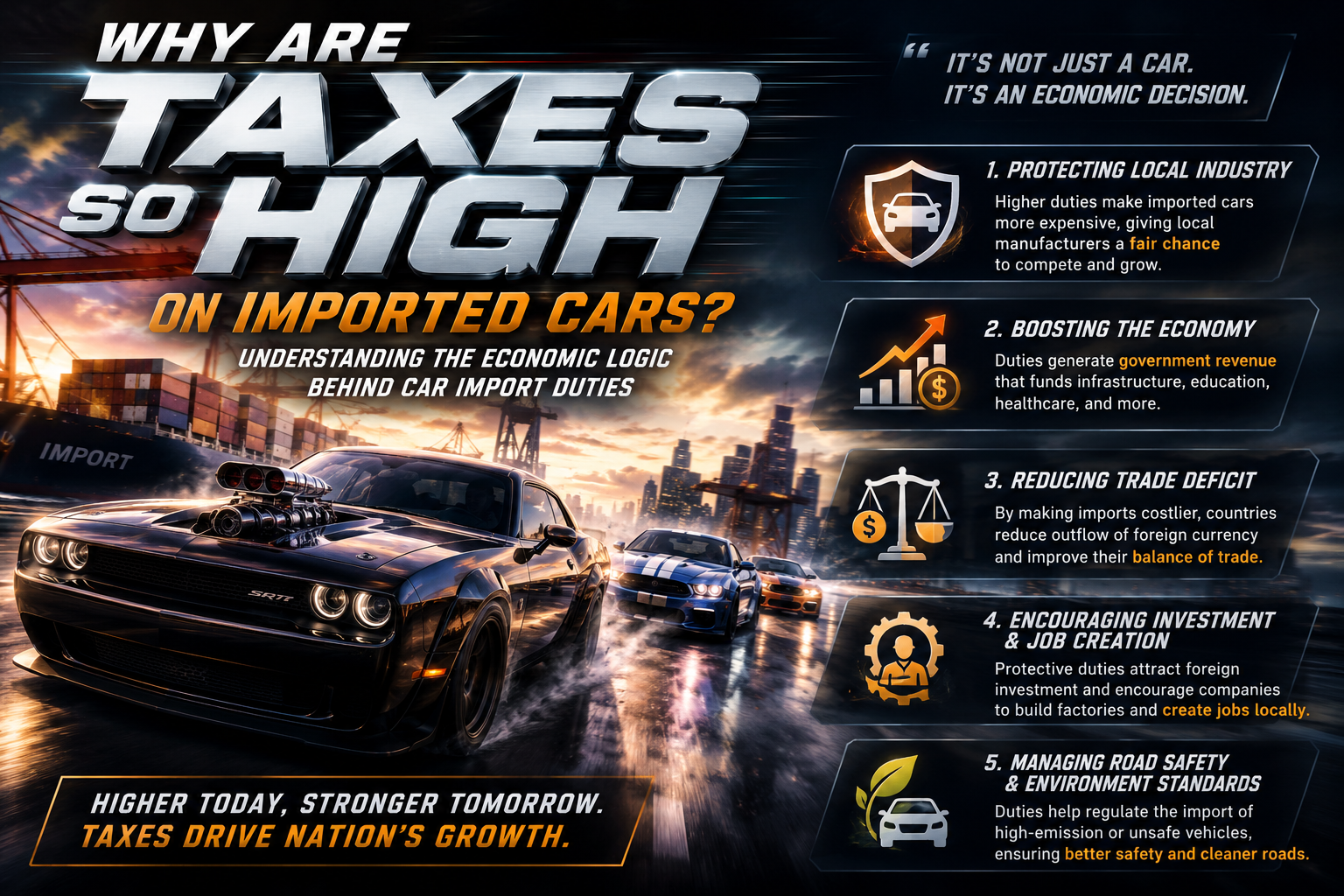
Understanding the Economic Logic Behind Car Import Duties
Every automobile enthusiast has wondered at some point:
“Why does a car that costs ₹30 lakhs abroad become ₹70 lakhs or more after entering another country?”
The answer lies in taxation, economic policy, industrial protection, and national development strategies. Imported cars are not taxed heavily without reason. Behind every import duty is a broader vision connected to employment, domestic manufacturing, revenue generation, and economic stability.
As consumers, we often focus only on the final price tag. But from a government’s perspective, imported vehicle taxation serves multiple strategic purposes.

The Concept of Imported Cars
Imported cars are vehicles manufactured in foreign countries and brought into another nation for sale or personal use.
These imports are generally categorized into:
1. Completely Built Units (CBUs)
Vehicles manufactured entirely abroad and imported in finished form.
2. Completely Knocked Down (CKD) Units
Vehicles imported in parts and assembled locally.
Most governments impose significantly higher taxes on CBUs because they provide fewer domestic economic benefits compared to locally assembled vehicles.
Protecting Domestic Automobile Industries
One of the primary reasons governments impose high taxes on imported cars is to protect domestic automobile manufacturers.
Without import duties:
- Foreign brands could dominate the market
- Local manufacturers might struggle to survive
- Domestic industries could weaken over time
Import taxes create a level of protection that allows local automobile companies to grow, compete, and invest in long-term manufacturing capabilities.
Countries aiming for industrial self-reliance often use taxation as a strategic economic tool rather than merely a revenue mechanism.
Encouraging Local Manufacturing and Employment
High import taxes encourage global automobile companies to establish manufacturing plants within the country instead of exporting fully built vehicles.
This creates: ✔ Employment opportunities ✔ Local supply chains ✔ Technology transfer ✔ Infrastructure development ✔ Industrial growth
Initiatives like “Make in India” are heavily supported by such taxation policies. Governments prefer foreign companies to manufacture domestically because it strengthens the national economy and creates large-scale employment.
When global automobile brands establish factories locally, thousands of direct and indirect jobs are generated across:
- Manufacturing
- Logistics
- Engineering
- Sales
- Maintenance
- Spare parts industries
Thus, import taxation indirectly supports economic development.
Revenue Generation for National Development
Imported luxury vehicles are considered premium goods, and governments often use them as significant sources of revenue.
Several layers of taxes may apply:
- Customs Duty
- GST/VAT
- Luxury Tax
- Road Tax
- Registration Charges
- Compensation Cess
These revenues contribute to:
- Public infrastructure
- Healthcare
- Transportation systems
- Welfare schemes
- National development programs
In many developing economies, taxation on luxury imports becomes an important fiscal instrument.
Controlling Foreign Exchange Outflow
When a country imports cars, foreign currency flows out to international manufacturers.
Excessive imports can:
- Affect foreign exchange reserves
- Increase trade deficits
- Put pressure on the domestic currency
By imposing higher import duties, governments discourage unnecessary imports and encourage domestic production.
This helps maintain economic stability and protects the nation’s financial balance.
Luxury Consumption and Taxation Philosophy
Imported luxury cars are often categorized as non-essential or premium consumption goods.
Governments sometimes follow the principle:
“Those with greater purchasing power can contribute more through taxation.”
This concept is linked to economic equity.
The logic is:
- Essential goods should remain affordable
- Luxury consumption can bear higher taxation
As a result, premium imported vehicles attract higher duties compared to budget-friendly or locally manufactured vehicles.
Environmental and Sustainability Factors
Modern taxation policies are also influenced by environmental concerns.
Some imported vehicles:
- Have larger engines
- Consume more fuel
- Produce higher emissions
Governments increasingly use taxation to:
- Promote electric vehicles
- Encourage fuel efficiency
- Reduce carbon emissions
- Support sustainable transportation
This is why many countries provide tax benefits for EVs while maintaining higher duties on fuel-intensive luxury imports.
The Consumer Perspective
From a consumer’s point of view, high import taxes can feel restrictive.
Challenges include:
- Higher vehicle prices
- Limited affordability
- Reduced access to global automotive innovation
- Fewer luxury options
Many automobile enthusiasts argue that excessive taxation limits competition and delays technological advancement in domestic markets.
There is also an ongoing debate about finding the right balance between protectionism and open-market competition.
Striking the Right Balance
Governments constantly attempt to balance:
- Economic growth
- Consumer interests
- Industrial development
- Employment generation
- Environmental sustainability
- Revenue needs
The objective is not simply to make imported cars expensive. Instead, taxation becomes part of a larger national economic strategy.
A strong domestic automobile sector can contribute significantly to GDP, exports, innovation, and long-term economic resilience.
Final Thoughts
Taxes on imported cars are far more than simple financial barriers. They reflect a nation’s economic priorities, industrial policies, and long-term development goals.
While consumers may see only the increased price, governments often see:
- Employment opportunities
- Industrial growth
- Economic protection
- Revenue generation
- National self-reliance
In today’s interconnected world, automobile taxation represents the intersection of economics, policy, industry, and national interest.
Understanding the reasoning behind these taxes helps us view the issue not just as consumers — but also through the lens of governance and economic planning.
#AutomobileIndustry #ImportedCars #Economics #Taxation #MakeInIndia #PublicPolicy #Business #Automotive #EconomicDevelopment #LuxuryCars #GlobalTrade #Industry #LinkedInArticles