
Introduction
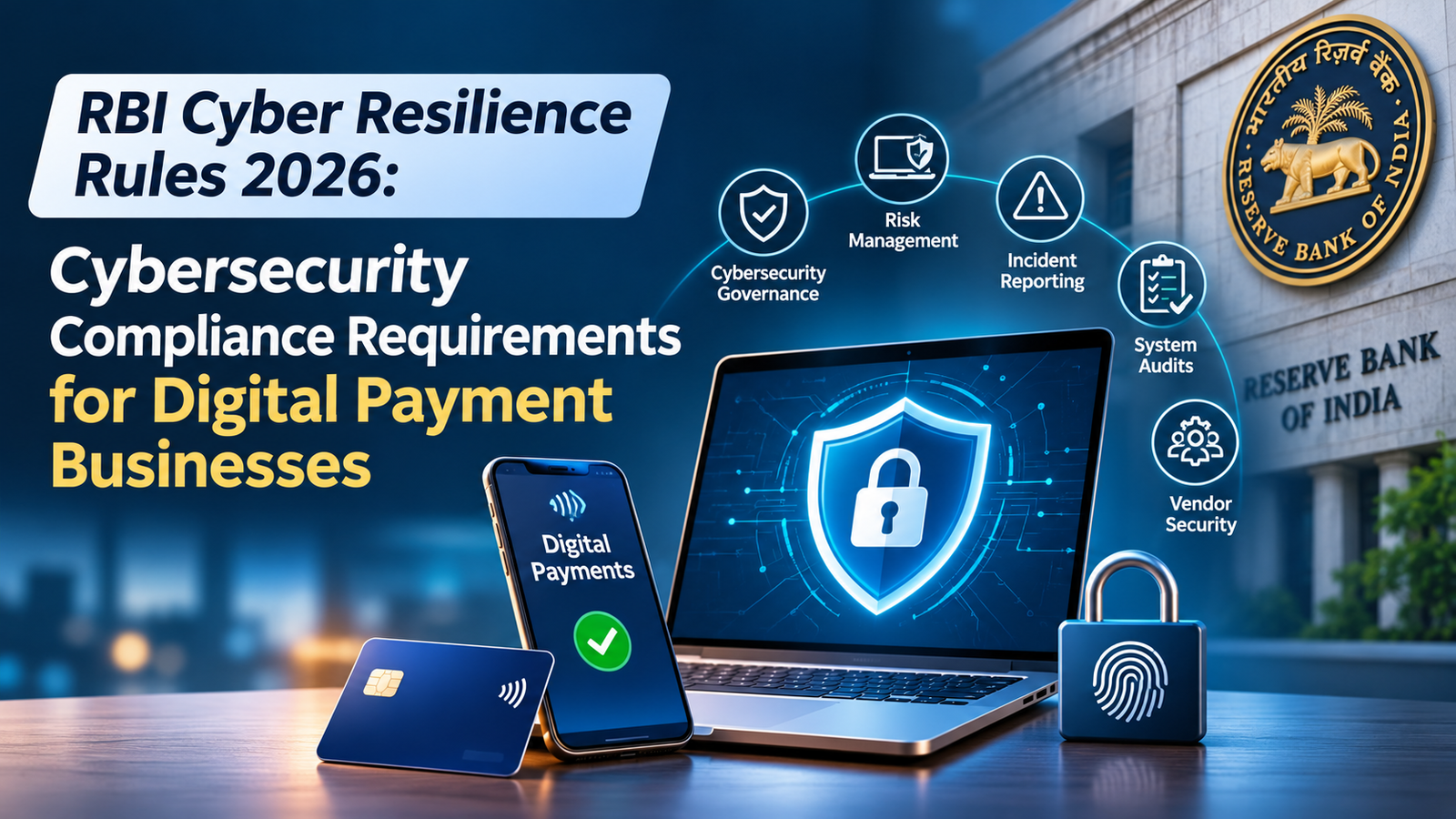
RBI Cyber Resilience is an important part of India’s digital payment security framework. The Reserve Bank of India (RBI) issued new cybersecurity directions on 5 November 2026 for authorised non-bank Payment System Operators. These directions introduce requirements for cybersecurity governance, risk management, incident reporting and digital payment security.
However, the growth of digital payments also increases cybersecurity risks. Payment operators must protect customer information, prevent fraud and maintain secure payment systems.
To strengthen digital payment security, the Reserve Bank of India (RBI) issued new Master Directions on Cyber Resilience and Digital Payment Security Controls on 5 November 2026.
These directions introduce stronger cybersecurity requirements for authorised non-bank Payment System Operators (PSOs). They cover security governance, incident reporting, system audits, vendor management and digital payment protection.
The RBI Cyber Resilience Rules 2026 are particularly important for payment aggregators, prepaid payment instrument issuers, card networks and other authorised non-bank payment operators.
This article explains the new RBI directions, their applicability, important cybersecurity requirements and the steps payment operators should take to maintain compliance.
1. What Are the RBI Cyber Resilience Rules 2026?
The RBI Cyber Resilience Rules 2026 refer to the Master Directions on Cyber Resilience and Digital Payment Security Controls for non-bank Payment System Operators.
The RBI issued these directions on 5 November 2026.
The main objective is to strengthen the security of digital payment systems. The directions also bring earlier cybersecurity instructions together into one regulatory framework.
The new framework focuses on several important areas:
- Cybersecurity governance.
- Information security policies.
- Technology risk management.
- Digital payment security.
- Cyber incident reporting.
- Third-party vendor security.
- System audits.
- Business continuity and disaster recovery.
These requirements help payment operators identify security risks and respond to cyber threats.
The directions are issued under Sections 10(2) and 18 of the Payment and Settlement Systems Act, 2007.
2. Who Must Follow the New RBI Cybersecurity Directions?
The directions apply to all authorised non-bank Payment System Operators.
These organisations operate or support payment systems in India.
Examples include:
- Payment aggregators.
- Prepaid Payment Instrument (PPI) issuers.
- Card payment networks.
- White Label ATM Operators.
- Other authorised non-bank payment system operators.
The requirements also address risks arising from third-party service providers and vendors connected to payment systems.
For example, a payment operator may use an external payment gateway or technology provider. It must address relevant cybersecurity risks arising from that relationship.
However, the directions do not automatically apply to every merchant or business that accepts online payments.
Organisations should first determine whether they fall within the RBI’s definition of an authorised non-bank PSO.
3. RBI Cyber Resilience Rules 2026: Important Compliance Dates
The RBI has provided different implementation timelines based on the size of the payment operator.
Important Dates
| Particulars | Compliance timeline |
|---|---|
| RBI Master Directions issued | 5 November 2026 |
| Large non-bank PSOs | Effective from RBI website publication |
| Medium non-bank PSOs | Effective from RBI website publication |
| Small non-bank PSOs | 1 April 2028 |
Large and medium operators must prepare for the requirements immediately from the applicable commencement date.
Small operators have additional time to implement the framework.
Therefore, each organisation should confirm its classification and applicable compliance timeline before preparing its implementation plan.
4. Key Cybersecurity Requirements Under the New RBI Directions
The RBI has introduced requirements covering governance, technology security and operational risk management.
Payment operators should review the following areas.
1. Stronger Cybersecurity Governance
The Board of Directors must oversee information security risks.
This includes cyber risks and the organisation’s ability to respond to security incidents.
The Board may delegate primary oversight to a specialised committee.
However, the committee must be headed by a member with relevant information security or cybersecurity experience.
It must also meet at least once every quarter.
2. Information Security Policy
Payment operators must establish a Board-approved Information Security Policy.
The policy should explain how the organisation identifies, assesses and manages information security risks.
It should also define the responsibilities of:
- Board members.
- Senior management.
- Information security teams.
- Other key employees.
- Relevant stakeholders.
The policy must be reviewed annually.
3. Cyber Crisis Management Plan
Payment operators must prepare a separate Cyber Crisis Management Plan (CCMP).
This plan should explain how the organisation will respond to cyber threats and attacks.
It should cover three important stages:
- Detecting security incidents.
- Containing and responding to attacks.
- Recovering affected systems and services.
A clear response plan helps organisations reduce disruption and restore critical operations.
4. Risk Assessment and Monitoring
Payment operators must continuously assess their cybersecurity position.
They should identify potential risks before those risks affect payment services.
The RBI directions also require appropriate Key Risk Indicators (KRIs) and Key Performance Indicators (KPIs).
These indicators help organisations monitor risk events and measure the effectiveness of security controls.
5. Digital Payment Security and Authentication Requirements
Digital payment systems handle sensitive customer and transaction information.
Therefore, payment operators must establish strong authentication and transaction monitoring controls.
Multi-Factor Authentication
The directions require multi-factor authentication for electronic payment transactions involving account debits, except where specifically permitted or relaxed.
This adds another layer of security to payment transactions.
Real-Time Fraud Monitoring
Payment operators must maintain real-time or near-real-time fraud monitoring solutions.
These systems should identify suspicious transaction patterns and generate alerts.
For example, repeated unusual transactions may indicate possible fraud.
An effective monitoring system helps operators investigate suspicious activity quickly.
Customer Fraud Reporting
Payment operators must provide a facility through their website or mobile application.
Customers should be able to identify or mark fraudulent transactions after appropriate authentication.
The system should support immediate notification to the relevant payment instrument issuer.
Secure Payment Notifications
Payment notifications should protect confidential information.
For example, account and card numbers should be masked to the extent possible.
Transaction messages should also provide relevant details, such as the merchant name and payment amount.
6. Six-Hour Cyber Incident Reporting Requirement
One important requirement under the RBI Cyber Resilience Rules 2026 relates to incident reporting.
Payment operators must report specified unusual incidents to the RBI within six hours of detection.
These incidents may include:
- Cyberattacks.
- Outages of critical systems or infrastructure.
- Internal fraud.
- Settlement delays.
- Other specified unusual incidents.
The report must follow the prescribed Incident Reporting Format.
Cybersecurity incidents must also be reported to CERT-In in accordance with applicable requirements.
Why Is the Six-Hour Reporting Requirement Important?
Quick reporting helps regulators understand the impact of security incidents.
It also supports timely investigation and corrective action.
Payment operators should establish a clear internal reporting process.
Their employees must know whom to contact when they identify a security incident.
A well-defined process can reduce reporting delays.
7. Third-Party Vendor and Technology Risk Management
Payment operators often depend on external technology providers.
These providers may include payment gateways, software developers, cloud service providers and other vendors.
However, third-party connections can introduce additional cybersecurity risks.
The RBI directions require payment operators to establish appropriate vendor risk controls.
Important measures include:
- Reviewing vendor security practices.
- Assessing third-party technology risks.
- Protecting internal networks from vendor environments.
- Reviewing vendor access permissions.
- Checking security controls for critical vendors.
- Obtaining independent audit assurance where required.
Payment operators must also establish an appropriate organisational policy approved by the Board.
The policy should address cybersecurity requirements for relevant third-party entities, subject to mutual agreement.
Therefore, vendor management should become part of the organisation’s regular security review process.
8. System Audits and Security Testing
Regular security testing helps identify weaknesses before attackers can exploit them.
The RBI directions require payment operators to conduct security testing of their applications.
This may include:
- Source code reviews.
- Vulnerability Assessments (VA).
- Penetration Testing (PT).
- Application security testing.
- Infrastructure security reviews.
Applications must undergo rigorous security testing at least annually through qualified professionals.
The directions also require system audit reports to be submitted annually within two months of the financial year-end.
For organisations following an April-to-March financial year, the system audit report should be submitted by 1 June.
The audit must be conducted by eligible professionals, such as CERT-In empanelled auditors, registered CISA professionals or holders of the specified DISA qualification.
Corrective Action After an Audit
An audit may identify security weaknesses or compliance gaps.
Payment operators must prepare corrective action plans.
Open audit observations must be addressed within the prescribed time limits.
The RBI directions specify a maximum period of three months for corrective action on each open observation.
This helps organisations improve their security controls continuously.
9. Data Security and Customer Information Protection
Payment operators handle sensitive financial and personal information.
Therefore, protecting customer data is a major part of the new framework.
The RBI directions require suitable measures to protect data confidentiality, integrity and availability.
Important security practices include:
- Encrypting data in transit and at rest.
- Maintaining access controls.
- Monitoring sensitive data access.
- Preventing unauthorised data transfers.
- Maintaining appropriate data security policies.
- Protecting information stored with vendors.
- Testing data backups regularly.
Payment operators that store card information must also follow applicable PCI-DSS requirements and obtain the prescribed certification.
Proper data security reduces the risk of information theft and unauthorised access.
10. Business Continuity and Disaster Recovery
Cyberattacks and system failures can interrupt payment services.
Therefore, payment operators must prepare for unexpected disruptions.
The RBI directions require a Business Continuity Plan (BCP).
This plan should explain how the organisation will continue or restore critical services after a disruption.
Important requirements include:
Regular BCP reviews: The plan must be reviewed at least once every year.
Disaster recovery facility: The Disaster Recovery facility must be located in a different seismic zone from the Primary Data Centre.
Regular DR drills: Disaster Recovery drills must be conducted at least half-yearly.
Recovery planning: Organisations should define Recovery Time Objectives (RTO) and Recovery Point Objectives (RPO).
Data reconciliation: The recovery process should ensure that payment records are not lost when services resume.
These measures help organisations maintain payment service availability during emergencies.
11. Mobile Payment and Customer Protection Requirements
The new directions also introduce specific security controls for mobile payment services.
Payment operators providing or facilitating mobile payment transactions must review their application security practices.
Important requirements include:
- Secure mobile application sessions.
- Device binding and fingerprinting.
- Automatic session termination after inactivity.
- Controls for repeated failed authentication attempts.
- Notifications for failed login attempts.
- Controls against remote access applications, to the extent possible.
Twelve-Hour Cooling Period
The directions also introduce an important safeguard for customers.
When the registered mobile number or email address linked to a payment instrument changes, a minimum cooling period of 12 hours must apply before online payment transactions are allowed through the relevant channels.
This measure helps reduce the risk of unauthorised transactions following changes to customer contact details.
Payment operators should review their authentication and transaction systems to implement the applicable requirement.
12. RBI Cyber Resilience Compliance Checklist for Payment Operators
Payment operators can use the following checklist to review their cybersecurity readiness.
- Confirm the organisation’s PSO classification.
- Identify the applicable implementation date.
- Review the Board-approved Information Security Policy.
- Establish a Cyber Crisis Management Plan.
- Assign cybersecurity responsibilities to senior management.
- Conduct regular cyber risk assessments.
- Implement multi-factor authentication where required.
- Establish real-time or near-real-time fraud monitoring.
- Review third-party vendor security controls.
- Conduct annual application security testing.
- Prepare for annual system audits.
- Establish the six-hour incident reporting process.
- Review data encryption and access controls.
- Test data backups and disaster recovery systems.
- Implement applicable mobile payment safeguards.
- Maintain records of security incidents and corrective actions.
Completing these checks can help organisations identify gaps and improve their cybersecurity readiness.
13. Common Cybersecurity Compliance Mistakes Businesses Should Avoid
Payment operators may face operational challenges when implementing new security requirements.
However, proper planning can help prevent common mistakes.
1. Ignoring Third-Party Risks
External vendors may introduce security weaknesses into payment systems.
Solution: Review vendor access, contracts and security controls regularly.
2. Delaying Incident Reporting
Slow internal communication can affect regulatory reporting timelines.
Solution: Establish a clear incident escalation and reporting process.
3. Skipping Security Testing
Untested applications may contain vulnerabilities.
Solution: Schedule regular vulnerability assessments and penetration tests.
4. Using Weak Access Controls
Excessive user permissions can increase security risks.
Solution: Apply role-based access controls and multi-factor authentication where required.
5. Ignoring Disaster Recovery
An untested recovery plan may fail during a major system outage.
Solution: Conduct regular disaster recovery exercises and review recovery objectives.
6. Missing Audit Corrective Actions
Unresolved audit findings can create ongoing compliance risks.
Solution: Assign responsibility and deadlines for every corrective action.
14. How Derecho Consulting Can Help Businesses
Cybersecurity compliance involves both technology and regulatory responsibilities.
Payment operators must understand the applicable RBI directions. They must also maintain suitable policies, records and internal controls.
Derecho Consulting can support organisations with legal and regulatory compliance requirements.
Professional support may include:
- Regulatory compliance reviews.
- RBI direction applicability assessments.
- Cybersecurity policy documentation.
- Vendor agreement reviews.
- Compliance gap assessments.
- Regulatory documentation support.
- Risk management and compliance planning.
- Legal guidance on regulatory obligations.
With proper compliance planning, organisations can improve their regulatory readiness and strengthen their internal governance processes.
Visit Derecho Consulting to learn more about its legal and compliance services.
15. Frequently Asked Questions About RBI Cyber Resilience Rules 2026
1. What are the RBI Cyber Resilience Rules 2026?
They are the RBI Master Directions on Cyber Resilience and Digital Payment Security Controls for authorised non-bank Payment System Operators. They establish cybersecurity, governance, risk management and payment security requirements.
2. When were the new RBI directions issued?
The RBI issued the Master Directions on 5 November 2026.
3. Who must follow these directions?
They apply to authorised non-bank Payment System Operators, including payment aggregators, PPI issuers, card networks and White Label ATM Operators.
4. When must large and medium PSOs comply?
The directions become effective for large and medium non-bank PSOs from the date they are placed on the official RBI website.
5. When must small PSOs comply?
Small non-bank Payment System Operators must comply from 1 April 2028.
6. What is the six-hour reporting requirement?
Specified unusual incidents, including cyberattacks and critical system outages, must be reported to the RBI within six hours of detection.
7. How often must payment operators conduct security testing?
The directions require rigorous application security testing at least annually. System audit reports must also be submitted annually.
8. What is the 12-hour cooling period?
A minimum 12-hour cooling period applies after a change in the registered mobile number or email ID linked to a payment instrument before online payment transactions are allowed through the relevant channels.
Conclusion
The RBI Cyber Resilience Rules 2026 represent an important development in India’s digital payment security framework.
The new Master Directions strengthen cybersecurity governance, incident reporting, system audits, vendor management and customer payment protection.
Authorised non-bank Payment System Operators should review their existing security policies and identify areas that require improvement.
They should also establish effective incident reporting procedures, strengthen authentication controls and conduct regular security assessments.
Most importantly, organisations should confirm their classification and applicable implementation dates. Large and medium operators must follow the directions from the applicable publication date, while small operators have until 1 April 2028.
Strengthen cybersecurity, improve regulatory readiness and protect digital payment operations with support from Derecho Consulting.
Disclaimer: This article is for general informational purposes only and does not constitute legal or cybersecurity advice. The applicability of the RBI Master Directions depends on the organisation’s authorisation, classification and activities. Readers should review the official RBI notification and obtain professional advice before making compliance decisions.
Be Part of Something Bigger!
Whether you’re exploring new ideas, learning something new, or looking for opportunities, Enigma Community brings you closer to a world of possibilities.
Join Us: https://www.enigmacommunity.com/