
Can Companies Legally Call Their Products Energy Drinks in India? FSSAI Rules Explained
The use of the term “energy drink” on beverage products has become a major legal issue in India. The Food Safety and Standards Authority of India (FSSAI) has questioned whether manufacturers can legally use this description for certain high-caffeine beverages, raising concerns about product labelling, misleading claims and consumer awareness.
In June 2026, FSSAI issued directions asking certain beverage manufacturers to stop using the term “energy drink” on their products. Major companies, including Red Bull, PepsiCo and Monster Energy, challenged the regulatory action before the Delhi High Court.
The dispute has brought the into the spotlight, particularly the distinction between a commercially recognised product name and a legally prescribed food category.
The central question is whether manufacturers can use a familiar marketing expression when the food regulator believes that the description may mislead consumers.
What Are Energy drink labelling in Indiain India?
India regulates caffeinated beverages under the Food Safety and Standards Act, 2006, and the Food Safety and Standards (Food Products Standards and Food Additives) Regulations, 2011.
These regulations prescribe standards for carbonated and non-carbonated caffeinated beverages, including requirements relating to caffeine content, permitted ingredients and labelling.
An important development in this dispute is an FSSAI advisory dated 28 March 2024. The advisory clarified that the term “Energy Drinks” could be used for products licensed under food categories FCS 14.1.4.1 and 14.1.4.2, covering specified carbonated and non-carbonated water-based flavoured drinks.
However, FSSAI’s subsequent directions in June 2026 questioned the use of this description by certain manufacturers.
The regulator’s position is that product descriptions must comply with food safety and labelling requirements and should not create misleading impressions about a beverage’s nature or benefits.
Therefore, the dispute is not simply about whether these beverages can be manufactured or sold. It also concerns how manufacturers identify and advertise their products.
FSSAI’s concerns relate primarily to consumer protection and the possibility of misleading product descriptions.
The word “energy” may create an impression that a beverage provides particular health, physical or performance benefits. However, the presence of caffeine or other ingredients does not automatically establish that a product delivers every benefit suggested by its marketing.
Food businesses must ensure that product labels and advertisements do not mislead consumers.
The regulator has also questioned whether manufacturers are using the expression in a manner that creates confusion about the actual nature and functional properties of their products.
This distinction is important because a product’s commercial name cannot override the statutory requirements governing its ingredients, composition and labelling.
What Are the Caffeine Limits Under FSSAI Regulations?
The applicable caffeinated beverage standards prescribe specific requirements for caffeine content and other ingredients.
Some important requirements include:
1. Caffeine content
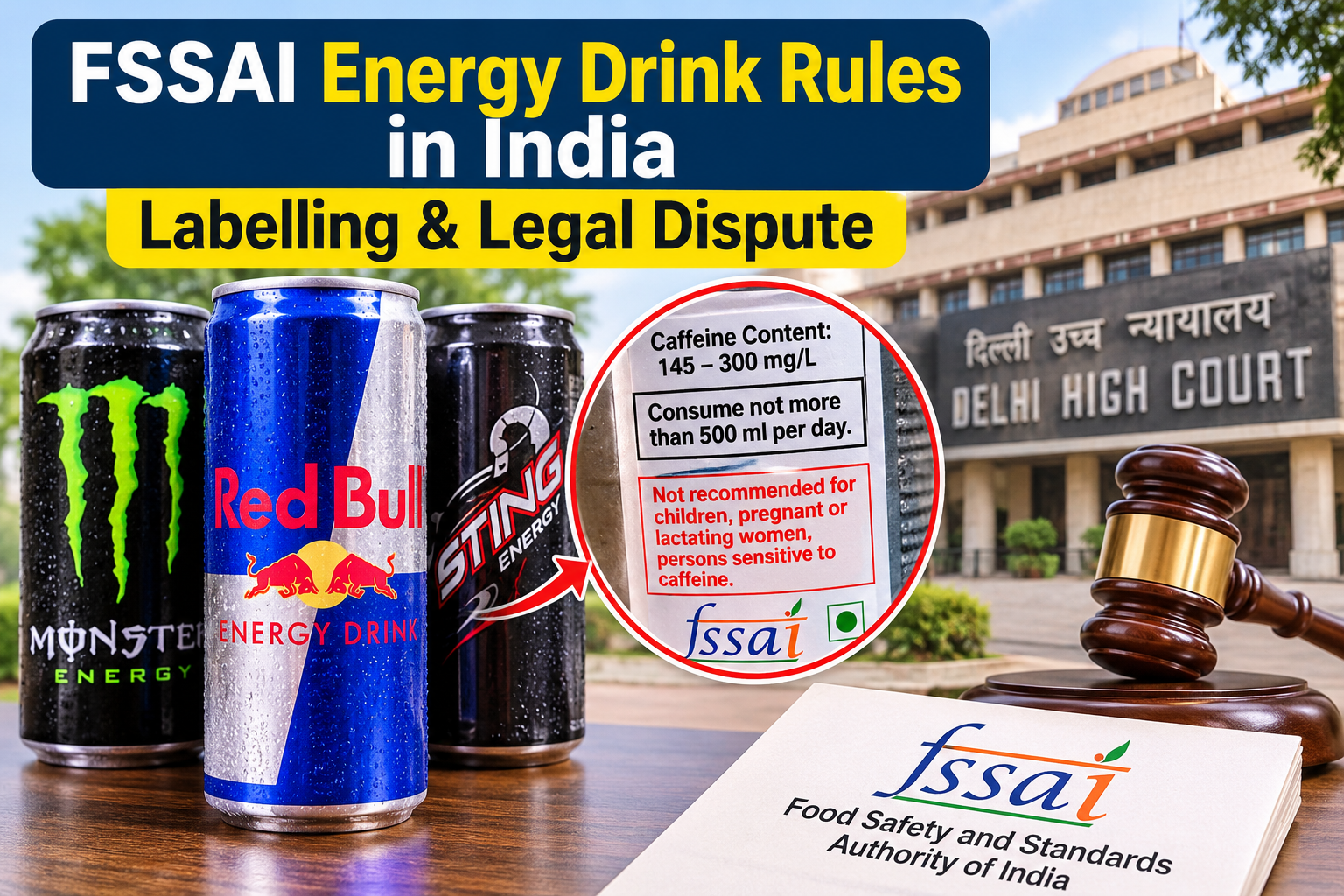
The total caffeine content must generally be between 145 mg and 300 mg per litre of the beverage, irrespective of its source.
2. Maximum daily consumption declaration
The label must carry the declaration:
“Consume not more than 500 ml per day.”
3. Health warning
The prescribed warning is:
“Not recommended for children, pregnant or lactating women, persons sensitive to caffeine.”
4. Caffeine disclosure
Manufacturers must declare caffeine content in the prescribed manner so consumers can understand the quantity present in the beverage.
5. Additional ingredients
Ingredients such as taurine, D-glucurono-y-lactone, inositol and certain vitamins are subject to specified limits and conditions under the applicable regulations.
These requirements are intended to ensure that caffeinated beverages meet prescribed food safety standards.
For the complete regulatory provisions, readers can consult the official FSSAI food product standards and additives regulations.
Why Are Red Bull, PepsiCo and Monster Challenging FSSAI?
The beverage manufacturers have questioned the regulatory action on legal and procedural grounds.
One of their principal arguments concerns the FSSAI advisory dated 28 March 2024.
According to the companies, the advisory expressly permitted the use of the expression “Energy Drink” for products licensed under specified food categories.
They argue that manufacturers relied on this regulatory clarification when developing their product labels, packaging and marketing strategies.
The companies have also raised concerns about the manner in which the June 2026 directions were issued.
They contend that regulatory decisions with significant commercial consequences should follow due process, including providing affected businesses with an opportunity to respond.
FSSAI, on the other hand, has maintained that the product description may mislead consumers and has defended its regulatory action.
The dispute therefore involves two important considerations:
- Whether the product description complies with applicable food labelling requirements.
- Whether the regulator followed the proper legal procedure before issuing directions affecting the manufacturers.
What Has the Delhi High Court Decided in the Energy Drink Labelling Dispute?
The Delhi High Court has passed different orders in the cases brought by beverage manufacturers. However, these orders should not be interpreted as a final decision on the legality of the term “energy drink”.
1. Red Bull India Case
On 29 September 2026, the Delhi High Court set aside the FSSAI direction dated 30 June 2026 concerning Red Bull India.
The Court noted that the company had not been given an opportunity to submit a reply or explanation before the direction was issued.
It observed that an administrative decision having serious civil consequences should follow the principles of natural justice.
However, the Court did not decide whether Red Bull could legally use the term “energy drink” on its products.
It left FSSAI free to take a fresh decision after providing the company with an opportunity to respond.
On 6 November 2026, the High Court issued notice to Red Bull India on FSSAI’s review petition challenging the earlier order. The matter was listed for 27 January 2027.
2. PepsiCo India Case
PepsiCo challenged the FSSAI directions affecting products such as Sting and Adrenaline Rush.
On 6 October 2026, the Delhi High Court granted interim relief after noting that the challenged directions had been issued without a show-cause notice or an opportunity of hearing.
The Court permitted the company to sell existing stock carrying the disputed description.
However, the interim protection did not permit fresh manufacturing of products carrying the “energy drink” description under the challenged arrangement.
The underlying dispute remains pending.
3. Monster Energy India Case
Monster Energy also approached the Delhi High Court challenging FSSAI’s directions concerning its beverages, including Monster Energy and Predator Energy.
On 6 October 2026, the Court granted interim relief concerning the regulatory directions.
The relief allowed the sale of existing stock but did not authorise further manufacturing of products carrying the disputed description.
The matter remained pending, with further proceedings scheduled for January 2027.
These developments demonstrate that the dispute is still being examined by the Court. The interim orders concern procedural and temporary relief, not a final determination of the labelling issue.
What Happens If a Company Violates FSSAI Labelling Requirements?
Food manufacturers in India must comply with the Food Safety and Standards Act, 2006, and the regulations made under it.
Depending on the nature of the violation, non-compliance with food labelling requirements may result in regulatory action.
Possible consequences include:
- Directions to correct or modify product labels.
- Regulatory inspections and enforcement proceedings.
- Penalties where the relevant statutory conditions are established.
- Action against misleading advertisements or claims.
- Other measures available under the applicable food safety laws.
The legal consequences depend on the nature of the violation, the applicable statutory provision and the circumstances of the particular case.
Importantly, the mere use of the words “energy drink” should not automatically be treated as an offence without examining the applicable regulatory provisions and operative directions.
What Should Consumers Know About Energy Drink Labelling?
The legal dispute is also important from a consumer protection perspective.
Consumers often rely on product descriptions when choosing beverages. However, a familiar brand name or marketing expression does not necessarily explain the actual caffeine content or suitability of a drink.
Before purchasing caffeinated beverages, consumers should check:
- Caffeine content: Understand how much caffeine is present in each serving.
- Daily consumption warning: Follow the prescribed maximum consumption declaration.
- Health warnings: Pay attention to warnings concerning children, pregnant or lactating women and people sensitive to caffeine.
- Ingredient information: Read the complete ingredient list.
- Advertising claims: Do not assume that performance or health-related claims are medically established simply because they appear in promotional material.
A change in the product description does not necessarily mean that its formulation has changed.
The most useful information remains the beverage’s ingredients, caffeine content, nutritional details and prescribed warnings.
Product Branding Versus Food Safety Regulations: The Larger Legal Question
The dispute highlights an important issue in Indian food law: how should regulators balance commercial branding with statutory labelling requirements?
Manufacturers invest considerable resources in developing brand identities, packaging and consumer recognition. A sudden change in the permitted product description can have significant commercial consequences.
At the same time, food regulators have a responsibility to ensure that product labels and advertisements provide accurate information and do not mislead consumers.
Similar questions arise in relation to expressions such as:
- Natural
- Healthy
- Immunity boosting
- Sugar free
- High protein
A familiar marketing expression does not automatically become legally acceptable simply because consumers recognise it.
Manufacturers must ensure that their product descriptions comply with the applicable regulations and that any claims made about their products are properly supported.
Conclusion: Are Energy Drinks Legal in India?
The ongoing dispute does not amount to a general ban on the sale of caffeinated beverages in India.
The central issue is whether manufacturers can legally use the description “energy drink” on products covered by the challenged regulatory directions.
FSSAI has raised concerns about consumer understanding, product classification and potentially misleading descriptions. Beverage manufacturers have relied on earlier regulatory guhttps://www.enigmacommunity.com/idance and challenged the manner in which the directions were issued.
The Delhi High Court has granted different forms of relief to the companies, but it has not finally decided the substantive legality of using the term.
The dispute could have wider implications for food manufacturers, particularly concerning product branding, regulatory powers and procedural fairness.
Until the legal proceedings and regulatory process reach a final outcome, manufacturers should carefully monitor applicable FSSAI directions and court orders.
For consumers, the key takeaway is simple: look beyond the product name and pay attention to caffeine content, ingredients and health warnings.
Disclaimer: This article is intended for general information and educational purposes only. It does not constitute legal advice. The proceedings discussed are ongoing, and the legal position may change through subsequent judicial orders or regulatory directions.