
Introduction
India’s new Labour Codes 2026 have brought significant changes to the country’s employment and workplace compliance framework. The reforms aim to simplify labour regulations, strengthen employee protections, improve workplace safety, and streamline statutory compliance for businesses.
The Government of India consolidated 29 central labour laws into four Labour Codes, which came into force on 21 November 2025. Final Central Rules were notified in May 2026. However, employers must also consider applicable state-level rules, which are being introduced on different timelines.
As businesses adapt to these changes, understanding Labour Codes Compliance 2026 is essential for managing payroll, employment contracts, statutory benefits, workplace policies, and regulatory responsibilities.
This guide explains the four Labour Codes, their implications for employers, and a practical compliance checklist to help Indian businesses prepare.
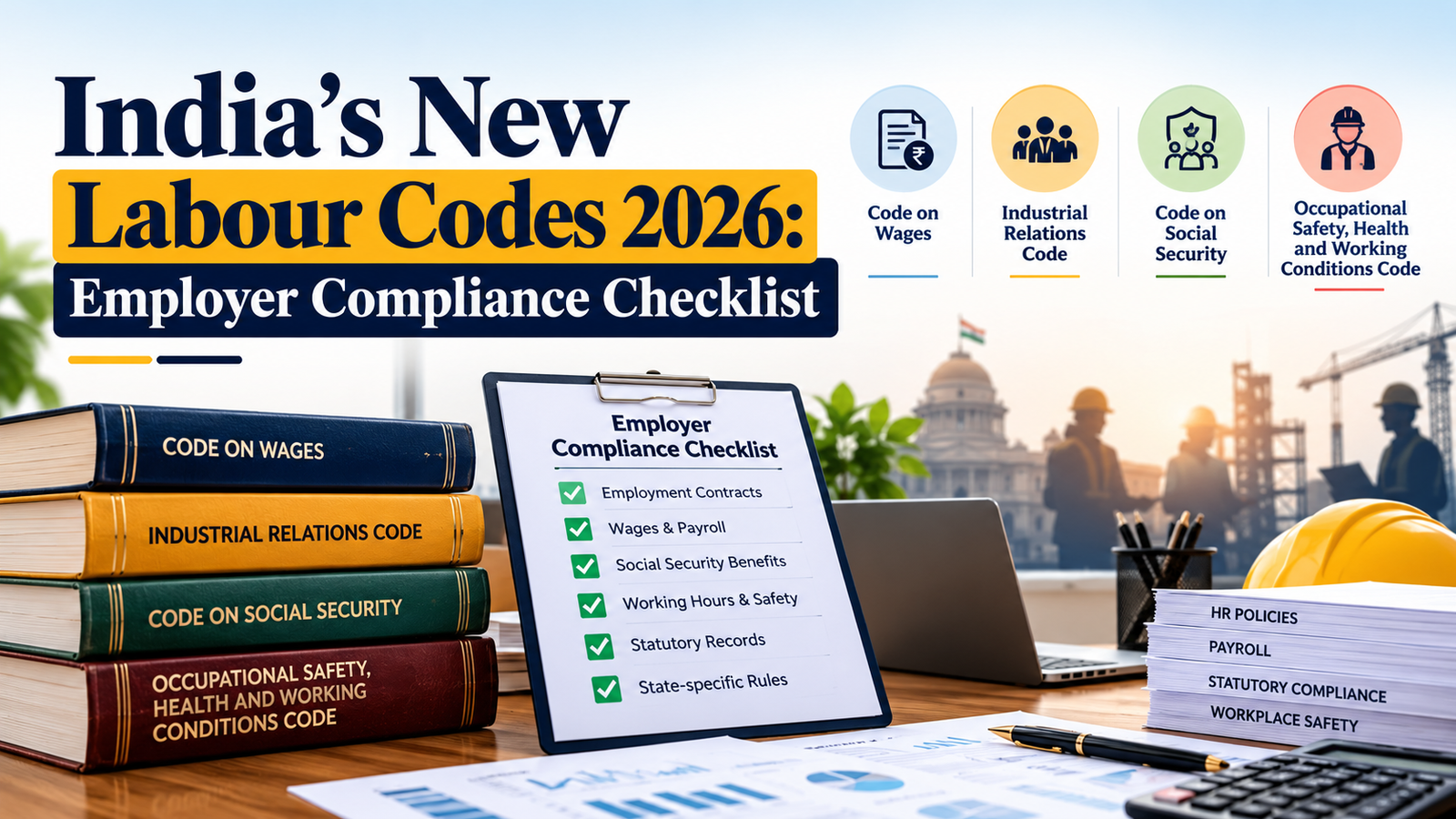
1. Understanding India’s Four New Labour Codes
The four Labour Codes cover different aspects of employment and workforce management.
Code on Wages, 2019
The Code on Wages establishes a consolidated framework for minimum wages, wage payments, remuneration, and equal treatment in wage-related matters.
Employers should review salary structures, applicable minimum wage requirements, wage-payment timelines, and authorised deductions.
Industrial Relations Code, 2020
The Industrial Relations Code addresses industrial disputes, trade unions, standing orders, retrenchment, and other aspects of employer-employee relations.
Businesses should examine their disciplinary procedures, grievance-resolution mechanisms, and workforce restructuring policies.
Code on Social Security, 2020
The Code on Social Security consolidates provisions concerning employee benefits, provident funds, insurance, gratuity, maternity benefits, and social protection for eligible categories of workers.
Employers should assess statutory benefit eligibility, employee classifications, and contribution requirements.
Occupational Safety, Health and Working Conditions Code, 2020
This Code addresses workplace safety, employee welfare, working conditions, and occupational health requirements.
Businesses should review workplace safety procedures, working-hour arrangements, appointment letters, and relevant registration obligations.
Together, these reforms establish a more consolidated approach to employment regulation in India.
2. Labour Codes Compliance 2026: Key Changes for Employers
The new framework introduces several areas that require employer attention.
Changes to Salary Structures and Wage Calculations
The Labour Codes introduce a more consistent statutory definition of wages.
Under the relevant wage definition, certain excluded remuneration components may be added back when they exceed the prescribed 50% threshold. This can affect calculations for applicable employee benefits.
Employers should evaluate salary structures carefully rather than assuming that every employee’s basic salary must automatically equal 50% of total compensation.
Employee Appointment Letters and Documentation
Employment documentation is an important compliance requirement.
Employers should ensure that eligible employees receive appropriate appointment letters and that employment terms are accurately recorded.
Social Security and Employee Benefits
The new framework strengthens the legal structure governing social security.
Businesses should review applicable provident fund, employee insurance, gratuity, and other statutory benefit obligations.
Working Hours and Workplace Safety
Employers should evaluate working hours, overtime arrangements, rest periods, occupational safety procedures, and workplace welfare facilities.
The precise requirements may depend on the establishment, industry, exemptions, and applicable rules.
3. Labour Codes Compliance 2026: Employer Checklist
Businesses can use the following checklist to review their compliance readiness.
1. Review employment contracts
Check appointment letters, employment agreements, job classifications, and existing HR policies against applicable requirements.
2. Audit salary and payroll structures
Review wage definitions, salary components, statutory deductions, overtime payments, and benefit calculations.
3. Verify social security obligations
Confirm applicable EPF, ESI, gratuity, maternity benefit, and other statutory requirements.
4. Review working hours and leave policies
Examine employee schedules, overtime procedures, weekly rest arrangements, and leave records.
5. Update workplace safety practices
Assess safety training, workplace inspections, emergency procedures, and occupational health requirements.
6. Maintain statutory records
Organise employee records, payroll information, registers, attendance details, and statutory documentation.
7. Check state-specific labour rules
Identify whether the Central Government or the relevant State Government is the appropriate authority for the establishment.
Verify final rules through official notifications rather than relying on draft provisions.
8. Train HR and payroll teams
Ensure responsible employees understand relevant changes and can implement the applicable requirements correctly.
9. Review contractor and workforce arrangements
Examine contract labour arrangements, worker classifications, and responsibilities relating to outsourced personnel.
10. Conduct periodic compliance audits
Review internal processes regularly and address identified gaps before they create regulatory risks.
4. Why Labour Codes Compliance Matters for Indian Businesses
Effective Labour Codes Compliance 2026 can help businesses improve workforce management and reduce avoidable compliance risks.
A structured approach can support:
- More accurate payroll and statutory benefit calculations.
- Better employment documentation and recordkeeping.
- Stronger workplace safety and employee welfare practices.
- Improved HR policies and grievance-management procedures.
- Better preparedness for inspections and regulatory reviews.
- Reduced exposure to penalties arising from non-compliance.
Businesses operating across multiple states should pay particular attention to jurisdiction-specific requirements.
5. Common Labour Compliance Mistakes Employers Should Avoid
Even businesses with established HR processes may overlook important requirements.
Common mistakes include using outdated employment agreements, failing to review salary components, maintaining incomplete employee records, overlooking statutory benefit eligibility, and applying draft state rules as though they were final.
Another mistake is assuming that one compliance checklist applies identically to every business.
Requirements may vary according to employee strength, establishment type, industry, location, and the appropriate government.
Employers should therefore adopt a compliance process suited to their operations.
6. Labour Codes Compliance 2026: What Employers Should Do Next
Employers should begin by conducting an internal assessment of existing employment practices.
HR, payroll, legal, and finance teams can work together to identify areas requiring changes.
Businesses should prioritise reviewing employment contracts, statutory contributions, workplace policies, and relevant registers.
They should also monitor notifications from the Ministry of Labour and Employment and their respective state labour departments.
The Central Government had expressed an expectation that states and Union Territories would notify their remaining rules by 31 October 2026. However, that target should not be treated as confirmation that every state has completed the process.
Companies should verify the latest official gazette notifications before changing their statutory compliance procedures.
7. How Derecho Consulting Can Help Businesses
Understanding employment regulations and implementing practical compliance processes can be challenging, particularly for growing businesses and organisations operating across multiple locations.
Derecho Consulting helps businesses understand regulatory developments and identify compliance considerations relevant to their operations.
Employers can benefit from professional guidance when reviewing employment documentation, workplace policies, payroll-related obligations, and statutory compliance requirements.
A proactive approach can help businesses identify gaps, improve internal processes, and prepare for regulatory changes.
Conclusion
India’s new Labour Codes represent an important transformation in the country’s employment and workforce compliance framework.
For businesses, Labour Codes Compliance 2026 requires more than understanding the four Codes. Employers must review their existing practices, identify applicable central and state requirements, and ensure that their HR and payroll systems reflect the relevant legal obligations.
From wage calculations and employee benefits to workplace safety and employment documentation, proactive compliance planning can help organisations strengthen workforce governance and reduce regulatory risks.
As implementation continues across states, employers should regularly review official notifications and seek appropriate professional guidance.
Stay informed with Derecho Consulting for practical insights into India’s changing labour laws and business compliance requirements.
Disclaimer: This article is for general informational purposes and does not constitute legal advice. Employers should verify applicable central and state rules and seek professional advice based on their specific circumstances.