
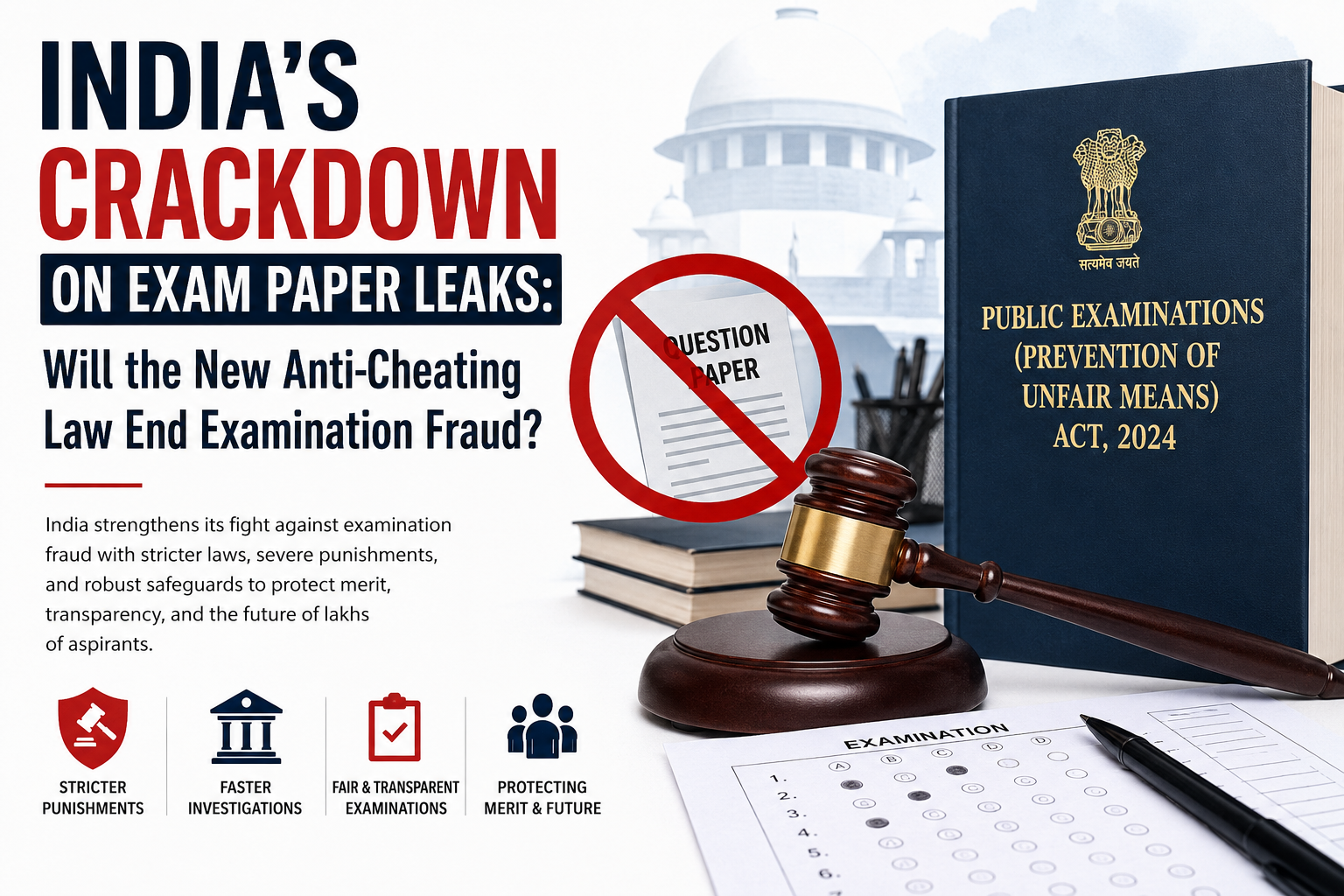
India’s anti-cheating law is facing its biggest test yet in 2026. The government is moving to sharply toughen penalties following yet another round of NEET and UGC-NET controversies. The Public Examinations (Prevention of Unfair Means) Act, 2024, was supposed to end the paper leak crisis that has plagued India’s competitive exams for years. Two years later, the leaks haven’t stopped. The Centre is now pushing for even harsher punishment. Here’s what India’s anti-cheating law actually does, why it hasn’t fully worked yet, and whether the new amendments stand a real chance of changing that.
What India’s Anti-Cheating Law Actually Covers
The Public Examinations (Prevention of Unfair Means) Act, 2024, received presidential assent in February 2024. It was formally notified in June 2024, arriving after nationwide protests over irregularities in the NEET-UG and UGC-NET examinations. Before this law, India had no dedicated central legislation targeting organized examination fraud. It only had general provisions under the Indian Penal Code that weren’t built for this specific problem.
India’s anti-cheating law applies to public examinations run by central agencies. This includes the Union Public Service Commission, the Staff Selection Commission, the National Testing Agency, and railway and banking recruitment exams. It defines a wide range of illegal acts. These cover everything from leaking question papers and tampering with OMR sheets to creating fake examination websites, issuing counterfeit admit cards, and hacking into confidential examination systems.
The Penalties Behind India’s Anti-Cheating Law
Under the original 2024 law, individuals involved in organized cheating networks face five to ten years of imprisonment. They also face a minimum fine of one crore rupees. The Act targets more than just the person who leaks a paper. It goes after the entire chain around them: technology providers who enable the fraud, intermediaries, and institutions that knowingly participate.
Beyond punishment, India’s anti-cheating law mandates real procedural safeguards throughout the exam cycle. These include pre-audits of examination centers, biometric verification of candidates, secure handling protocols for question papers, CCTV surveillance, and post-examination audits. The goal: catch irregularities before they spiral into a full scandal.
Why the Leaks Kept Happening Anyway
Despite these provisions, major examination controversies have continued well into 2026. This has prompted renewed pressure from students and opposition parties for stronger deterrence. The government has now designated a special fast-track court at Delhi’s Rouse Avenue Court specifically to expedite the trial of paper leak cases. This is a clear admission that ordinary court timelines weren’t delivering justice fast enough to actually deter future leaks.
That admission matters. A law with strong penalties on paper does little if prosecutions drag on for years. The deterrent effect depends on offenders believing they will actually get caught and punished quickly. Speed of enforcement has become just as central to the current debate as the size of the fines themselves.
What the New Amendments to India’s Anti-Cheating Law Propose
The Union Cabinet has now approved amendments that would raise the minimum punishment for paper leak offences from three years to five years. The changes would also increase the maximum prison term to ten years and push the maximum fine up to ten crore rupees. India’s anti-cheating law is set to become considerably harsher than its original 2024 form. This reflects the government’s attempt to restore public confidence in the competitive examination system.
The proposed changes will also likely expand the use of special and fast-track courts nationally, rather than relying on a single designated court in Delhi. The timing is notable: these amendments follow a fresh wave of controversy involving the National Testing Agency. The government is simultaneously announcing broader changes to how the NTA itself operates.
Will India’s Anti-Cheating Law Actually End Examination Fraud?
This is the honest, unresolved question at the center of the debate. India’s anti-cheating law has clearly raised the legal stakes for anyone involved in organized exam fraud. The fast-track court system shows real intent to close the enforcement gap that undermined the original 2024 law. However, tougher penalties alone don’t address every weak point in the system.
Organized cheating networks in India have historically relied on insider access, weak digital security at printing and transport stages, and corruption within local administration. A harsher sentence doesn’t automatically fix any of that. Other sectors have had to formalize internal accountability structures too — many companies adopted detailed remote and hybrid work policies to close gaps in oversight and conduct. India’s examination bodies may need equally rigorous internal safeguards alongside tougher external law. Only that combination can genuinely close the loopholes that have enabled repeat leaks.
Final Thought
India’s anti-cheating law represents a genuine and overdue attempt to bring order to a system that had been failing students for years. The 2024 Act gave India its first dedicated legal framework for this problem. The proposed 2026 amendments push penalties and enforcement speed even further. Will that combination actually stop paper leaks, rather than simply punishing them more severely after the fact? That depends on how consistently the law gets enforced at the ground level — not just how tough it reads on paper.