
GST registration is mandatory once a business crosses prescribed turnover limits. These limits vary based on type of supply (goods/services) and state category (normal vs special category states).
GST provisions are governed under the Central Goods and Services Tax Act, 2017.
What is GST Registration Threshold?
It is the minimum turnover limit beyond which a business must register under GST.
- If your turnover exceeds this limit → GST registration becomes compulsory
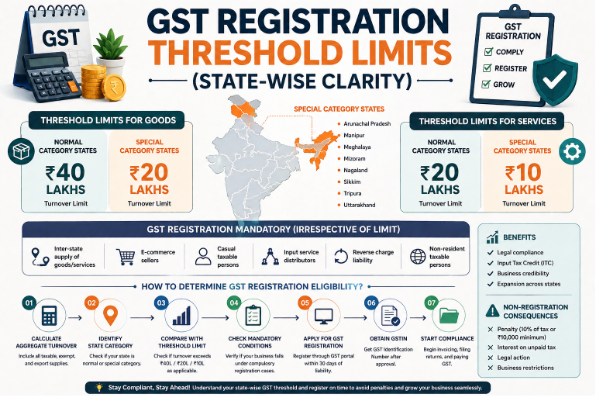
Threshold Limits for Goods (State-wise)
Normal Category States
- Threshold Limit: ₹40 Lakhs
Special Category States
- Threshold Limit: ₹20 Lakhs
Threshold Limits for Services
Normal Category States
- Threshold Limit: ₹20 Lakhs
Special Category States
- Threshold Limit: ₹10 Lakhs
List of Special Category States
These states have lower GST limits:
- Arunachal Pradesh
- Manipur
- Meghalaya
- Mizoram
- Nagaland
- Sikkim
- Tripura
- Uttarakhand
When GST Registration is Mandatory (Irrespective of Limit)
You must register even if below threshold if:
- Inter-state supply of goods/services
- E-commerce sellers
- Casual taxable persons
- Input service distributors
- Reverse charge liability
- Non-resident taxable persons
Step-by-Step: When to Register for GST
Step 1: Calculate Aggregate Turnover
Include all taxable, exempt, and export supplies.
Step 2: Identify State Category
Check if your state falls under normal or special category.
Step 3: Compare with Threshold Limit
Check if turnover exceeds ₹40L / ₹20L / ₹10L as applicable.
Step 4: Check Mandatory Conditions
Verify if your business falls under compulsory registration cases.
Step 5: Apply for GST Registration
Register through GST portal within 30 days of liability.
Step 6: Obtain GSTIN
Get GST Identification Number after approval.
Step 7: Start Compliance
Begin invoicing, filing returns, and paying GST.
Benefits of GST Registration
- Legal compliance
- Input Tax Credit (ITC)
- Business credibility
- Expansion across states
Advantages
- Seamless tax system
- Better business opportunities
- Improved transparency
- Competitive advantage
Consequences of Non-Registration
- Penalty (10% of tax or ₹10,000 minimum)
- Interest on unpaid tax
- Legal action
- Business restrictions
Conclusion
Understanding GST threshold limits is crucial for every business in India. Since limits vary based on state and nature of business, proper evaluation is necessary to avoid penalties and ensure smooth compliance.
Businesses should monitor turnover regularly and register under GST at the right time.