
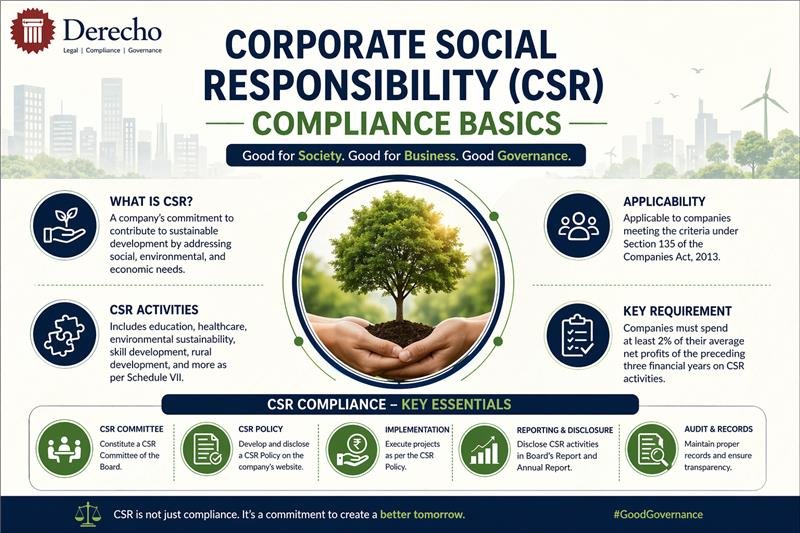
Corporate Social Responsibility (CSR) refers to a company’s obligation to contribute towards social, environmental, and economic development. In India, CSR is not just voluntary—it is a statutory requirement for eligible companies under the Companies Act, 2013 (Section 135).
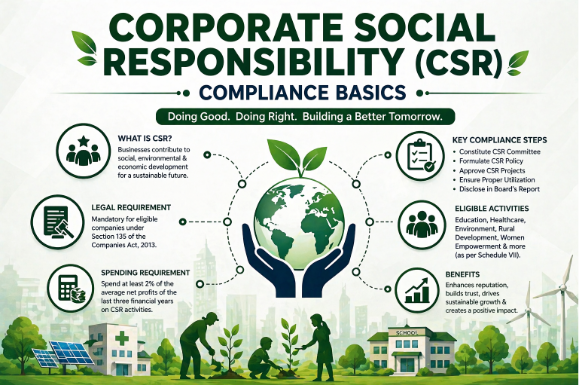
What is CSR?
CSR means:
- Businesses taking responsibility for their impact on society
- Investing in social welfare activities
- Promoting sustainable development
Applicability of CSR
CSR provisions apply to companies meeting any of the following:
- Net worth ≥ ₹500 crore
- Turnover ≥ ₹1000 crore
- Net profit ≥ ₹5 crore
CSR Spending Requirement
- Companies must spend at least 2% of the average net profits (last 3 years)
- Funds must be used for approved CSR activities
Eligible CSR Activities
As per Schedule VII, activities include:
- Education and skill development
- Healthcare and sanitation
- Environmental sustainability
- Rural development
- Women empowerment
Key Compliance Requirements
- Constitute CSR Committee
- Formulate CSR Policy
- Approve CSR projects
- Ensure proper fund utilization
- Disclose CSR activities in Board Report
Step-by-Step CSR Compliance Process
Step 1: Check Applicability
Determine whether the company meets CSR criteria.
Step 2: Constitute CSR Committee
Form a committee of directors to oversee CSR activities.
Step 3: Draft CSR Policy
Prepare CSR policy outlining focus areas and implementation plan.
Step 4: Approve CSR Budget
Calculate and allocate required CSR spending (2%).
Step 5: Implement CSR Activities
Execute approved CSR projects through eligible entities.
Step 6: Monitor and Report
Track progress and maintain proper documentation.
Step 7: Disclose in Annual Report
Report CSR activities and spending in Board’s report.
Benefits of CSR Compliance
- Enhances brand reputation
- Builds social trust
- Supports community development
- Improves stakeholder relations
Advantages
- Strengthens corporate image
- Encourages sustainable growth
- Attracts investors
- Improves employee engagement
Consequences of Non-Compliance
- Penalties and fines
- Legal consequences
- Reputational damage
- Regulatory action
Conclusion
CSR compliance is an essential responsibility for eligible companies in India. It not only ensures legal compliance but also contributes to social and environmental development.
Companies should strategically plan CSR activities to create meaningful impact while staying compliant with legal requirements.