
Introduction
Copyright Compliance is an important legal requirement for OTT platforms and digital content businesses that create, acquire, license, distribute, stream, or promote films, web series, music, videos, photographs, scripts, and other digital content. As online streaming continues to expand, platforms need to ensure that the content they make available is properly licensed and that copyright ownership, usage rights, territorial restrictions, and contractual obligations are clearly documented.
India’s Copyright Act, 1957 provides the principal legal framework for copyright protection, including protection in the digital environment. The Copyright Office notes that the 2012 amendments strengthened protection in the digital environment and addressed issues including technological protection measures, rights-management information, internet-service-provider liability, and statutory licensing.
OTT platforms also operate within the broader digital-media regulatory framework. The Ministry of Information and Broadcasting administers Part III of the Information Technology (Intermediary Guidelines and Digital Media Ethics Code) Rules, 2021 for publishers of online curated content, including OTT platforms.
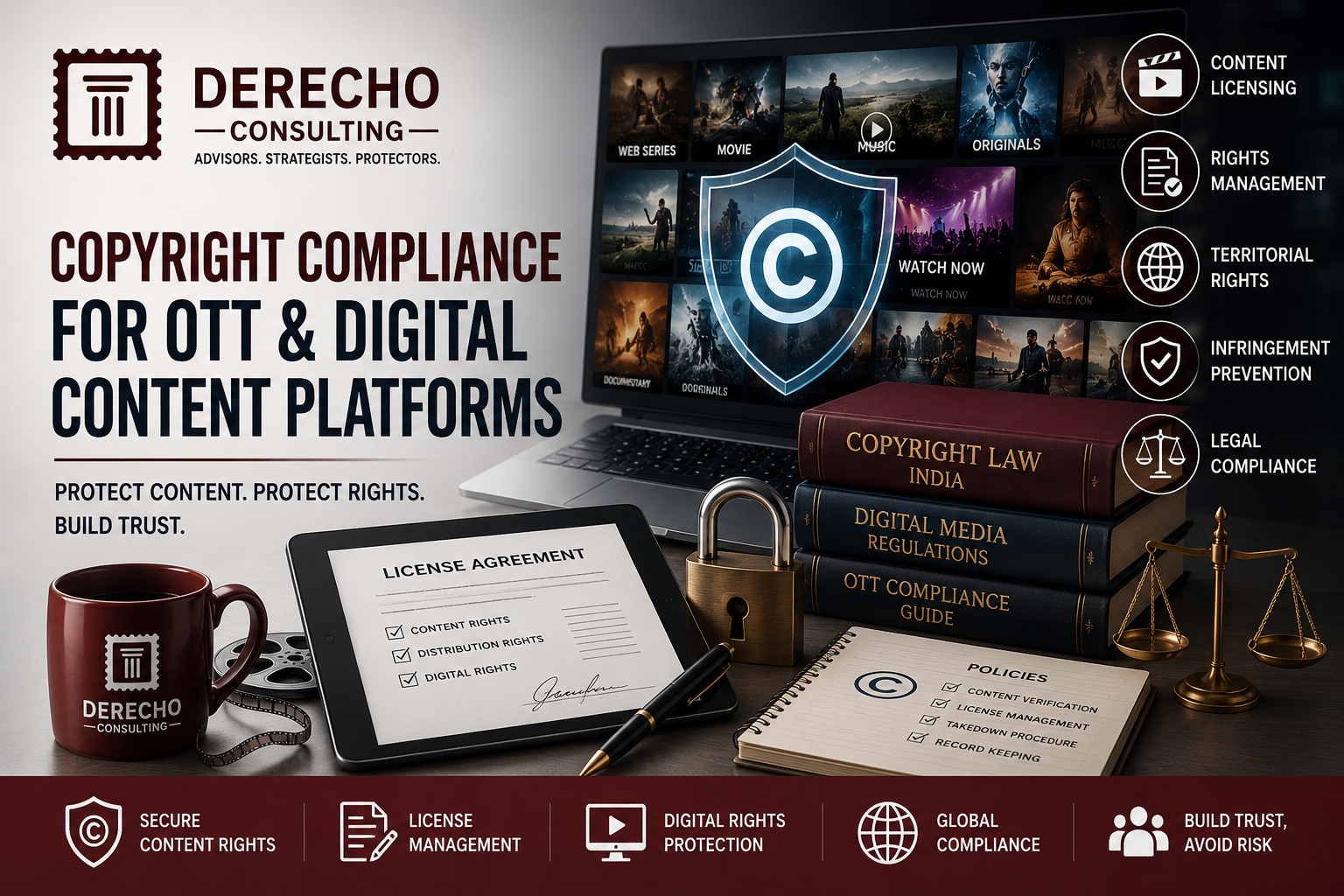
This guide explains Copyright Compliance for OTT and Digital Content Platforms, including content licensing, ownership verification, music and film rights, territorial restrictions, copyright infringement risks, contractual safeguards, takedown procedures, digital rights management, and practical compliance measures for 2026.
Why Copyright Compliance Matters
Digital content can involve multiple rights holders, including producers, authors, performers, musicians, composers, broadcasters, distributors, and other licensors. Using content without the appropriate rights can expose platforms to disputes, infringement claims, financial losses, and reputational damage.
Effective Copyright Compliance can help OTT and digital content platforms:
- Verify ownership of digital content.
- Obtain appropriate licences before publishing content.
- Clearly define the scope of licensed rights.
- Manage territorial and platform-specific restrictions.
- Maintain records of copyright permissions.
- Reduce infringement risks.
- Protect against unauthorised content uploads.
- Strengthen contracts with content creators and licensors.
- Establish effective copyright-complaint procedures.
- Support responsible digital content distribution.
Key Areas of Copyright Compliance
1. Content Ownership Verification
Before acquiring or publishing content, platforms should verify who owns the relevant copyright and whether the person or organisation granting the rights has the authority to do so.
The review may include:
- Copyright ownership.
- Chain of title.
- Producer agreements.
- Author agreements.
- Performer agreements.
- Music rights.
- Distribution rights.
- Previous licensing arrangements.
- Existing restrictions or disputes.
Proper ownership verification can reduce the risk of acquiring content from a party that does not possess the necessary rights.
2. Content Licensing Agreements
OTT platforms should use detailed licensing agreements when acquiring third-party content.
Agreements should clearly address:
- Type of content.
- Rights granted.
- Duration of the licence.
- Territory.
- Language.
- Platform and medium.
- Exclusivity.
- Streaming rights.
- Download rights.
- Promotional rights.
- Sub-licensing rights.
- Renewal and termination.
- Royalty or licence payments.
Clear contractual drafting can help prevent disputes about what a platform is legally permitted to do with licensed content.
3. Music and Sound Recording Rights
Music used in films, web series, advertisements, trailers, reels, or other digital content can involve separate copyright and related rights.
Platforms should verify applicable rights relating to:
- Musical compositions.
- Lyrics.
- Sound recordings.
- Performers.
- Background music.
- Synchronisation.
- Public performance.
- Digital communication to the public.
A platform should not assume that obtaining rights to a film or video automatically provides every right required for separately protected music or sound recordings.
4. Territorial and Distribution Rights
Digital licences frequently contain geographic restrictions.
A licensing agreement may permit content to be distributed:
- Only in India.
- In selected countries.
- Globally.
- For a specified territory.
- Through specific platforms or channels.
OTT platforms should therefore implement appropriate technical and contractual controls to prevent content from being made available outside the licensed territory.
5. Digital Rights Management
Technology can play an important role in protecting licensed content.
Platforms may use digital rights management measures to control:
- Access.
- Downloads.
- Screen recording.
- Content copying.
- Account sharing.
- Unauthorised redistribution.
The Copyright Act framework also recognises technological protection measures and rights-management information in the digital environment.
6. Copyright Infringement and Unauthorised Content
Platforms may face risks when copyrighted material is uploaded, streamed, reproduced, or distributed without appropriate rights.
Potential issues may involve:
- Unauthorised films.
- Pirated web series.
- Unlicensed music.
- Copyrighted photographs.
- Clips and excerpts.
- User-generated content.
- Unauthorised promotional material.
Businesses should establish appropriate processes for identifying and responding to copyright complaints.
7. Copyright Takedown and Grievance Procedures
A platform should maintain a structured process for receiving and evaluating copyright complaints.
The process should establish:
- How complaints are submitted.
- Information required from the complainant.
- How ownership is verified.
- Internal review procedures.
- Content restriction or removal processes.
- Communication with affected parties.
- Record keeping.
- Escalation procedures.
The broader IT Rules framework includes due-diligence obligations concerning content that infringes copyright or other proprietary rights.
8. OTT Content Regulation and Compliance
Copyright is only one part of the compliance framework for OTT platforms.
Part III of the IT Rules covers publishers of online curated content and includes a Code of Ethics and a three-tier grievance-redressal mechanism.
OTT platforms should therefore consider copyright compliance alongside applicable requirements relating to:
- Content classification.
- Content descriptors.
- Access controls.
- Age verification.
- Accessibility.
- Grievance redressal.
- Regulatory documentation.
The current 2026 version of the IT Rules also includes updated definitions relating to audio, visual, and audio-visual information.
Common Copyright Risks for OTT and Digital Platforms
Digital content businesses may face copyright risks due to:
- Incomplete ownership verification.
- Missing licensing documentation.
- Expired licences.
- Use of content outside the licensed territory.
- Unauthorised music usage.
- Unclear contractual rights.
- Unauthorised user-generated content.
- Copyright infringement complaints.
- Inadequate content-monitoring systems.
- Poor rights-management records.
- Unauthorised redistribution.
- Weak takedown procedures.
- Failure to monitor contractual restrictions.
Best Practices for Copyright Compliance
OTT and digital content platforms should consider the following practices:
- Maintain a centralised content-rights database.
- Verify ownership before acquiring content.
- Conduct proper chain-of-title reviews.
- Use detailed content licensing agreements.
- Clearly define territories and licence periods.
- Track licence expiry and renewal dates.
- Verify music and sound-recording rights separately where required.
- Maintain copyright documentation.
- Implement appropriate digital rights management.
- Establish copyright complaint procedures.
- Conduct periodic content-rights audits.
- Review user-generated-content policies.
- Train relevant employees on copyright requirements.
- Coordinate legal, content-acquisition, and technology teams.
2026 Copyright Compliance Considerations
Copyright compliance remains particularly important in 2026 as digital content platforms continue to expand their use of streaming, user-generated content, AI-assisted production, short-form video, and cross-platform distribution.
The Ministry of Information and Broadcasting continues to administer the digital-media framework applicable to publishers of online curated content, while the Ministry of Electronics and Information Technology has published updated versions and proposed amendments to the IT Rules during 2026.
Platforms should therefore regularly review their licensing arrangements, content-rights databases, copyright policies, grievance mechanisms, and contractual safeguards rather than relying on outdated compliance procedures.
How Derecho Consulting Can Help
Derecho Consulting can help OTT and digital content platforms manage copyright and digital-media legal risks through copyright compliance reviews, licensing and contract analysis, content-rights assessments, regulatory analysis, intellectual-property advisory, grievance-process reviews, and corporate legal advisory.
A proactive approach to Copyright Compliance can help platforms verify content rights, strengthen licensing arrangements, manage infringement risks, and develop appropriate processes for handling copyright-related disputes.
Conclusion
Copyright Compliance for OTT and Digital Content Platforms is an important part of responsible digital-content management. As platforms acquire and distribute increasingly large volumes of films, music, web series, videos, and user-generated content, effective rights management becomes essential.
By verifying ownership, obtaining appropriate licences, maintaining accurate rights records, monitoring territorial restrictions, protecting digital content, and establishing effective copyright complaint procedures, OTT platforms can better manage intellectual-property risks.
A proactive and well-documented approach to Copyright Compliance can help digital platforms reduce infringement exposure, strengthen relationships with content creators and licensors, and support sustainable growth in India’s rapidly developing digital-content ecosystem.