
Introduction
The aviation industry is one of the most internationally regulated sectors in the world. Every day, millions of passengers travel across borders, and thousands of tons of cargo are transported through complex airline networks. While air travel is generally safe and efficient, incidents such as passenger injuries, delayed flights, lost baggage, cargo damage, and accidents can occur. When these events happen, an important question arises:
How much compensation can passengers or cargo owners legally receive?
The answer is governed largely by international aviation conventions that establish standardized liability and compensation limits. These treaties ensure consistency across countries, prevent legal uncertainty, and balance the interests of passengers, airlines, and cargo operators.
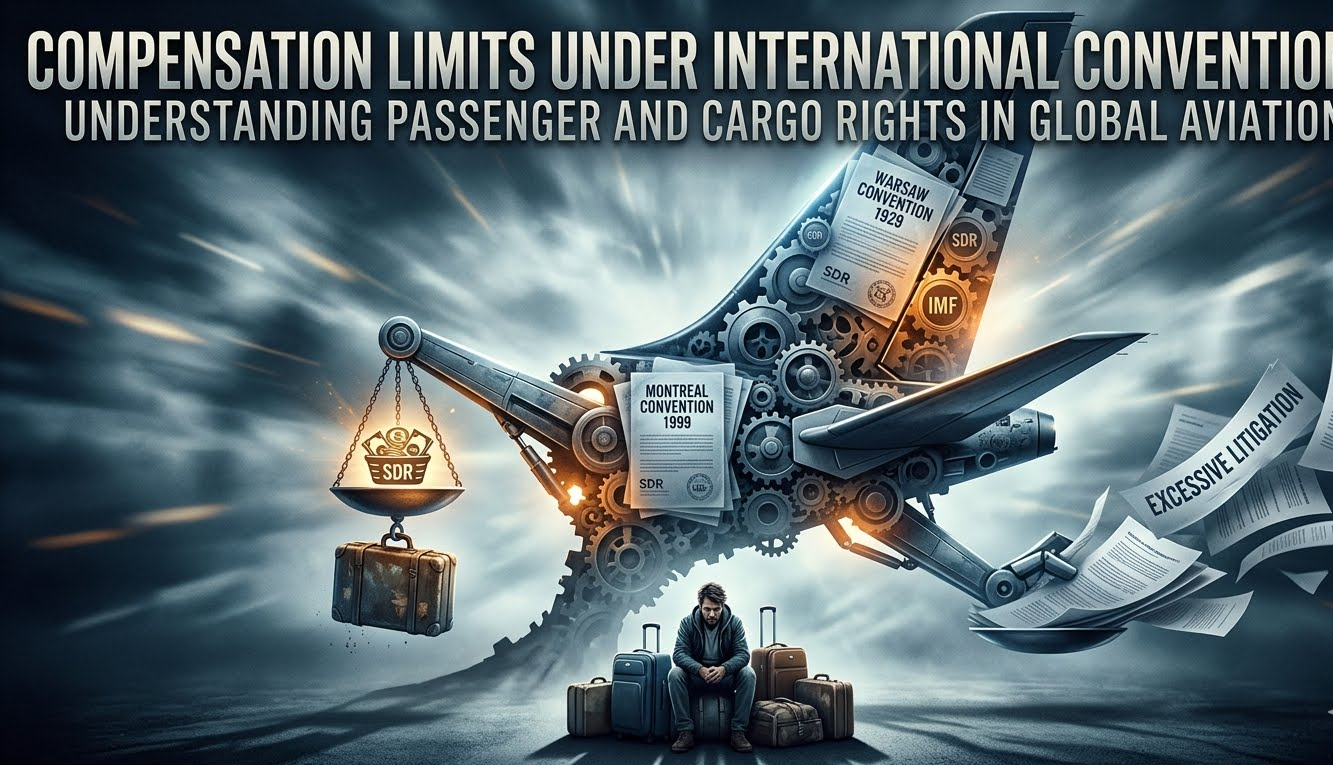
Among these conventions, the Warsaw Convention of 1929 and the Montreal Convention of 1999 play the most significant roles in determining compensation limits in international air transport.
This article explores the legal framework governing compensation limits, the evolution of international aviation liability laws, passenger rights, cargo claims, and the future of compensation regulations in the global aviation industry.
Why International Compensation Rules Are Necessary
International aviation involves multiple jurisdictions. A passenger may purchase a ticket in one country, fly through another, and arrive in a third country. Without uniform rules, legal disputes would become extremely complicated.
International conventions aim to:
- Create predictable liability standards.
- Protect passengers and cargo owners.
- Prevent excessive litigation.
- Encourage international air transportation.
- Provide fairness between airlines and consumers.
- Simplify dispute resolution across borders.
Without these conventions, compensation amounts could vary dramatically depending on where a lawsuit is filed.
Historical Evolution of Aviation Compensation Laws
The Warsaw Convention (1929)
The Warsaw Convention was the first major international treaty regulating airline liability.
It established:
- Airline responsibility for passenger injury and death.
- Liability for baggage loss.
- Liability for cargo damage.
- Compensation limits to protect airlines from catastrophic financial exposure.
At the time, aviation was still developing, and governments wanted to encourage industry growth without exposing airlines to unlimited lawsuits.
However, as aviation evolved, the compensation limits under the Warsaw Convention became outdated and insufficient.
The Montreal Convention (1999)
To modernize international aviation law, countries adopted the Montreal Convention.
The convention:
- Replaced most provisions of the Warsaw Convention.
- Increased compensation limits significantly.
- Simplified claims procedures.
- Strengthened passenger rights.
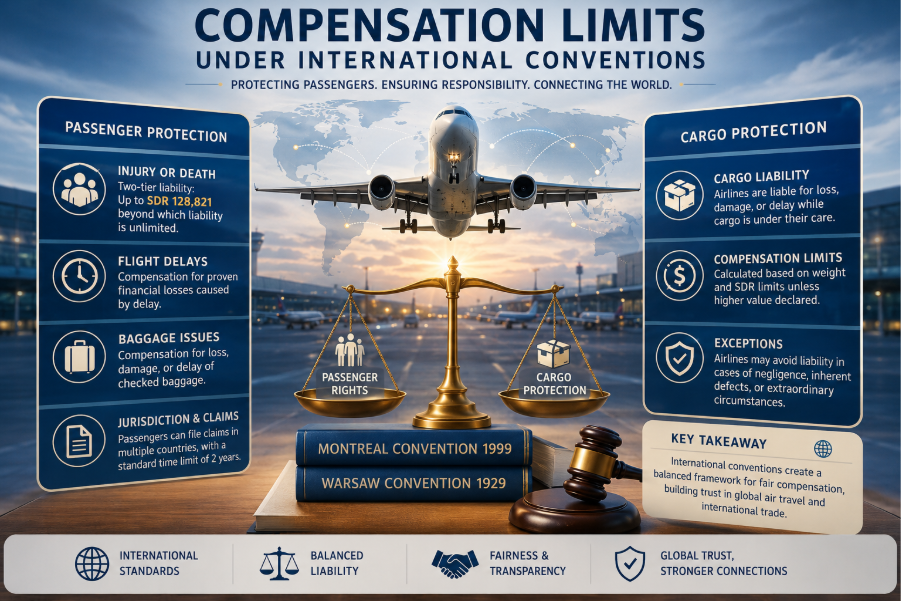
- Introduced a two-tier liability system for passenger injuries and deaths.
Today, over 130 countries have ratified the Montreal Convention, making it the primary framework governing international aviation compensation.
Passenger Injury and Death Compensation
One of the most important aspects of international aviation law involves compensation for passengers injured or killed during international flights.
Two-Tier Liability System
The Montreal Convention introduced a two-level compensation structure.
Tier 1: Strict Liability
Airlines are automatically liable for damages up to a specified limit.
Passengers or families do not need to prove airline negligence.
Compensation applies if:
- An accident occurred.
- The accident happened onboard the aircraft or during boarding/disembarkation.
- The injury or death resulted from the accident.
This system allows victims to receive compensation more quickly.
Tier 2: Unlimited Liability
For damages exceeding the first compensation threshold:
- Airlines may face unlimited liability.
- The airline must prove it was not negligent.
- If negligence is established, compensation can exceed standard limits significantly.
This provision provides stronger protection to passengers and their families.
Understanding Special Drawing Rights (SDRs)
Compensation limits under international conventions are not expressed in national currencies.
Instead, they are measured in:
Special Drawing Rights (SDRs)
SDRs are an international reserve asset created by the:
International Monetary Fund
The value of SDRs is based on a basket of major currencies including:
- US Dollar
- Euro
- Chinese Yuan
- Japanese Yen
- British Pound
Using SDRs prevents compensation limits from being affected by inflation or fluctuations in a single currency.
Compensation for Flight Delays
Flight delays can create financial losses for passengers.
Examples include:
- Missed business meetings
- Lost hotel reservations
- Missed connecting flights
- Additional accommodation expenses
Under the Montreal Convention:
Airlines may be liable for delay-related damages if passengers can demonstrate actual losses.
However, airlines can avoid liability if they prove that:
- All reasonable measures were taken to prevent the delay.
- It was impossible to take such measures.
Examples of Recoverable Delay Costs
Passengers may recover:
- Hotel expenses
- Meal costs
- Transportation costs
- Rebooking expenses
- Other reasonable financial losses
Compensation is not automatic and generally requires documentation.
Compensation for Lost, Delayed, or Damaged Baggage
Baggage disputes are among the most common airline liability issues.
Passengers frequently experience:
- Lost baggage
- Delayed baggage
- Damaged baggage
- Missing personal items
International conventions provide compensation limits to address these situations.
Checked Baggage Liability
Airlines are generally responsible for baggage once it has been checked in.
Compensation may be available for:
- Permanent loss
- Physical damage
- Significant delay
Passengers should:
- Report issues immediately.
- Retain baggage tags.
- Keep purchase receipts for essential replacement items.
Valuable Items and Limitations
Passengers carrying expensive items such as:
- Jewelry
- Electronics
- Luxury watches
- Professional equipment
should consider declaring higher values or purchasing additional insurance.
Standard compensation limits may not fully cover high-value belongings.
Cargo Liability Under International Conventions
International air cargo represents billions of dollars in global trade annually.
Cargo may include:
- Pharmaceuticals
- Electronics
- Industrial machinery
- Medical supplies
- Consumer products
The Montreal Convention establishes specific compensation rules for cargo damage and loss.
Cargo Carrier Responsibility
Airlines are generally liable when cargo is:
- Lost
- Destroyed
- Damaged
- Delayed
during the period in which the cargo remains under their control.
Compensation Calculation
Cargo compensation is generally calculated based on:
- Weight of the cargo.
- Applicable SDR limits.
- Declared value if provided.
This system ensures predictable financial exposure for carriers while protecting cargo owners.
Real-World Scenario
International Business Shipment
A pharmaceutical company ships temperature-sensitive vaccines from Europe to Asia.
During transit:
- Refrigeration equipment fails.
- Cargo quality deteriorates.
- The shipment becomes unusable.
Under the Montreal Convention:
- The airline may be liable for the resulting losses.
- Compensation would generally be limited according to cargo liability provisions unless a higher value had been declared beforehand.
This illustrates why many businesses purchase supplementary cargo insurance.
Circumstances Where Airlines May Avoid Liability
International conventions recognize situations where airlines should not be held responsible.
Examples include:
Passenger Negligence
If the passenger’s own actions contributed to the damage or injury.
Examples:
- Ignoring safety instructions.
- Carrying prohibited items.
- Failing to properly secure belongings.
Inherent Defects in Cargo
Airlines may avoid liability if cargo damage resulted from:
- Internal deterioration.
- Defective packaging.
- Natural spoilage.
Extraordinary Circumstances
Certain events may relieve airlines of liability, such as:
- Severe weather.
- Political unrest.
- Airspace closures.
- Security threats.
Each case depends on specific facts and legal interpretation.
Jurisdiction and Passenger Rights
The Montreal Convention significantly improved passenger access to justice.
Passengers may bring claims in several locations, including:
- Airline domicile.
- Airline principal place of business.
- Ticket purchase location.
- Final destination.
- Passenger’s principal residence (under certain conditions).
This flexibility makes pursuing compensation more practical.
Time Limits for Claims
Passengers and cargo owners must act promptly.
Common claim periods include:
Baggage Damage
Typically must be reported shortly after receipt.
Cargo Damage
Must generally be reported within specified convention deadlines.
Legal Actions
Most lawsuits under the Montreal Convention must be filed within two years.
Failure to meet deadlines may result in loss of compensation rights.
Relationship Between International Conventions and Consumer Protection Laws
Many countries have adopted additional passenger protection regulations.
Examples include:
European Union
European Union passenger rights regulations provide compensation for delays and cancellations.
United States
Consumer protection rules administered by the:
U.S. Department of Transportation
provide additional safeguards.
These national laws often operate alongside international conventions.
Challenges in Determining Compensation
Several factors can complicate compensation claims:
Valuation Disputes
Determining the actual value of lost property.
Proof of Loss
Passengers must often provide receipts and evidence.
Multiple Carrier Involvement
Code-share flights may involve several airlines.
Cross-Border Legal Issues
Different jurisdictions may interpret convention provisions differently.
Future Trends in Aviation Compensation
As air travel continues to evolve, compensation frameworks may require modernization.
Emerging issues include:
Autonomous Aircraft
Liability standards for AI-assisted operations.
Digital Claims Processing
Automated compensation systems.
Cybersecurity Risks
Compensation for disruptions caused by cyberattacks.
Environmental Disruptions
Liability questions arising from climate-related operational challenges.
Increased Passenger Expectations
Growing demand for faster and more transparent compensation processes.
International regulators continue evaluating how conventions should adapt to technological and operational changes.
Best Practices for Passengers
To maximize protection when traveling internationally:
Keep Travel Documentation
Maintain copies of:
- Tickets
- Boarding passes
- Baggage receipts
Report Problems Immediately
Notify airline staff as soon as issues arise.
Save Receipts
Keep records of expenses caused by delays or baggage problems.
Understand Airline Policies
Review conditions of carriage before travel.
Consider Travel Insurance
Additional coverage may exceed convention limits.
Conclusion
Compensation limits under international conventions form the backbone of global aviation liability law. By establishing uniform rules for passenger injuries, flight delays, baggage claims, and cargo losses, treaties such as the Warsaw Convention and the Montreal Convention create a balanced legal framework that benefits airlines, passengers, and international commerce alike.