
Introduction
AI Tool Risks are becoming an important concern for businesses as employees increasingly use generative AI platforms for drafting, research, coding, analysis, marketing, customer support, and other workplace activities. While AI tools can improve productivity, using unauthorised tools without appropriate organisational controls can expose businesses to data-protection, confidentiality, intellectual-property, cybersecurity, contractual, and regulatory risks.
Employees may unintentionally enter confidential business information, customer data, source code, financial information, internal documents, or proprietary material into AI platforms that have not been reviewed or approved by the organisation. Depending on the circumstances, such use can create risks relating to data handling, confidentiality, ownership, third-party terms, information security, and compliance obligations.
The Ministry of Electronics and Information Technology (MeitY) has published the Digital Personal Data Protection Rules, 2025, together with an enforcement timeline, making data governance an important consideration for businesses handling personal data.
India’s technology regulatory framework is also continuing to develop. The IT Rules, 2021 were updated in February 2026, and MeitY has issued materials concerning synthetically generated information and related digital-platform obligations.
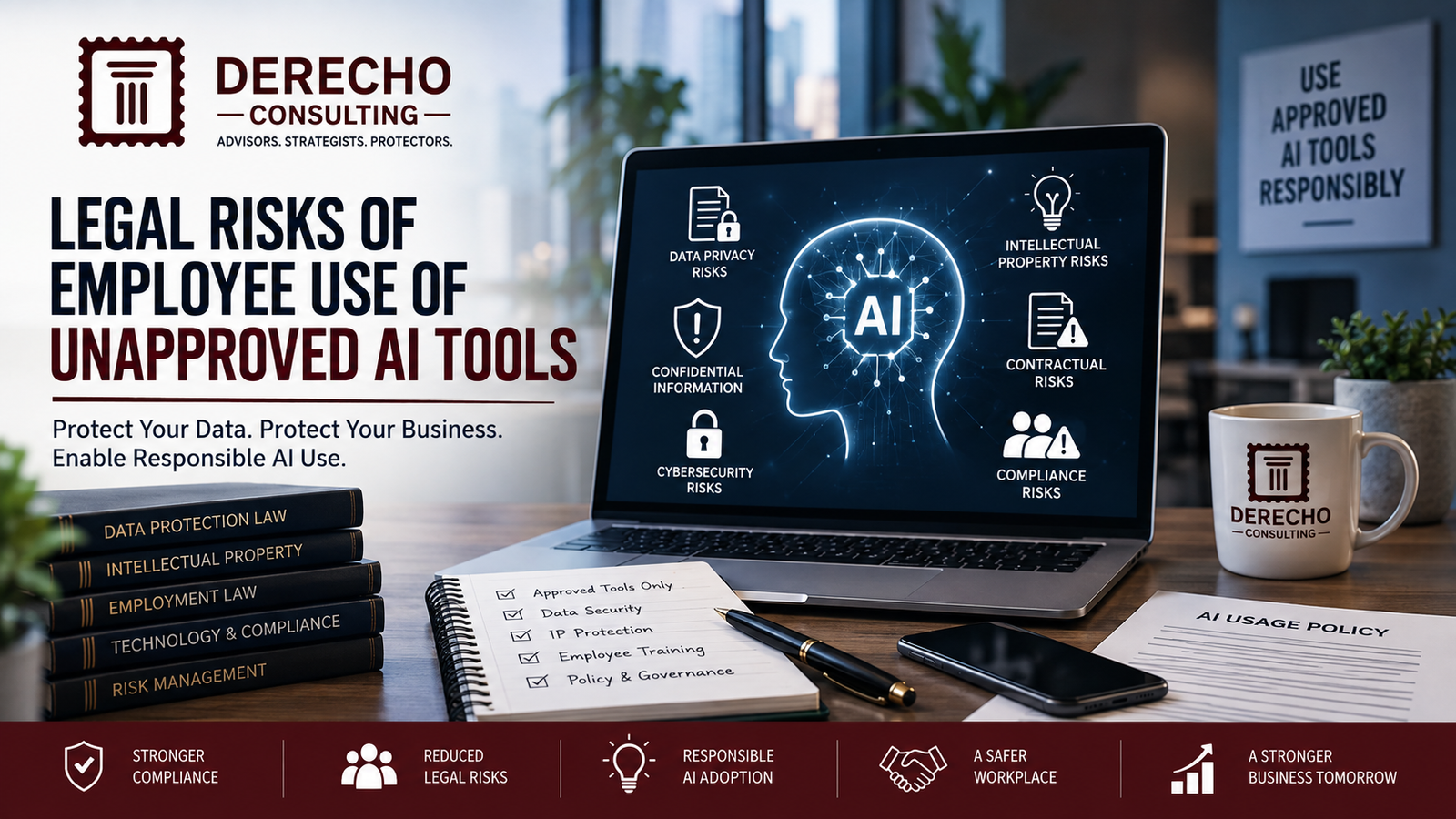
This guide explains AI Tool Risks associated with employee use of unapproved AI tools, including data privacy, confidential information, intellectual property, cybersecurity, contractual obligations, AI-generated content, employee policies, regulatory compliance, and practical risk-management measures for 2026.
Why AI Tool Risks Matter
Employees may use AI tools without fully understanding how submitted information is processed, stored, retained, shared, or used by the service provider. Uncontrolled AI usage can therefore create legal and operational risks for organisations.
Understanding AI Tool Risks can help businesses identify how unauthorised AI use may affect data protection, confidentiality, intellectual property, cybersecurity, contractual obligations, and regulatory compliance.
Effective controls can help businesses:
- Protect confidential and proprietary information.
- Reduce unauthorised disclosure of business data.
- Manage personal-data protection risks.
- Protect intellectual property and trade secrets.
- Reduce cybersecurity exposure.
- Review third-party AI service terms.
- Establish clear employee AI-use requirements.
- Manage risks associated with AI-generated content.
- Improve organisational accountability.
- Strengthen technology governance and compliance.
A clear AI-use framework can help businesses obtain the benefits of AI while reducing unnecessary legal and operational exposure.
Key Areas of AI Tool Risks
1. Confidential and Proprietary Information
Employees may enter confidential business information into public or third-party AI platforms without obtaining approval.
This information may include:
- Business strategies.
- Financial information.
- Customer information.
- Internal reports.
- Product plans.
- Source code.
- Technical documentation.
- Trade secrets.
- Pricing information.
- Internal communications.
Businesses should establish clear rules regarding which categories of information employees may and may not submit to AI tools.
Unauthorised disclosure of confidential information can potentially create contractual, employment, intellectual-property, and commercial risks.
2. Data Privacy and Personal Information
Employees may use AI tools to process personal information relating to customers, employees, vendors, or other individuals.
The review may include:
- Personal information.
- Customer databases.
- Employee records.
- Contact information.
- Identification information.
- Financial information.
- Customer communications.
- Personal information contained in business documents.
Businesses should assess whether an AI tool is appropriate for processing personal data and whether suitable contractual, technical, and organisational safeguards are in place.
The Digital Personal Data Protection Rules, 2025 are published by MeitY along with an enforcement timeline for the DPDP Act, making data-handling controls an important area for organisations using external AI services.
Businesses should also monitor the latest materials published by the Ministry of Electronics and Information Technology (MeitY) when reviewing their data-protection practices.
3. Intellectual Property and Trade Secrets
AI tools may create intellectual-property risks when employees upload or process proprietary materials.
Potential issues may involve:
- Source code.
- Software architecture.
- Product designs.
- Copyrighted materials.
- Marketing content.
- Research documents.
- Patents and inventions.
- Trade secrets.
- Proprietary databases.
- Internal technical information.
Employees should understand that business information should not automatically be shared with external AI services simply because those services are available online.
Organisations should establish safeguards for protecting valuable intellectual property and confidential business assets.
Businesses should also consider emerging intellectual-property and copyright concerns relating to the use of data, software, and digital content in AI systems. For related reading, see Derecho Consulting’s article on AI Training Data Lawsuits: Data Privacy & Copyright Risks in 2026.
4. AI-Generated Content and Ownership
Employees may use AI tools to generate text, images, software code, presentations, reports, or other business materials.
Businesses should consider:
- Whether AI-generated material can be used commercially.
- Whether third-party material has been incorporated.
- Copyright-related concerns.
- Licensing restrictions.
- Ownership considerations.
- Attribution requirements.
- Accuracy of generated information.
- Use of AI-generated images or content.
- Risks associated with confidential inputs.
The legal position surrounding AI-generated and AI-assisted content continues to develop, making human review and organisational controls particularly important.
Businesses using AI-generated content should also consider copyright protection and digital-content compliance when creating or distributing content.
5. Third-Party AI Terms and Contracts
Employees may sign up for AI tools using personal accounts or accept online terms without involving the organisation’s legal or procurement teams.
Potential concerns include:
- Data-use provisions.
- Data retention.
- Confidentiality.
- Licence grants.
- Ownership provisions.
- Usage restrictions.
- Service termination.
- Indemnification.
- Liability limitations.
- Jurisdiction and dispute resolution.
Businesses should review the contractual terms of AI vendors before approving their use for business activities.
6. Cybersecurity and Information Security
Unapproved AI tools can create additional cybersecurity risks if employees connect external applications to company systems or upload sensitive information.
Potential risks may involve:
- Unauthorised data sharing.
- Malicious AI applications.
- Unsafe browser extensions.
- Unapproved integrations.
- Credential exposure.
- Account compromise.
- Data leakage.
- Third-party security weaknesses.
- Inadequate access controls.
Organisations should maintain appropriate technical controls and monitor the use of unauthorised applications.
Businesses should also review cybersecurity requirements and incident-response guidance issued by CERT-In when developing information-security processes.
7. Employee Policies and AI Governance
A business should not rely only on informal instructions to control employee AI usage.
An internal AI policy can establish:
- Approved AI tools.
- Prohibited AI tools.
- Permitted use cases.
- Restricted information.
- Data-handling requirements.
- Approval procedures.
- Human-review requirements.
- Security requirements.
- Intellectual-property safeguards.
- Monitoring and reporting procedures.
Clear policies can help employees understand what constitutes acceptable and unacceptable AI use.
These measures can help organisations identify and manage AI Tool Risks while allowing employees to use approved AI technologies responsibly.
8. Regulatory and Compliance Requirements
The legal risks associated with AI use may extend beyond data protection and intellectual property.
Depending on the organisation and industry, businesses may need to consider:
- Data protection requirements.
- Cybersecurity obligations.
- Contractual obligations.
- Intellectual-property law.
- Employment requirements.
- Consumer protection.
- Industry-specific regulations.
- Confidentiality obligations.
- Record-keeping requirements.
- Regulatory reporting.
The IT Rules, 2021 were updated on 10 February 2026, and MeitY has published materials relating to synthetically generated information and related compliance requirements.
Businesses should therefore monitor regulatory developments relevant to their particular AI use cases and industry.
Common AI Tool Risks for Businesses
Businesses may face significant AI Tool Risks due to:
- Employees using unapproved AI applications.
- Confidential information being entered into external AI tools.
- Personal data being processed without appropriate controls.
- Unauthorised disclosure of trade secrets.
- Source code being uploaded to third-party platforms.
- Unclear ownership of AI-generated material.
- Use of copyrighted material without appropriate review.
- Employees accepting third-party AI terms without approval.
- Unauthorised AI integrations with company systems.
- Weak AI-use policies.
- Lack of employee training.
- Inaccurate or misleading AI-generated information.
- Inadequate human review.
- Cybersecurity vulnerabilities.
- Failure to maintain appropriate AI governance records.
These risks can become more significant when AI tools are used across multiple departments without centralised oversight.
Best Practices for Managing AI Tool Risks
Businesses should consider the following practices:
- Create a formal AI-use policy.
- Maintain a list of approved AI tools.
- Identify prohibited AI applications.
- Define categories of information that employees cannot submit to AI tools.
- Conduct vendor and contractual reviews.
- Establish data-protection safeguards.
- Protect source code and intellectual property.
- Require human review of AI-generated outputs.
- Implement appropriate access controls.
- Monitor unauthorised software and applications.
- Train employees on responsible AI use.
- Establish an AI incident-reporting process.
- Conduct periodic AI governance reviews.
- Maintain records of approved AI use cases.
- Coordinate legal, HR, IT, cybersecurity, and compliance teams.
These measures can help organisations identify and manage AI Tool Risks while allowing employees to use AI technologies responsibly.
A centralised governance approach can help businesses manage AI adoption while reducing uncontrolled employee use of third-party tools.
2026 AI Tool Risks Considerations
AI Tool Risks remain particularly important in 2026 as businesses increasingly use generative AI for software development, marketing, research, customer service, document preparation, analytics, and internal operations.
Businesses should therefore pay particular attention to:
- Employee use of public generative AI tools.
- Confidential information entered into AI systems.
- Personal-data processing through AI services.
- AI vendor contracts and data-handling terms.
- Source-code and intellectual-property protection.
- AI-generated business content.
- AI-assisted decision-making.
- Cybersecurity risks associated with AI applications.
- Shadow AI and unauthorised software.
- Employee AI training and awareness.
- AI governance policies.
- Documentation and accountability.
MeitY’s current policy repository includes the Digital Personal Data Protection Rules, 2025 and the IT Rules, 2021, while the IT Rules were updated in February 2026 and include provisions concerning synthetically generated information.
Businesses should therefore regularly review their AI policies, approved-tool lists, vendor arrangements, data-protection controls, and employee training rather than waiting for an AI-related incident to occur.
How Derecho Consulting Can Help
Derecho Consulting can help businesses identify and manage AI Tool Risks through AI policy development, technology-contract review, data-protection advisory, intellectual-property risk assessment, employee-policy review, regulatory analysis, cybersecurity legal advisory, and AI governance support.
A proactive approach can help businesses establish appropriate AI-use policies, protect confidential information, manage data-protection risks, safeguard intellectual property, review third-party AI services, and strengthen overall technology governance.
Derecho Consulting can also support organisations in reviewing existing policies and identifying areas where employee use of AI tools may create legal or compliance exposure.
Conclusion
AI Tool Risks are becoming an important consideration for businesses adopting generative AI technologies. Although AI tools can improve productivity and efficiency, uncontrolled employee use can create risks involving confidential information, personal data, intellectual property, cybersecurity, contracts, and regulatory compliance.
By establishing clear AI-use policies, approving appropriate tools, restricting sensitive information, reviewing vendor terms, protecting intellectual property, training employees, and maintaining effective governance processes, businesses can reduce unnecessary legal exposure.
Managing AI Tool Risks should therefore be treated as an ongoing part of an organisation’s technology, data-protection, cybersecurity, and compliance strategy.
A proactive and well-documented approach to AI Tool Risks can help organisations adopt AI responsibly while protecting business information, employees, customers, intellectual property, and long-term commercial interests.