
Introduction
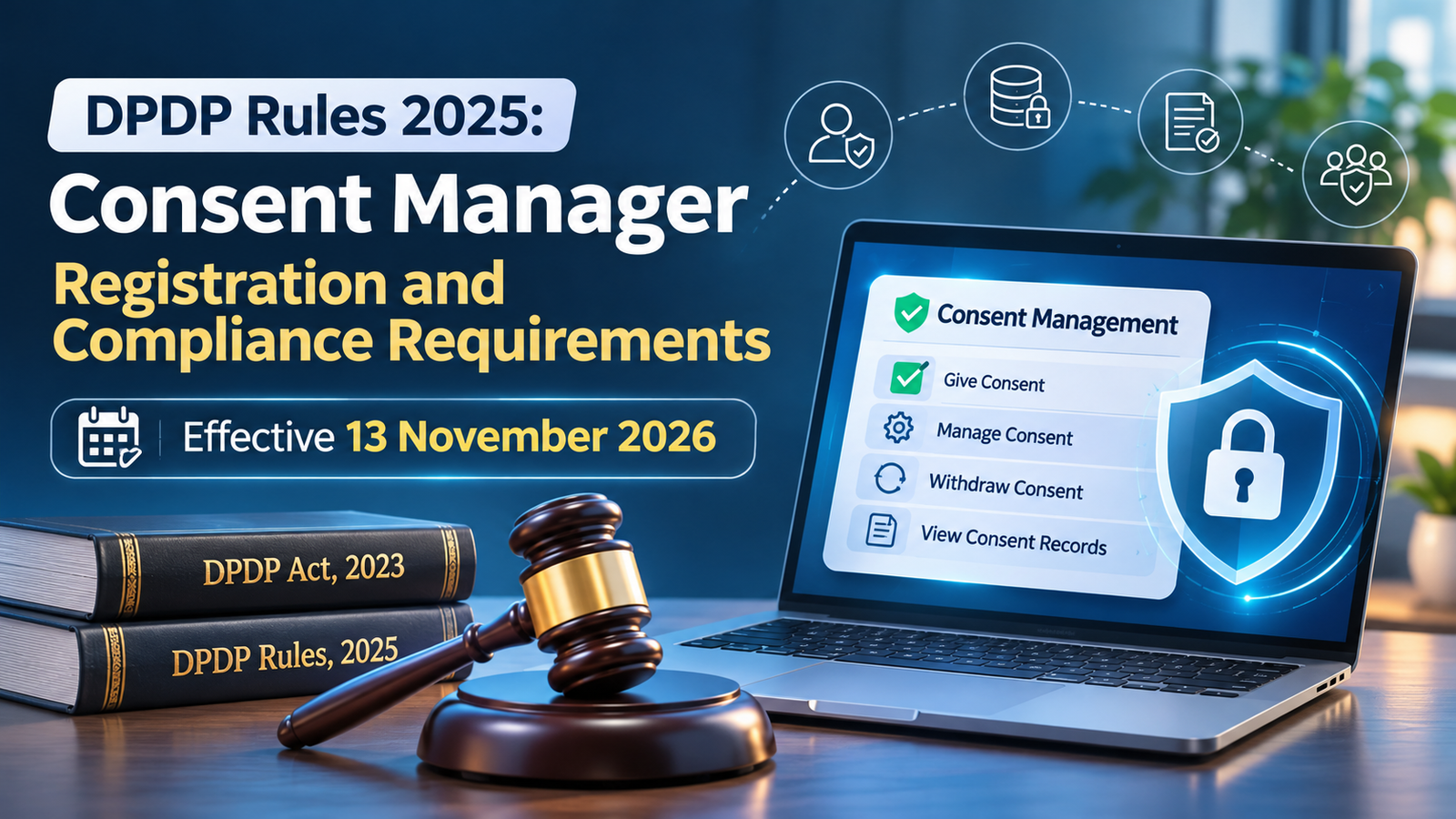
The DPDP Consent Manager framework is an important development in India’s digital data protection system. Rule 4 of the DPDP Rules, 2025 introduces registration requirements for eligible organisations that want to provide Consent Manager services, effective from 13 November 2026.
One important development is the registration framework for Consent Managers. Rule 4 of the DPDP Rules, 2025 comes into effect on 13 November 2026.
This development is important for businesses, technology companies and organisations involved in digital services. It also creates a new framework for individuals to manage their personal data consent.
A Consent Manager helps individuals give, review, manage and withdraw consent through a dedicated platform.
However, businesses should understand that registering as a Consent Manager is different from complying with the DPDP Act as a Data Fiduciary.
This article explains the DPDP Consent Manager framework, registration requirements, responsibilities and important compliance steps. It also discusses how businesses can prepare for India’s changing data protection environment.
1. What Are the DPDP Rules 2025?
The Digital Personal Data Protection Rules, 2025 were notified by the Ministry of Electronics and Information Technology (MeitY) on 14 November 2025.
These Rules provide the implementation framework for the Digital Personal Data Protection Act, 2023.
The framework aims to protect individuals’ digital personal data. It also explains how organisations should collect, use, store and process personal information.
The DPDP framework focuses on several important principles:
- Consent and transparency.
- Purpose limitation.
- Data minimisation.
- Accuracy of personal data.
- Storage limitation.
- Reasonable security safeguards.
- Accountability of organisations.
For example, a company collecting customer information through its website should explain why it needs that information.
It should also provide clear information about how the data will be used.
The DPDP framework aims to make these practices more transparent and accountable.
2. Why Is 13 November 2026 Important?
The date 13 November 2026 is an important milestone under the DPDP Rules, 2025.
Rule 4, which deals with Consent Manager registration and obligations, comes into effect one year after the Rules were published.
This means eligible companies can apply to the Data Protection Board of India for registration as Consent Managers under the prescribed framework.
However, this date does not mean every business must register as a Consent Manager.
Only organisations that intend to provide Consent Manager services need to meet the registration requirements.
Businesses that collect and process personal data must separately prepare for their applicable DPDP obligations.
DPDP Rules: Important Implementation Dates
| Date | Important development |
|---|---|
| 14 November 2025 | DPDP Rules, 2025 notified |
| 13 November 2026 | Rule 4: Consent Manager registration framework becomes effective |
| 13 May 2027 | Major remaining operational rules become effective |
The implementation is phased. Therefore, organisations should review each effective date instead of assuming that all requirements apply at once.
3. What Is a Consent Manager Under the DPDP Rules?
A DPDP Consent Manager provides individuals with a platform to manage their personal data consent and review their permissions.
A Consent Manager is a registered entity that provides a platform for individuals to manage their consent.
Under the DPDP framework, individuals are called Data Principals. Organisations that determine the purpose and means of processing personal data are generally called Data Fiduciaries.
A Consent Manager acts as an intermediary between these parties for consent management.
It allows individuals to manage permissions through a single platform.
Key Functions of a Consent Manager
A registered Consent Manager should enable individuals to:
- Give consent for personal data processing.
- Review existing consent permissions.
- Manage consent preferences.
- Withdraw previously given consent.
- Access records of consent.
- Review relevant data-sharing information.
For example, an individual may use a Consent Manager platform to review permissions given to different service providers.
The individual can also use the platform to manage or withdraw consent.
This framework aims to give individuals greater control over their personal data.
4. DPDP Consent Manager Registration Requirements
Rule 4 and Part A of the First Schedule explain the registration requirements.
An organisation must satisfy specific conditions before applying to operate as a Consent Manager.
The following are the main requirements.
1. Company Incorporated in India
The applicant must be a company incorporated in India.
This condition ensures that the applicant meets the prescribed legal structure.
2. Technical and Operational Capacity
The applicant must have sufficient technical and operational resources.
It should be capable of providing secure and reliable consent management services.
3. Minimum Net Worth of ₹2 Crore
The applicant must maintain a minimum net worth of ₹2 crore.
This financial requirement helps demonstrate the organisation’s ability to operate the platform.
4. Sound Financial Position
The applicant must have a sound financial condition.
Its business prospects, capital structure and expected business volume must meet the prescribed requirements.
5. Management Integrity
The directors, key managerial personnel and senior management must have a general reputation for fairness and integrity.
This requirement supports trust and accountability.
6. Appropriate Company Documents
The company’s Memorandum of Association and Articles of Association must contain the prescribed provisions.
These provisions must support compliance with the Consent Manager obligations under the Rules.
Organisations should review their corporate documents before submitting an application.
5. How to Apply for Consent Manager Registration
Eligible organisations must apply to the Data Protection Board of India.
The application must include the prescribed particulars, information and supporting documents.
The Board may examine the application and verify whether the applicant meets the required conditions.
General Registration Process
Step 1: Check eligibility
First, review the conditions under Part A of the First Schedule.
Confirm that the company satisfies the incorporation, financial and management requirements.
Step 2: Review financial documents
Next, check the company’s net worth and financial records.
The applicant must meet the minimum net worth requirement of ₹2 crore.
Step 3: Assess technical capability
Review the platform’s security, operational capacity and consent management features.
The system should support the required consent management functions.
Step 4: Prepare company documents
Prepare the company’s constitutional documents and other prescribed supporting records.
Check that the documents contain the required provisions.
Step 5: Submit the application
Submit the application with the required information and documents to the Data Protection Board.
Step 6: Respond to verification
The Board may make enquiries to verify the applicant’s eligibility.
If the requirements are satisfied, the Board may register the applicant as a Consent Manager.
Otherwise, it may reject the application and communicate the reasons.
The exact application procedure and document requirements should be checked against the Board’s latest published instructions.
6. Responsibilities of Registered Consent Managers
A registered DPDP Consent Manager must maintain transparency, protect consent records and follow the applicable security requirements.
Registration is only the beginning. Consent Managers must follow the obligations under Part B of the First Schedule.
These requirements help protect individuals and maintain transparency.
1. Provide a Consent Management Platform
A Consent Manager must develop and maintain a website, application or both.
This platform acts as the main way for individuals to access its services.
2. Maintain Consent Records
The platform must maintain records of consent and related data-sharing activities.
Individuals should also be able to access their records.
3. Retain Records for Seven Years
Consent Managers must maintain the prescribed records for at least seven years.
A longer period may apply if agreed with the individual or required by law.
4. Provide Machine-Readable Records
When requested by an individual, the Consent Manager must make relevant records available in machine-readable form, in accordance with its terms of service.
This supports transparency and accessibility.
5. Protect Personal Data
Consent Managers must implement reasonable security safeguards.
These safeguards should help prevent personal data breaches.
6. Avoid Conflicts of Interest
Consent Managers must act in a fiduciary capacity towards individuals.
They must avoid conflicts of interest with Data Fiduciaries.
They must also maintain measures to prevent conflicts involving directors, key managerial personnel and senior management.
7. Do Not Subcontract Core Obligations
Consent Managers cannot subcontract or assign the performance of their obligations under the Act and Rules.
This helps maintain accountability.
8. Maintain Transparency
Consent Managers must publish prescribed information about their promoters, directors, key managerial personnel and shareholding structure.
This information should be accessible through their website or application.
7. How the DPDP Consent Manager Framework Affects Businesses
The Consent Manager framework creates a new way for individuals to manage consent.
However, businesses should understand their separate responsibilities under the DPDP Act.
A business does not automatically become a Consent Manager simply because it collects personal data.
Most businesses that collect and process personal data will operate as Data Fiduciaries, depending on their role.
They should review their data collection and processing practices.
Important Actions for Businesses
Review data collection practices
Identify the personal data collected from customers, employees and website visitors.
Improve privacy notices
Explain what information is collected and why it is required.
Use clear and simple language.
Review consent mechanisms
Ensure that consent is obtained through appropriate and transparent processes where required.
Maintain data records
Keep accurate records of data processing activities and consent where applicable.
Strengthen data security
Review access controls, security policies and data protection measures.
Review third-party arrangements
Check how vendors and service providers handle personal data.
These steps can help businesses prepare for the wider DPDP compliance framework.
8. Common DPDP Compliance Mistakes Businesses Should Avoid
Businesses may face challenges when implementing new data protection requirements.
However, proper planning can help prevent common mistakes.
1. Treating Consent as a Formality
Some businesses collect consent without clearly explaining the purpose.
Solution: Provide clear notices that explain why personal data is required.
2. Collecting Unnecessary Information
Collecting more personal data than needed can increase privacy risks.
Solution: Review data collection forms and remove unnecessary fields.
3. Ignoring Data Security
Weak access controls can expose personal information.
Solution: Use appropriate security safeguards and restrict unauthorised access.
4. Not Reviewing Vendor Practices
Third-party service providers may process customer or employee information.
Solution: Review vendor agreements and data handling procedures.
5. Confusing Consent Manager Registration with Business Compliance
Not every company needs to register as a Consent Manager.
Solution: Identify whether the organisation is acting as a Data Fiduciary, a Consent Manager applicant or another relevant entity.
6. Ignoring Implementation Dates
The DPDP Rules follow a phased implementation schedule.
Solution: Maintain a compliance calendar and track each effective date.
9. DPDP Compliance Checklist for Businesses
Businesses can use this checklist to review their data protection practices.
- Identify the personal data collected.
- Review the purpose of data collection.
- Update privacy notices.
- Review consent collection mechanisms.
- Check consent withdrawal processes.
- Maintain relevant data and consent records.
- Review data retention practices.
- Implement reasonable security safeguards.
- Review third-party vendor arrangements.
- Assign responsibility for privacy compliance.
- Track the DPDP implementation schedule.
- Review applicable requirements before 13 May 2027.
Organisations planning to become Consent Managers should also review the registration conditions and obligations under Rule 4 and the First Schedule.
10. How Derecho Consulting Can Help Businesses
Data protection compliance requires legal understanding and proper documentation.
Businesses must identify their responsibilities and review how they collect, use and protect personal data.
Derecho Consulting can support organisations with legal and regulatory compliance requirements.
Professional assistance may include:
- DPDP compliance reviews.
- Privacy policy drafting and review.
- Consent notice documentation.
- Data protection risk assessments.
- Vendor agreement reviews.
- Data handling policy development.
- Regulatory compliance planning.
- Legal guidance on data protection responsibilities.
With proper legal guidance, businesses can improve their privacy practices and prepare for applicable regulatory requirements.
Visit Derecho Consulting to learn more about its legal and compliance services.
11. Frequently Asked Questions About DPDP Consent Managers
1. When does Rule 4 of the DPDP Rules 2025 become effective?
Rule 4 becomes effective on 13 November 2026. It covers Consent Manager registration and obligations.
2. Is Consent Manager registration mandatory for every business?
No. Registration applies to organisations that want to operate as Consent Managers. Other businesses must comply with the DPDP requirements applicable to their roles.
3. What is the minimum net worth required for a Consent Manager?
An applicant must have a minimum net worth of ₹2 crore.
4. Who can apply for Consent Manager registration?
A company incorporated in India that meets the conditions in Part A of the First Schedule can apply to the Data Protection Board.
5. How long must Consent Managers retain records?
They must retain the prescribed records for at least seven years, or longer where agreed with the individual or required by law.
6. Can a Consent Manager subcontract its obligations?
No. The Rules prohibit Consent Managers from subcontracting or assigning the performance of their obligations under the Act and Rules.
7. When do the major remaining DPDP Rules become effective?
The major remaining operational rules are scheduled to become effective on 13 May 2027.
Conclusion
The DPDP Rules, 2025 introduce an important framework for protecting digital personal data in India.
The introduction of Consent Manager registration under Rule 4 on 13 November 2026 is a significant step towards giving individuals greater control over their personal information.
Eligible companies that want to operate as Consent Managers must meet the registration conditions. They must also maintain secure platforms, protect consent records and avoid conflicts of interest.
At the same time, other businesses should review their data collection practices, privacy notices and security policies. They should prepare for the remaining DPDP requirements that become effective in May 2027.
Stay informed, strengthen your data protection practices and manage regulatory compliance with support from Derecho Consulting.
Disclaimer: This article is for general informational purposes only. It does not constitute legal advice. The applicability of the DPDP Act and Rules depends on the organisation’s activities and legal role. Readers should refer to the official Gazette notification and latest instructions from the Data Protection Board of India or consult a qualified legal professional before taking action.
Be Part of Something Bigger!
Whether you’re exploring new ideas, learning something new, or looking for opportunities, Enigma Community brings you closer to a world of possibilities.
Join Us: https://www.enigmacommunity.com/