
Introduction
Employment Contracts are essential for businesses in India because they define the terms and conditions between employers and employees. They explain job responsibilities, salary, working hours and workplace policies. A clear employment agreement helps protect both parties and reduces misunderstandings.
A clear employment agreement protects both parties. It explains salary, job responsibilities, working hours, leave policies and termination conditions.
However, some businesses use employment agreements without reviewing their legal terms. Missing clauses can create disputes and affect business operations.
Therefore, employers should prepare clear and legally appropriate employment documents. They should also review these documents whenever company policies or employment laws change.
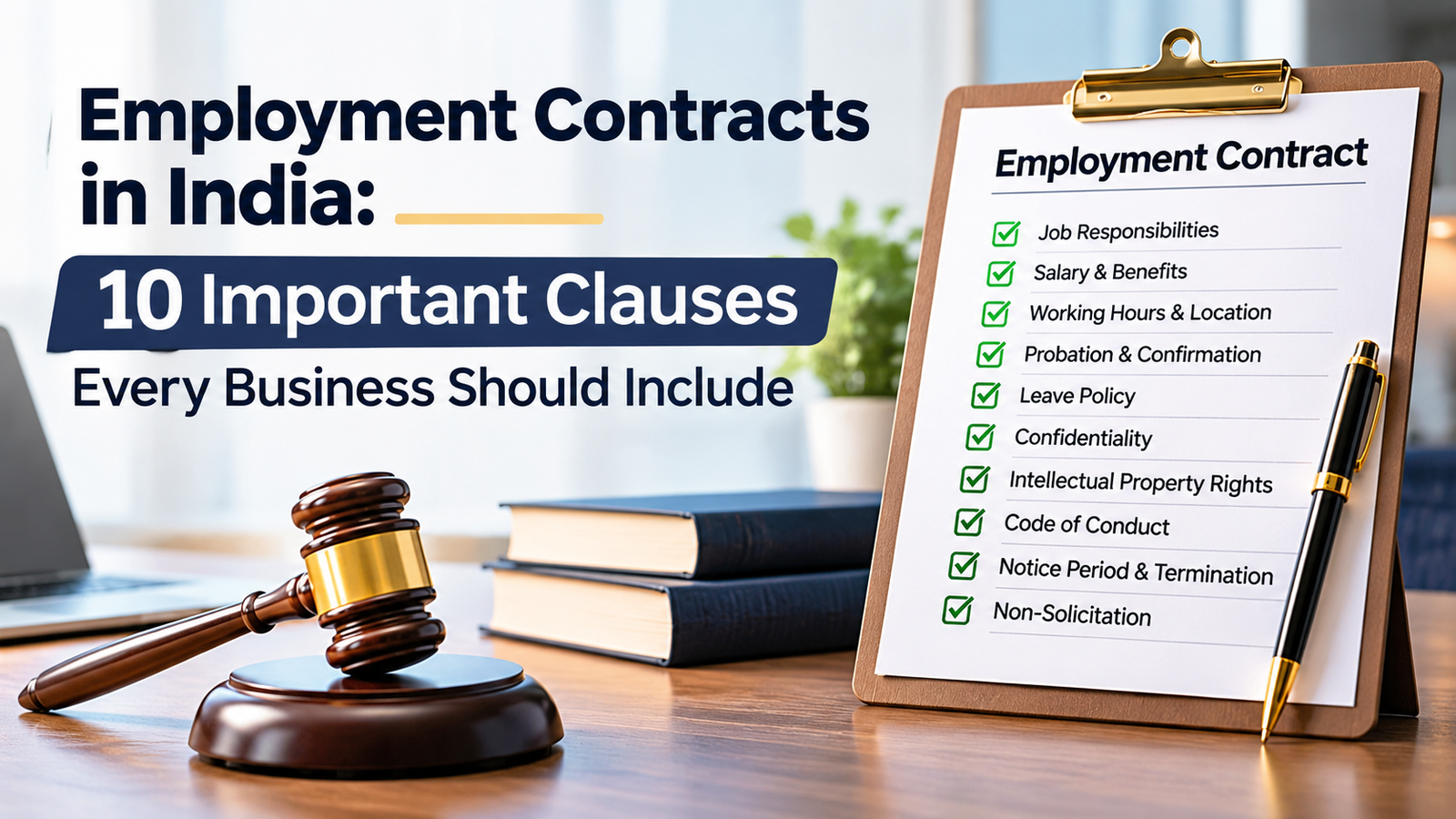
This article explains Employment Contracts in India and the 10 important clauses every business should consider. It also covers legal requirements, common mistakes and a practical checklist for employers.
What Are Employment Contracts in India?
Employment Contracts help employers explain workplace rules, employee duties and important employment conditions.
An employment contract is a written agreement between an employer and an employee.
It explains the terms and conditions of employment. Both parties should understand their rights and responsibilities before signing the agreement.
A typical employment agreement includes:
- Employee and employer details.
- Job title and responsibilities.
- Salary and benefits.
- Working hours and location.
- Leave and holiday policies.
- Confidentiality requirements.
- Notice period and termination conditions.
Employment Contracts give both parties a clear understanding of their working relationship. They also provide a reference if a workplace dispute arises.
Why Are Employment Contracts Important for Businesses?
Well-written Employment Contracts help businesses maintain transparency and build trust with employees.
Every business should maintain clear employment documents. These documents help employers manage their workforce and reduce legal risks.
Here are some important benefits.
Clear job responsibilities: Employees understand their duties and expectations.
Salary transparency: The agreement explains compensation and payment terms.
Better workplace management: Clear policies help employees understand company rules.
Confidentiality protection: Appropriate clauses help protect business information.
Dispute prevention: Written terms reduce misunderstandings between both parties.
Legal compliance: Proper employment documents help businesses meet applicable labour requirements.
Therefore, well-drafted Employment Contracts support both business operations and employee protection.
10 Important Clauses in Employment Contracts
Employers should review the following 10 clauses while preparing an employment agreement.
1. Job Title and Responsibilities
The employment contract should clearly explain the employee’s position and duties.
It should mention the job title, department and reporting manager. It should also describe the main responsibilities of the role.
For example, a software developer’s agreement may include:
- Developing and maintaining applications.
- Fixing software issues.
- Working with development teams.
- Following company security policies.
- Completing assigned project tasks.
A clear job description helps employees understand their responsibilities. It also reduces confusion about work expectations.
2. Salary and Compensation Structure
Employment Contracts should clearly explain salary components, payment schedules and applicable employee benefits.
Salary is one of the most important parts of an employment agreement.
The contract should clearly explain the employee’s compensation structure.
It may include:
- Basic salary.
- House Rent Allowance (HRA).
- Special allowances.
- Performance incentives.
- Bonus, where applicable.
- Payment frequency.
- Permitted deductions.
Employers should also explain how salary revisions and performance-based payments work.
For example, the agreement can specify that salary is paid monthly through bank transfer.
However, the compensation structure must follow applicable wage and statutory benefit requirements.
3. Working Hours and Work Location
The agreement should explain where and when the employee is expected to work.
This clause should cover:
- Normal working hours.
- Weekly working days.
- Weekly rest days.
- Office location.
- Remote or hybrid work arrangements.
- Applicable overtime requirements.
For example, an agreement may specify that an employee works from Monday to Friday at the company’s Hyderabad office.
If the company offers remote work, it should explain the applicable conditions.
Clear working-hour terms help employees plan their schedules. They also help employers manage attendance and productivity.
4. Probation Period and Confirmation
Many companies appoint employees on a probationary basis.
During this period, employers review the employee’s performance and suitability for the role.
The contract should explain:
- Probation duration.
- Performance expectations.
- Review process.
- Confirmation procedure.
- Extension conditions.
- Applicable notice requirements.
For example, a company may provide a three-month probation period.
After reviewing performance, the employer may confirm the employee or extend probation where legally permitted.
The agreement should explain the process clearly. Employers must also follow applicable employment laws and service rules.
5. Leave and Holiday Policy
Employees need clear information about leave entitlements.
The employment agreement should refer to the company’s applicable leave policy.
It may cover:
- Casual leave.
- Sick leave.
- Earned or annual leave.
- Public holidays.
- Maternity benefits, where applicable.
- Other statutory leave entitlements.
The agreement should also explain the leave application and approval process.
However, employers cannot reduce statutory leave benefits through an employment contract.
They must follow the applicable central and state labour laws.
6. Confidentiality and Data Protection
Employment Contracts should also explain how employees must protect confidential business information and customer data.
Employees may access confidential business information during their employment.
This information may include:
- Customer details.
- Financial records.
- Business strategies.
- Product information.
- Internal documents.
- Login credentials.
- Technical information.
A confidentiality clause explains how employees must protect this information.
For example, employees should not share confidential customer records with unauthorised persons.
The agreement should also explain employee responsibilities when handling personal and business data.
Businesses should review applicable data protection requirements when drafting this clause.
7. Intellectual Property Rights
Employees may create software, designs, documents, reports and other work during their employment.
An intellectual property clause explains ownership and permitted use of such work.
It may cover:
- Software code.
- Website designs.
- Creative content.
- Research documents.
- Product designs.
- Business materials.
- Inventions created during employment.
For example, a software company may include terms covering ownership of code developed as part of an employee’s assigned duties.
However, intellectual property ownership depends on the nature of the work, applicable law and the agreement’s wording.
Employers should draft this clause carefully to avoid disputes.
8. Code of Conduct and Disciplinary Procedures
Every business should establish workplace standards.
A code of conduct clause explains the behaviour expected from employees.
It may cover:
- Professional behaviour.
- Workplace discipline.
- Attendance requirements.
- Anti-harassment policies.
- Conflicts of interest.
- Company property.
- IT and internet usage.
- Reporting misconduct.
The agreement should also refer to the company’s disciplinary procedure.
For example, employees must follow workplace safety and information security policies.
Clear conduct requirements help maintain a professional working environment.
Employers must also follow applicable procedures when investigating misconduct or taking disciplinary action.
9. Notice Period and Termination Conditions
Every employment agreement should explain how employment can end.
This clause helps both parties understand their responsibilities during separation.
It should cover:
- Notice period.
- Resignation procedure.
- Termination conditions.
- Notice pay, where applicable.
- Return of company property.
- Final settlement.
- Exit documentation.
For example, an agreement may provide a 30-day notice period, subject to applicable law and employment conditions.
Employers should avoid using unclear or excessively broad termination clauses.
They must also follow applicable legal protections and procedural requirements.
10. Non-Solicitation and Post-Employment Restrictions
Businesses may want to protect their customer relationships and confidential information after an employee leaves.
A carefully drafted non-solicitation clause may address the misuse of confidential customer information or active solicitation of business relationships.
However, employers must understand the legal limits of restrictive clauses.
Section 27 of the Indian Contract Act, 1872 generally makes agreements restraining lawful trade or profession void, subject to limited exceptions.
Therefore, a broad post-employment non-compete clause may be unenforceable in India.
Employers should seek legal advice before including non-compete or non-solicitation terms.
The clause should protect legitimate business interests without unlawfully restricting an employee’s right to work.
Legal Requirements for Employment Contracts in India
Employment agreements should comply with applicable Indian employment and labour laws.
India’s four Labour Codes came into effect on 21 November 2025, according to the Ministry of Labour and Employment.
These include:
- Code on Wages, 2019.
- Industrial Relations Code, 2020.
- Code on Social Security, 2020.
- Occupational Safety, Health and Working Conditions Code, 2020.
The framework covers wages, social security, industrial relations and workplace conditions.
It also provides for appointment letters to employees.
Employers should review their appointment letter formats and employment policies. They should ensure that their documents meet the requirements applicable to their establishment.
Important Legal Areas Employers Should Review
1. Appointment letters
Employers should issue appointment letters according to applicable labour requirements.
2. Wage payments
Salary and other applicable wage payments must follow statutory requirements.
3. Social security
Employers should review applicable EPF, ESI, gratuity and other social security obligations.
4. Working conditions
Employment terms should follow applicable working-hour, safety and welfare requirements.
5. Employee protection
Employers must follow relevant provisions relating to employee rights and workplace protections.
The exact obligations may vary based on the establishment, employee category and applicable central or state rules.
Common Employment Contract Mistakes Businesses Should Avoid
Poorly drafted employment agreements can create unnecessary legal problems.
Businesses should avoid these common mistakes.
1. Using Generic Templates
A standard template may not cover every business requirement.
Solution: Prepare agreements based on the employee’s role and applicable legal requirements.
2. Keeping Salary Terms Unclear
Unclear salary structures can create disputes.
Solution: Explain the compensation components and payment conditions.
3. Ignoring Confidentiality
Employees may handle sensitive business information.
Solution: Include clear confidentiality and data protection responsibilities.
4. Adding Unenforceable Restrictions
Overly broad restrictions can create legal challenges.
Solution: Review restrictive clauses under applicable Indian law.
5. Missing Termination Conditions
Unclear exit terms can cause disagreements.
Solution: Explain notice periods, termination procedures and final settlement conditions.
6. Not Updating Employment Agreements
Employment laws and business policies may change.
Solution: Review employment documents regularly and update them when necessary.
Employment Contracts: Checklist for Employers
Use this checklist before issuing an employment agreement.
- Verify employer and employee details.
- Include the correct job title and responsibilities.
- Explain the salary structure.
- Specify working hours and location.
- Mention probation and confirmation conditions.
- Include leave and holiday policies.
- Add confidentiality and data protection terms.
- Explain intellectual property ownership.
- Include code of conduct requirements.
- Specify notice period and termination conditions.
- Review non-solicitation and restrictive clauses.
- Check applicable labour law requirements.
- Provide the appointment letter to the employee.
- Obtain acknowledgement and maintain proper records.
This checklist helps HR teams review important contract terms before onboarding employees.
How Derecho Consulting Can Help Businesses
Employment law compliance requires careful planning and regular review.
Businesses must prepare appropriate employment documents. They must also understand employee rights and employer responsibilities.
Derecho Consulting can support businesses with employment and corporate legal requirements.
Professional legal support may include:
- Employment agreement drafting and review.
- Appointment letter preparation.
- HR policy documentation.
- Confidentiality agreement drafting.
- Employment law compliance reviews.
- Contractual risk identification.
- Legal guidance on employee separation.
With proper legal guidance, businesses can improve their employment documentation and reduce avoidable disputes.
Visit Derecho Consulting to learn more about its legal and compliance services.
Frequently Asked Questions About Employment Contracts
1. Is an employment contract mandatory in India?
The applicable labour framework provides for appointment letters to employees. Employers should follow the relevant requirements based on their establishment and employee category.
2. What should an employment contract include?
It should clearly explain job responsibilities, salary, working hours, leave, confidentiality, intellectual property and termination conditions.
3. Can an employer change an employment contract?
Changes should generally be made through a documented agreement or lawful process. Employers should not make changes that violate statutory rights or applicable service conditions.
4. Is a non-compete clause valid in India?
Section 27 of the Indian Contract Act, 1872 generally restricts agreements that prevent a person from carrying on a lawful trade or profession. Post-employment non-compete restrictions are therefore generally unenforceable, subject to applicable legal exceptions.
5. Can an employment contract include a notice period?
Yes. Employers can include notice period terms, subject to applicable labour laws, service conditions and other legal requirements.
6. Why should businesses review employment agreements regularly?
Regular reviews help businesses update policies, address legal changes and reduce contractual risks.
Reviewing Employment Contracts regularly helps businesses maintain clear employment terms and follow applicable labour requirements.
Conclusion
Employment Contracts are an important part of business and workforce management.
A clear agreement helps employers explain job responsibilities, salary, working hours and workplace policies. It also helps employees understand their rights and responsibilities.
Businesses should carefully review all 10 clauses before issuing employment agreements. They should also check the latest labour requirements and update their documents when necessary.
Most importantly, employers should avoid unclear terms and unlawful restrictions. A properly drafted employment agreement creates transparency and supports a professional workplace.
Protect your business, respect employee rights and strengthen your employment practices with legal support from Derecho Consulting.
Disclaimer: This article is for general informational purposes only. Employment laws and requirements may vary based on the establishment, employee category, industry and applicable state rules. The enforceability of contractual terms depends on the facts and applicable law. Consult a qualified legal professional before preparing or signing an employment agreement.