
Introduction
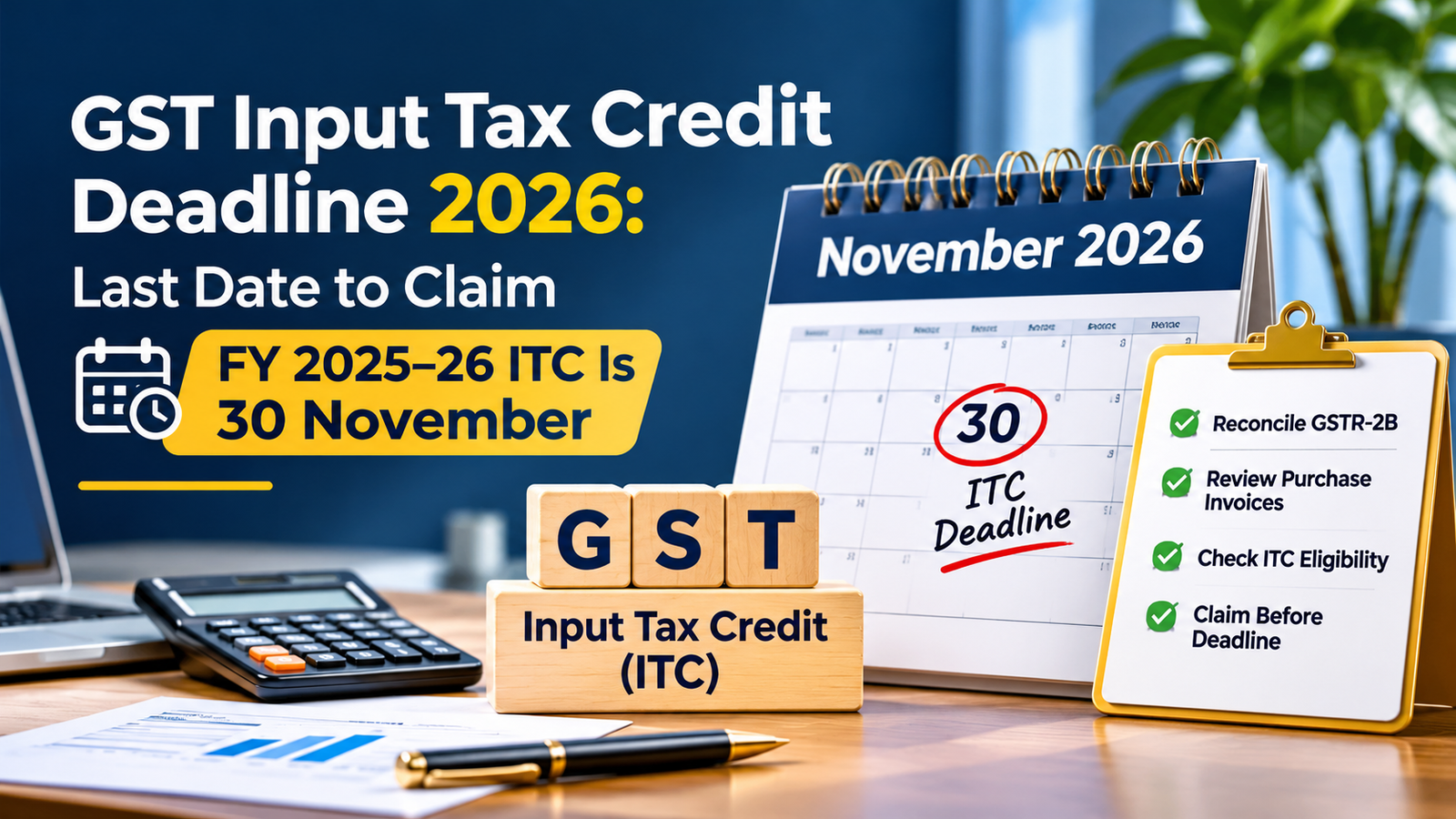
The GST Input Tax Credit Deadline for FY 2025–26 is approaching. Businesses must review their eligible Input Tax Credit (ITC) before 30 November 2026.
Input Tax Credit helps registered businesses reduce their GST liability. However, businesses must claim eligible credit within the prescribed time.
Missing the deadline may result in the loss of eligible tax credit. Therefore, businesses should check their purchase records and GST returns without delay.
This article explains the GST Input Tax Credit Deadline 2026, Section 16(4), GSTR-2B reconciliation and common filing mistakes. It also provides a simple checklist to help businesses prepare.
1. What Is the GST Input Tax Credit Deadline 2026?
The GST Input Tax Credit Deadline is the statutory time limit for claiming eligible ITC on invoices and debit notes.
For FY 2025–26, the general outer deadline is 30 November 2026.
However, businesses must also consider the date of filing their relevant annual GST return. If they file that return earlier, the earlier date becomes the cut-off.
Therefore, businesses should complete their ITC review before filing the annual return.
Important GST ITC Dates
| Particulars | Details |
|---|---|
| Financial year | 2025–26 |
| General ITC cut-off | 30 November 2026 |
| Applicable provision | Section 16(4), CGST Act |
| Earlier cut-off | Date of filing the relevant annual return |
| Monthly GSTR-3B for October 2026 | Generally due 20 November 2026 |
| Main reconciliation document | GSTR-2B |
The November cut-off does not automatically extend the normal GSTR-3B filing deadline.
2. GST Input Tax Credit Deadline Under Section 16(4)
Section 16(4) of the Central Goods and Services Tax Act, 2017 sets the time limit for claiming ITC.
Under this provision, businesses must claim eligible ITC by the earlier of two dates:
- 30 November following the end of the relevant financial year.
- The date of filing the relevant annual GST return.
For FY 2025–26, the general date is 30 November 2026.
However, if a business files its annual return before that date, it may lose the opportunity to claim any remaining first-time ITC for that year.
Example
Suppose a company has an eligible purchase invoice dated 15 February 2026.
The company has not yet claimed the related ITC.
If the company has not filed its annual return, it may claim the credit within the applicable time limit. However, it must satisfy all other GST eligibility conditions.
If the company files its annual return on 15 November 2026, that date becomes the earlier cut-off.
Therefore, the company should complete its ITC review before filing the annual return.
3. Who Should Review the GST Input Tax Credit Deadline?
The GST Input Tax Credit Deadline is important for registered businesses that claim ITC on eligible purchases.
These may include:
- Manufacturers purchasing raw materials.
- Traders purchasing goods for resale.
- Service providers receiving taxable services.
- E-commerce businesses.
- Companies purchasing business equipment.
- Businesses with unclaimed eligible invoices.
However, GST registration alone does not make every purchase eligible for ITC.
Businesses must check the conditions under Section 16 and the restrictions under Section 17 of the CGST Act.
4. How to Reconcile GSTR-2B Before the ITC Deadline
GSTR-2B is an important document for GST reconciliation.
It provides a statement of input tax credit based on relevant supplier reporting and other available GST data.
Businesses should compare GSTR-2B with their purchase records before claiming ITC.
Step 1: Download GSTR-2B
First, log in to the official GST Portal.
Download the relevant GSTR-2B statements for FY 2025–26 and later periods containing relevant invoice details.
Step 2: Review Purchase Records
Next, prepare a complete purchase register.
Include invoice numbers, invoice dates, supplier GSTINs, taxable values and GST amounts.
Step 3: Match Invoice Details
Compare the purchase register with GSTR-2B.
Check the following information:
- Supplier GSTIN.
- Invoice number.
- Invoice date.
- Taxable value.
- CGST, SGST and IGST amounts.
- Credit notes and debit notes.
- ITC availability and restrictions.
Step 4: Identify Missing Invoices
Some invoices may appear in the purchase register but not in GSTR-2B.
In such cases, contact the supplier and request the necessary corrections.
However, businesses should not claim ITC merely because an invoice appears in their accounting records.
Step 5: Review Previous ITC Claims
Finally, compare the eligible ITC with amounts already claimed in GSTR-3B.
This helps identify unclaimed credit, duplicate claims and incorrect reversals.
5. Documents Required to Claim GST Input Tax Credit
Businesses should maintain proper documents to support their ITC claims.
Important documents include:
- Valid GST tax invoices.
- Debit notes, where applicable.
- Purchase registers.
- GSTR-2B statements.
- Relevant GSTR-3B returns.
- Proof of receipt of goods or services.
- Supplier payment records.
- ITC reconciliation statements.
- Credit note and reversal records.
These records help businesses verify their claims.
They also support future GST audits and compliance reviews.
6. Common ITC Mistakes Businesses Should Avoid
Businesses sometimes lose eligible credit because of incorrect reporting or delayed reconciliation.
Therefore, they should review the following mistakes before the deadline.
Missing Purchase Invoices
Some purchase invoices may not appear in the GST records.
Solution: Compare the purchase register with GSTR-2B. Contact suppliers when invoice details are missing.
Claiming Ineligible ITC
Not every business purchase qualifies for ITC.
Certain goods and services are restricted under Section 17(5) of the CGST Act.
Solution: Review the nature of each purchase before claiming credit.
Duplicate ITC Claims
Businesses may accidentally claim the same invoice twice.
Solution: Maintain an invoice-wise ITC register and compare it with previous returns.
Incorrect Supplier Details
Wrong GSTINs or invoice information can create mismatches.
Solution: Verify supplier details before completing the reconciliation.
Filing the Annual Return Too Early
Filing the relevant annual return before claiming all eligible ITC may close the claim window.
Solution: Complete the ITC reconciliation before filing the annual return.
Ignoring ITC Reversals
Certain situations require businesses to reverse ITC.
Solution: Review supplier payment conditions, applicable reversal rules and earlier credit adjustments.
7. What Happens If Businesses Miss the GST ITC Deadline?
Missing the GST Input Tax Credit Deadline can create financial difficulties.
Businesses may lose the right to claim otherwise eligible first-time ITC for the relevant financial year.
As a result, their effective tax costs may increase.
For example, suppose a business has ₹50,000 in eligible but unclaimed ITC.
If the statutory time limit expires before the business claims it, the credit may become unavailable.
However, certain special provisions and rules may apply to specific situations, including some previously reversed credits.
Therefore, businesses should review their circumstances before treating any credit as permanently lost.
8. GST Input Tax Credit Deadline 2026: Business Checklist
Businesses can use this checklist before the November deadline.
- Download relevant GSTR-2B statements.
- Prepare the FY 2025–26 purchase register.
- Match supplier GSTINs and invoice details.
- Identify missing purchase invoices.
- Contact suppliers about reporting errors.
- Review eligible and ineligible ITC.
- Check blocked credits under Section 17(5).
- Review earlier ITC reversals.
- Identify duplicate ITC claims.
- Reconcile ITC with previous GSTR-3B returns.
- Review applicable GST return deadlines.
- Claim remaining eligible ITC within the statutory time limit.
- Complete the ITC review before filing the annual return.
- Save reconciliation reports and supporting documents.
Completing these checks early can help businesses avoid last-minute problems.
9. Why Early GST ITC Reconciliation Matters
Early reconciliation helps businesses identify mistakes before the statutory cut-off.
It also gives suppliers more time to correct reporting errors.
In addition, regular reconciliation improves financial reporting and GST compliance.
Businesses can benefit from:
- Better purchase record accuracy.
- Fewer GST mismatches.
- Improved ITC tracking.
- Lower risk of duplicate claims.
- Better documentation.
- More reliable tax planning.
Therefore, businesses should review ITC every month instead of waiting until the financial year ends.
For related guidance, read our article on GST Compliance November 2026.
10. How Derecho Consulting Can Help Businesses
Managing GST compliance can be challenging for growing businesses.
Companies must review purchase records, track supplier reporting and understand changing tax requirements.
Derecho Consulting supports businesses with GST and regulatory compliance services.
Professional assistance can help businesses with:
- GST return filing support.
- ITC reconciliation.
- GST compliance reviews.
- Purchase invoice verification.
- Identification of ITC mismatches.
- Tax documentation.
- Compliance planning.
With proper support, businesses can improve their GST processes and reduce reporting errors.
Visit Derecho Consulting to learn more about its tax and compliance services.
11. Frequently Asked Questions
What is the GST Input Tax Credit Deadline for FY 2025–26?
The general deadline is 30 November 2026. However, the date of filing the relevant annual return becomes the deadline if it occurs earlier.
Can businesses claim FY 2025–26 ITC after 30 November 2026?
Generally, businesses cannot make a new ITC claim after the Section 16(4) cut-off. However, specific exceptions and rules may apply to certain circumstances.
Is GSTR-2B reconciliation mandatory before claiming ITC?
Businesses must meet the applicable ITC eligibility and reporting conditions. Reconciling GSTR-2B with purchase records is an important compliance step.
Can businesses claim ITC if the supplier has not reported the invoice?
An invoice missing from the relevant supplier reporting may prevent the recipient from satisfying the applicable ITC conditions. Businesses should follow up with the supplier and review the legal requirements.
Does the November deadline extend GSTR-3B filing dates?
No. The Section 16(4) ITC cut-off does not automatically extend the prescribed GSTR-3B filing deadlines.
What happens if a business files GSTR-9 early?
Filing the relevant annual return before 30 November may close the time window for claiming remaining first-time ITC for that financial year.
Conclusion
The GST Input Tax Credit Deadline for FY 2025–26 is an important compliance requirement for businesses across India.
The general outer deadline is 30 November 2026. However, businesses must also consider the date of filing their relevant annual return.
Therefore, companies should complete their ITC reconciliation without delay.
They should review purchase invoices, match GSTR-2B records and identify unclaimed eligible credit. They should also check applicable GST provisions before submitting returns.
A timely review can help businesses reduce errors and protect eligible tax credits.
Stay informed, review your GST records and manage your compliance with support from Derecho Consulting.
Disclaimer: This article is for general informational purposes only. ITC eligibility depends on the applicable GST provisions, taxpayer circumstances and relevant notifications. Businesses should verify current requirements on the official GST and CBIC portals or consult a qualified tax professional before making a claim.