
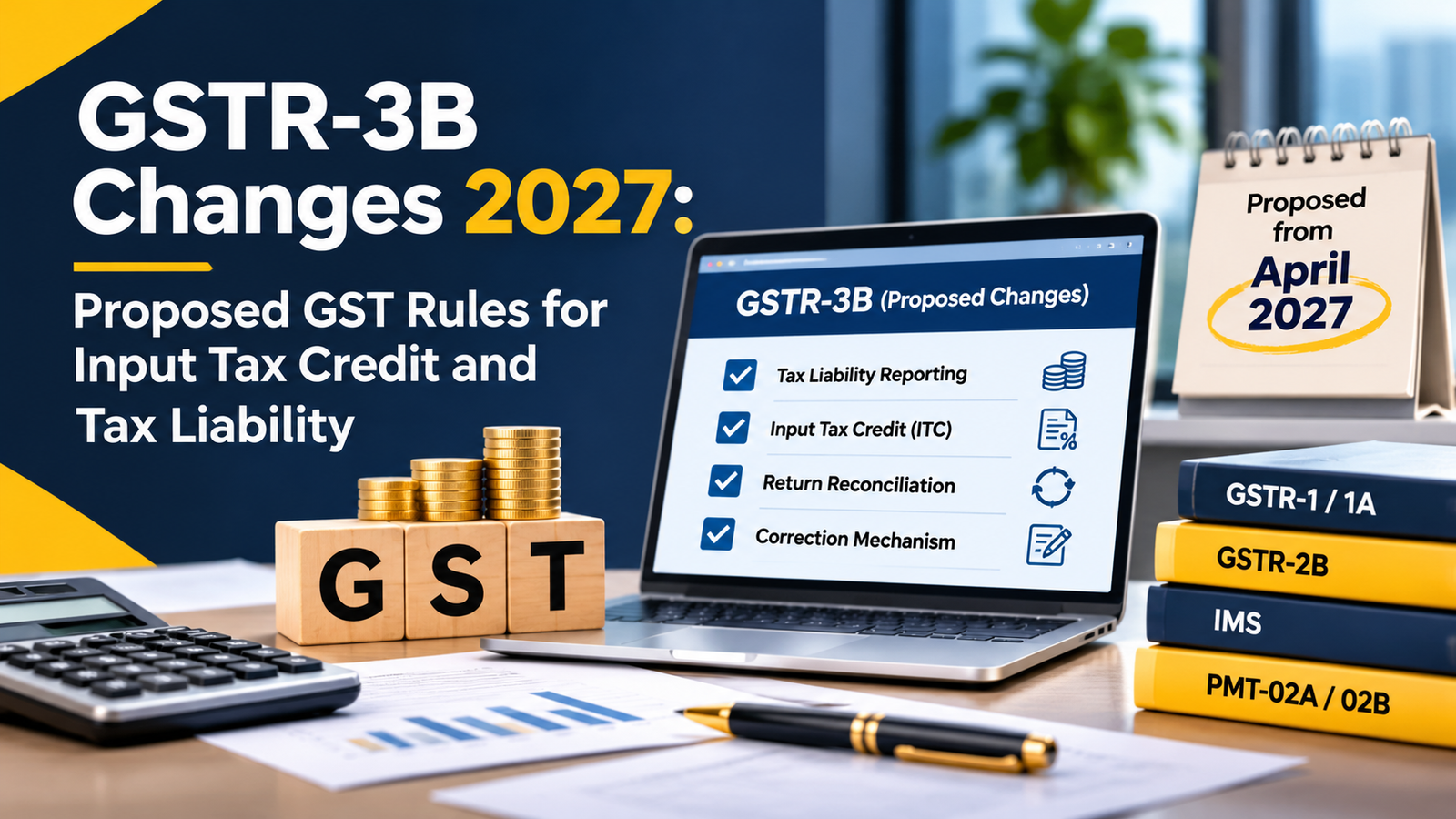
GSTR-3B Changes 2027 may bring important updates to GST return filing in India. The proposed changes focus on Input Tax Credit (ITC) and tax liability reporting.
The Central Board of Indirect Taxes and Customs (CBIC) has invited public comments on these proposals. The aim is to improve GST return accuracy and reduce differences between tax statements.
These changes may affect businesses, accountants and tax professionals. Therefore, businesses should understand the proposals and prepare their GST records in advance.
In this article, we explain the proposed rules in simple language. We also discuss their impact on businesses and important compliance steps.
1. What Are the Proposed GSTR-3B Changes 2027?
The proposed GSTR-3B changes aim to improve the GST return filing process.
The GST Council recommended an alternate mechanism for correcting tax liability and Input Tax Credit in GST returns.
Following this recommendation, CBIC invited public comments on 1 November 2026. The consultation covers proposed changes to GST rules and return forms.
The main objectives include:
- Correct reporting of tax liability.
- Better matching of ITC with available records.
- Fewer manual changes in GSTR-3B.
- Better use of GST portal facilities.
- Fewer errors caused by return mismatches.
The proposed mechanism may apply from the April 2027 return period.
Important: These changes are proposals under consultation. Businesses should not treat them as final rules until the government formally notifies them.
2. Why Are GSTR-3B Changes 2027 Being Proposed?
Businesses currently use different GST forms to report sales, tax liability and ITC.
However, the information in these forms does not always match.
For example, GSTR-1 contains details of outward supplies. GSTR-2B provides information about available ITC. GSTR-3B reports the summary of tax liability and ITC claimed.
Taxpayers can currently edit certain auto-populated figures in GSTR-3B before filing.
This flexibility can sometimes create differences between the forms.
Consider this simple example:
- A business reports sales in GSTR-1.
- The same business reports a different liability in GSTR-3B.
- The GST portal identifies a mismatch.
- The taxpayer may receive an intimation or notice.
Similar issues can occur when claimed ITC does not match GSTR-2B.
Therefore, CBIC wants to improve the connection between these forms. The proposed system aims to correct errors through the relevant statements instead of changing certain figures directly in GSTR-3B.
3. Proposed Changes to GST Tax Liability Reporting
One major proposal concerns the correction of outward supply details.
Under the proposed mechanism, taxpayers would use the appropriate outward supply statements to correct their reported liability.
These include:
- FORM GSTR-1.
- FORM GSTR-1A.
- Invoice Furnishing Facility (IFF), where applicable.
This means taxpayers would generally need to correct sales details through the relevant statement.
They would not directly change the corresponding outward supply figures in GSTR-3B.
Example of a Tax Liability Correction
Suppose a business reports sales of ₹10 lakh in GSTR-1.
Later, it identifies an error. The correct sales value is ₹12 lakh.
Under the proposed mechanism, the business would correct the relevant details through the applicable statement.
The corrected information would then flow into the GST return process.
This approach aims to keep sales details and tax liability consistent.
However, taxpayers should follow the final notified procedure once it becomes applicable.
4. Proposed Input Tax Credit (ITC) Changes
Input Tax Credit is an important part of GST compliance.
Businesses use eligible ITC to reduce their output tax liability. However, they must report and claim it correctly.
The proposed mechanism aims to connect ITC reporting more closely with supporting statements and records.
The proposals cover the following facilities.
A. Invoice Management System (IMS)
IMS helps recipients review invoices and other documents reported by suppliers.
Recipients can take appropriate actions on eligible documents.
These actions include:
- Accepting documents.
- Rejecting documents.
- Keeping documents pending.
The proposed mechanism aims to make IMS an important part of ITC management.
B. Electronic Credit Reversal and Reclaim Statement
The proposal also covers the Electronic Credit Reversal and Reclaim Statement in FORM GST PMT-02A.
This statement helps taxpayers track ITC reversals and later reclaims.
It can improve the reporting of credit that was reversed earlier and becomes eligible for reclaim.
C. Reverse Charge ITC Statement
The proposed Electronic Statement of Tax Paid on Reverse Charge Basis and ITC Claimed is associated with FORM GST PMT-02B.
It aims to improve the reporting of reverse charge tax payments and related ITC.
D. Other Proposed Facilities
The consultation also covers FORM GST PMT-04 and a proposed new FORM GST PMT-10.
These facilities are intended to support ITC management and the correction of certain reporting errors.
The final procedures will depend on the changes formally approved and notified by the government.
5. How Will the Proposed GSTR-3B Changes Affect Return Filing?
GSTR-3B is a summary return used by registered taxpayers to report tax liability and eligible ITC.
The proposed mechanism aims to make this return more closely aligned with supporting GST statements.
The key proposals include:
- Better alignment of outward supplies with GSTR-1, GSTR-1A or IFF.
- Better matching of eligible non-reverse-charge ITC with GSTR-2B.
- Improved reporting of ITC reversals.
- A separate mechanism for reporting eligible ITC reclaims.
- Better tracking of reverse charge tax payments and related ITC.
The proposed changes also aim to reduce manual corrections in GSTR-3B.
However, reverse charge liability and certain specific corrections may follow separate procedures.
Businesses should review the final rules before changing their filing process.
6. Role of GSTR-1, GSTR-1A and GSTR-2B
Each GST form has a different purpose.
Understanding these forms can help businesses prepare for the proposed changes.
FORM GSTR-1
GSTR-1 contains details of outward supplies made by a registered taxpayer.
It helps report sales and related invoice information.
FORM GSTR-1A
GSTR-1A allows taxpayers to add or amend certain details of outward supplies after filing GSTR-1, subject to applicable rules.
The proposed mechanism aims to improve its role in correcting liability information.
FORM GSTR-2B
GSTR-2B is an auto-drafted ITC statement.
It provides information about ITC based on documents reported by suppliers and other prescribed sources.
Taxpayers use it to check available ITC before reporting eligible credit.
FORM GSTR-3B
GSTR-3B is the summary return used to report tax liability and ITC.
The proposed changes aim to improve consistency between these forms.
7. How Will GSTR-3B Changes 2027 Affect Businesses?
The proposed changes may affect businesses of different sizes.
Companies with many invoices may need to review their GST reconciliation processes. Small businesses may also need to improve their invoice checks.
Here are some possible effects.
Better GST Reconciliation
Businesses may need to compare sales records with GSTR-1. They may also need to compare eligible ITC with GSTR-2B.
This can help identify errors before filing.
Fewer Manual Corrections
The proposed system aims to reduce direct changes to certain auto-populated figures in GSTR-3B.
As a result, businesses may need to correct errors through the appropriate statements.
Improved ITC Tracking
Businesses may need to monitor accepted, rejected and pending invoices through IMS.
They may also need to maintain proper records of ITC reversals and reclaims.
Changes to Accounting Processes
Finance teams may need to review their accounting software and GST filing procedures.
They should also ensure that sales and purchase records are accurate.
8. How Should Businesses Prepare for GSTR-3B Changes 2027?
Businesses do not need to wait until 2027 to improve their GST processes.
They can start reviewing their records and procedures now.
Follow these practical steps:
- Review sales records: Check whether your sales invoices match GSTR-1.
- Check GSTR-2B: Compare available ITC with your purchase records.
- Review IMS: Check how your team manages accepted, rejected and pending invoices.
- Track ITC reversals: Maintain clear records of reversed and reclaimed credit.
- Check reverse charge payments: Keep supporting documents for reverse charge transactions.
- Review accounting software: Check whether your system can support the proposed reporting process.
- Train finance teams: Explain the proposed changes to employees handling GST returns.
- Monitor CBIC updates: Review the final rules and notifications before implementation.
These steps can help businesses prepare for a more structured filing process.
9. Important GST Consultation Deadline for 2027 Changes
CBIC opened the public consultation on the proposed alternate mechanism on 1 November 2026.
Taxpayers and other stakeholders can submit their comments through the MyGov portal.
The consultation timeline is:
- Start date: 1 November 2026.
- Last date: 30 November 2026.
- Proposed implementation: April 2027 return period.
Businesses, tax professionals and industry associations can review the proposals and submit relevant suggestions.
Read the official CBIC consultation notice on the MyGov portal.
10. Common GST Compliance Mistakes to Avoid
Businesses should review their GST processes before the proposed changes take effect.
Avoid these common mistakes.
1. Ignoring GSTR-1 Reconciliation
Incorrect sales reporting can create differences in tax liability.
Check your outward supply details before filing.
2. Claiming ITC Without Proper Checks
Always review supplier invoices and available ITC records.
Do not rely only on internal purchase records.
3. Ignoring IMS Actions
Pending or rejected invoices can affect ITC reporting.
Review the available documents regularly.
4. Failing to Track ITC Reversals
Maintain clear records of reversed and reclaimed ITC.
This can help avoid reporting errors.
5. Waiting Until the Last Minute
Do not wait until the proposed implementation date to review your accounting process.
Start preparing your records and systems early.
11. How Derecho Consulting Can Help Businesses
GST compliance requires accurate reporting and regular reconciliation.
The proposed GSTR-3B Changes 2027 may require businesses to review their existing filing procedures.
Derecho Consulting can support businesses with GST and tax compliance requirements.
Our support may include:
- GST compliance guidance.
- GSTR-1 and GSTR-3B reconciliation support.
- Input Tax Credit review.
- GST documentation and record management.
- Compliance process reviews.
- Guidance on proposed GST changes.
- Support with tax compliance planning.
Businesses can also explore our guide on GST compliance changes in 2026 to understand other important developments.
With proper planning, businesses can improve their GST reporting and reduce avoidable compliance errors.
Conclusion
GSTR-3B Changes 2027 aim to improve GST return accuracy and reduce reporting mismatches.
The proposals focus on tax liability, Input Tax Credit and better coordination between GST forms.
Businesses may need to review their reconciliation processes, invoice records and ITC management systems.
However, these changes are still under consultation. The final requirements will depend on government approval and official notifications.
Therefore, businesses should follow CBIC updates and prepare their GST systems in advance.
Need help with GST compliance? Contact Derecho Consulting for professional guidance.
Disclaimer: This article is for general information only. It does not constitute legal, tax or financial advice. The changes discussed are proposals under public consultation as of 3 November 2026. Businesses should refer to official notifications and applicable GST law before taking action.