
Introduction
Employee Termination requires careful planning because the legal requirements can differ based on the employee’s role, the reason for termination, the establishment, and the applicable employment laws. Employers may need to consider employment contracts, company policies, standing orders, labour laws, and state-specific requirements.
India’s four Labour Codes came into force on 21 November 2025, including the Industrial Relations Code, 2020. The Ministry of Labour and Employment also notified the Industrial Relations (Central) Rules, 2026 on 8 May 2026.
Because of these changes, businesses should review their existing termination policies and employment documentation. Employers should also avoid assuming that one procedure applies to every employee.
Why Employee Termination Matters
A poorly managed Employee Termination can lead to disputes, claims, financial costs, and damage to employee relations. The employer should have a clear reason for the decision and should follow the applicable procedure.
Depending on the circumstances, termination may involve resignation, expiry of a fixed-term arrangement, dismissal for misconduct, redundancy or retrenchment, or another lawful ground. Each situation can require different steps.
Key Areas of Employee Termination
1. Employment Contract and Company Policy
The first step is to review the employee’s appointment letter and applicable company policies. These documents may contain provisions on notice periods, termination grounds, probation, misconduct, confidentiality, and final settlement.
The employer should also check whether any standing orders or sector-specific requirements apply.
2. Notice and Termination Procedure
Notice requirements can vary according to the employee’s circumstances and the applicable law. Employers should not apply a single notice period to every employee.
For covered workers, the Industrial Relations Code continues to provide for one month’s notice and retrenchment compensation in applicable retrenchment situations. The Ministry’s official FAQ also states that establishments with 300 or more workers require prior government permission for retrenchment.
Termination for misconduct is different from retrenchment. It may involve a disciplinary process and other procedural requirements.
3. Disciplinary Termination
When termination is based on alleged misconduct, the employer should follow a fair and documented process.
The process may include:
- A written allegation.
- An opportunity for the employee to respond.
- An internal inquiry where required.
- Review of the evidence.
- A reasoned decision.
- A written termination order.
The exact procedure should be checked against the applicable contract, standing orders, and law.
4. Retrenchment and Business Restructuring
Businesses may reduce their workforce because of restructuring, automation, financial pressures, or changes in operations. Such cases can fall within retrenchment rules depending on the facts.
The employer should first determine whether the proposed termination legally qualifies as retrenchment. If it does, the applicable notice, compensation, and permission requirements must be followed. The Industrial Relations Code retains important protections for covered workers.
5. Final Settlement and Employee Dues
An Employee Termination process should also cover the employee’s final financial dues.
Depending on eligibility and circumstances, the employer may need to address:
- Salary payable.
- Approved expense claims.
- Leave-related payments where applicable.
- Gratuity where applicable.
- Statutory contributions.
- Other contractual amounts.
The employer should maintain clear records of the calculation and payment.
6. Termination Letter and Documentation
A termination decision should be properly documented.
The records may include:
- Termination letter.
- Reason for termination.
- Notice details.
- Disciplinary documents, where applicable.
- Settlement calculation.
- Payment records.
- Company-property return.
- Access-closure records.
Good documentation can help the employer explain how and why the termination was handled.
7. Employee Data and Access Removal
Termination also creates cybersecurity and data-protection responsibilities.
When an employee leaves, the company should review:
- Email access.
- Application accounts.
- Cloud access.
- Company devices.
- Confidential files.
- Customer information.
- Passwords and credentials.
Access should be removed promptly and company property should be recovered.
8. Common Employee Termination Risks
Businesses may face risks when they:
- Terminate without checking the contract.
- Use the wrong termination procedure.
- Fail to provide required notice.
- Do not document misconduct properly.
- Ignore applicable standing orders.
- Miscalculate employee dues.
- Fail to preserve relevant records.
- Continue employee access to business systems.
- Apply inconsistent procedures.
- Overlook state-specific employment requirements.
These issues can increase the risk of employment disputes and compliance problems.
9. Best Practices for Employee Termination
Companies should create a documented Employee Termination process.
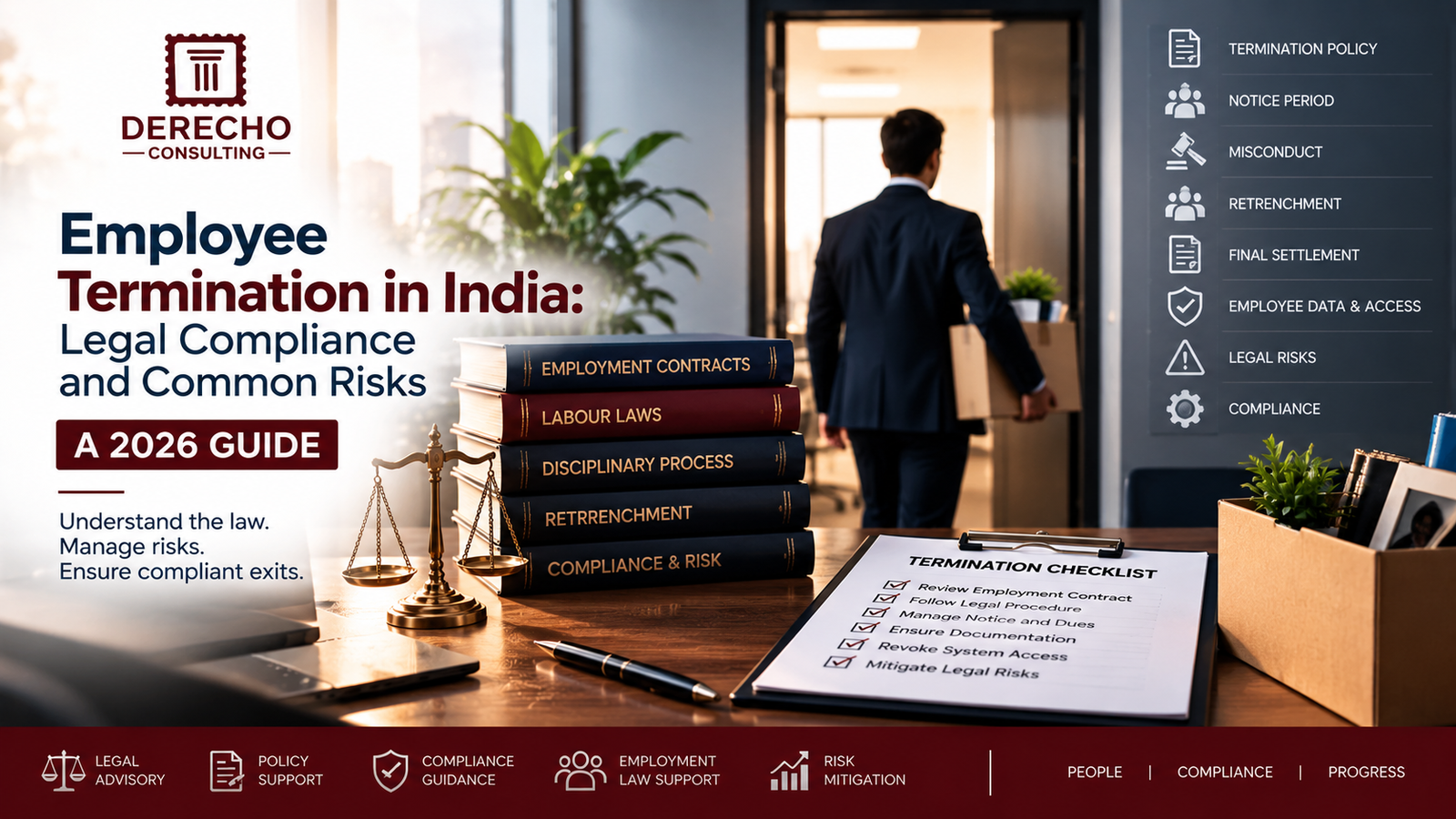
A practical checklist should include:
- Review the employment contract.
- Identify the reason for termination.
- Check the applicable law.
- Determine whether the employee is covered by retrenchment or other special provisions.
- Follow the required notice or disciplinary process.
- Calculate final dues correctly.
- Issue appropriate documentation.
- Recover company property.
- Revoke system access.
- Maintain records of the process.
Businesses should also review their termination policies whenever labour laws or company practices change.
10. 2026 Employee Termination Considerations
The Industrial Relations Code, 2020 has been in force since 21 November 2025, and the Industrial Relations (Central) Rules, 2026 were notified on 8 May 2026.
Employers should therefore review their termination procedures in light of the new framework. The Ministry’s official guidance confirms that mandatory one-month notice and retrenchment compensation continue for applicable retrenchment cases, while establishments with 300 or more workers require prior permission for retrenchment under the stated conditions.
How Derecho Consulting Can Help
Derecho Consulting can help businesses review Employee Termination procedures, employment contracts, disciplinary processes, retrenchment requirements, termination documentation, settlement processes, workplace policies, and labour-law compliance.
A structured review can help businesses identify procedural gaps, improve documentation, and align termination practices with applicable legal requirements.
Conclusion
Employee Termination in India should be handled through a clear and legally appropriate process. The correct approach can depend on the employee’s status, the reason for termination, the size and nature of the establishment, the contract, and the applicable labour framework.
The implementation of the Labour Codes and the notification of the Industrial Relations (Central) Rules, 2026 make it important for employers to review their current procedures.
A well-documented process can help businesses manage notice requirements, disciplinary procedures, retrenchment obligations, final settlements, employee data, and access controls while reducing avoidable disputes.