
Introduction
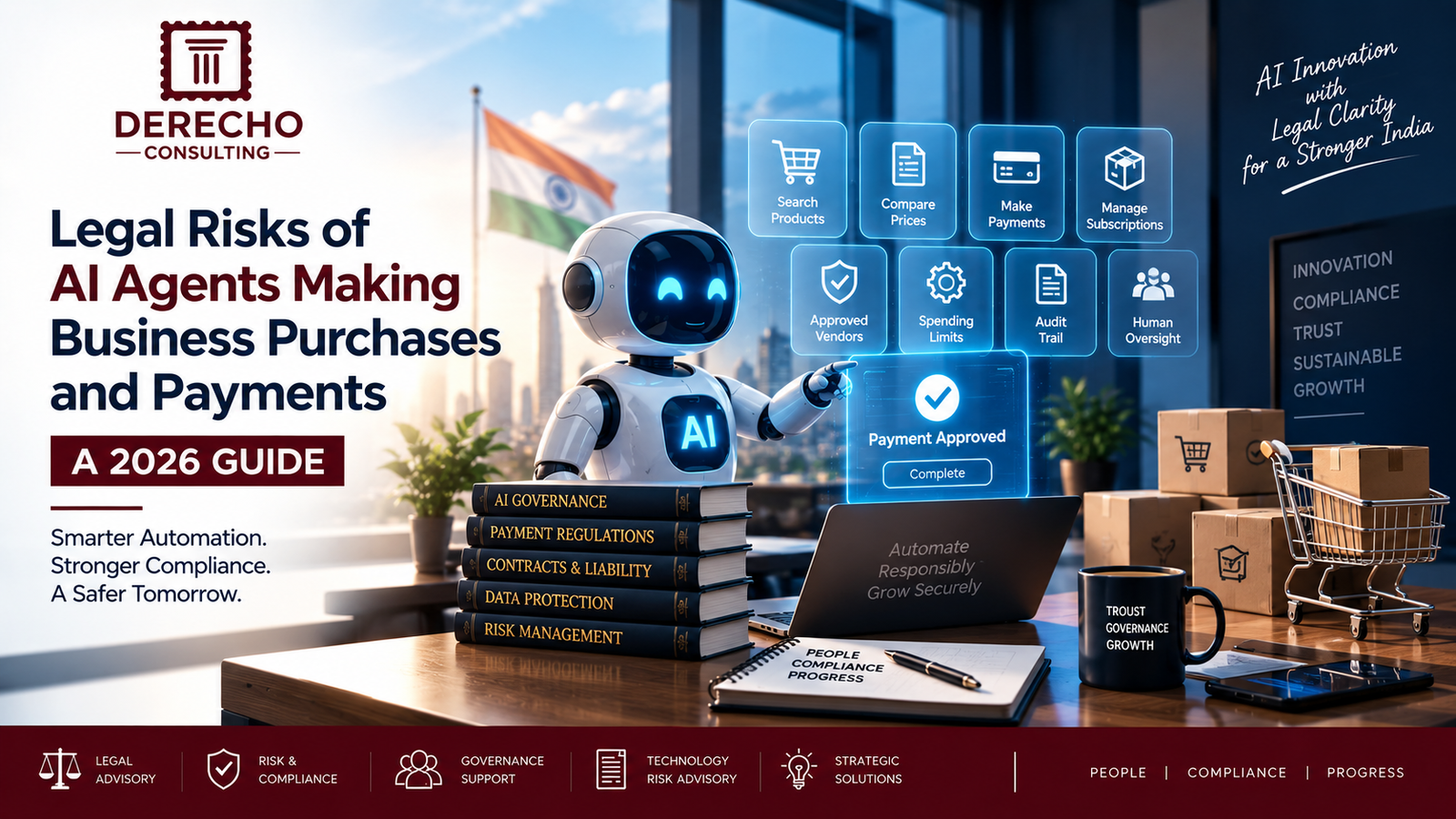
AI Agent Payments are becoming an emerging issue for Indian businesses as artificial intelligence systems move beyond answering questions and begin performing tasks on behalf of users. An AI agent may be able to search for products, compare prices, place orders, manage subscriptions, or initiate payments based on instructions and predefined rules.
This creates new legal questions. A business may need to determine who authorised the transaction, who is responsible when an AI agent makes a mistake, how spending limits should be controlled, and what happens when an agent makes an unauthorised purchase.
The issue is particularly relevant in India because NPCI is developing an agentic payments framework for UPI. Recent reporting says NPCI is working on mechanisms to verify and monitor AI agents conducting UPI transactions, with early use cases expected to focus on smaller, routine payments and with features such as identity checks, spending limits, rule-based payments, and liability provisions.
NPCI’s existing UPI framework already relies on customer authentication and user-controlled payment mechanisms. Its official UPI information states that transactions use UPI-PIN authentication and advises users not to share their UPI-PIN.
As AI agents gain greater authority to act on behalf of businesses, companies need to consider contracts, payment controls, data protection, cybersecurity, consumer protection, fraud, and corporate authority.
This guide explains AI Agent Payments and the legal risks Indian businesses should consider when AI agents make business purchases and payments in 2026.
Why AI Agent Payments Matter
AI agents can make business processes faster and more automated. However, giving an AI system the ability to spend money creates a different level of risk.
An ordinary AI assistant may provide information. An AI payment agent may actually take action.
For example, an agent could:
- Purchase office supplies.
- Renew a software subscription.
- Pay a supplier.
- Book business travel.
- Order inventory.
- Schedule recurring payments.
- Purchase digital services.
- Complete low-value UPI transactions.
Understanding AI Agent Payments can help businesses:
- Control automated spending.
- Define the agent’s authority.
- Reduce unauthorised transactions.
- Manage fraud risks.
- Protect payment information.
- Set financial limits.
- Establish approval procedures.
- Clarify liability.
- Improve audit trails.
- Prepare for emerging payment frameworks.
The development of agentic payment systems makes these issues increasingly relevant for businesses operating in India’s digital payments ecosystem.
Key Areas of AI Agent Payments
1. Defining the AI Agent’s Authority
The first question is simple:
What is the AI agent actually allowed to do?
Businesses should clearly define its authority.
The rules may specify:
- Permitted purchases.
- Approved suppliers.
- Maximum transaction value.
- Daily spending limits.
- Monthly spending limits.
- Permitted payment methods.
- Restricted products.
- Required approvals.
For example, an AI agent may be permitted to purchase office supplies up to ₹10,000 but may need human approval for larger purchases.
Clear limits can reduce the risk of uncontrolled spending.
2. Human Approval and Oversight
Not every transaction should necessarily be completed automatically.
Businesses should decide when human approval is required.
Human approval may be appropriate for:
- High-value payments.
- New suppliers.
- Unusual purchases.
- International transactions.
- Legal or financial commitments.
- Changes to recurring payments.
- Purchases outside approved categories.
This creates a balance between automation and accountability.
A human-approval process can also provide an additional control when an AI agent produces an unexpected recommendation or action.
3. Unauthorised Transactions
One of the biggest AI Agent Payments risks is an unauthorised transaction.
Problems can occur when:
- The agent misunderstands an instruction.
- A user account is compromised.
- An attacker manipulates the agent.
- The agent follows malicious instructions.
- A supplier’s payment details are changed.
- A system error causes duplicate payments.
Businesses should establish rules for detecting and stopping suspicious transactions.
They should also define who is responsible when an automated transaction occurs without proper authority.
4. Liability for AI Agent Errors
An AI agent may make a purchasing mistake.
For example, it could:
- Buy the wrong product.
- Select the wrong supplier.
- Pay the wrong amount.
- Renew an unwanted service.
- Make a duplicate payment.
- Misinterpret a purchasing instruction.
The business should consider where liability falls between:
- The business.
- The AI provider.
- The payment provider.
- The software developer.
- The supplier.
- Other technology vendors.
Contracts should clearly define responsibilities and remedies for material errors.
5. Spending Limits and Transaction Controls
Businesses should not give an AI agent unlimited payment authority.
Instead, companies can consider:
- Per-transaction limits.
- Daily limits.
- Monthly limits.
- Supplier limits.
- Category limits.
- Geographic limits.
- Time-based restrictions.
Spending controls can help reduce financial exposure when an AI system behaves unexpectedly.
India’s developing agentic-payment framework is reportedly considering mechanisms such as spending limits and rule-based payments.
6. Authentication and Identity
The business should be able to establish who or what initiated a transaction.
This can become more complex when the payment is initiated by an AI agent rather than directly by a person.
Companies should consider:
- Agent identity.
- User identity.
- Business identity.
- Device identity.
- Authentication.
- Authorisation.
- Transaction records.
- Agent credentials.
An agent should not be treated as having unlimited authority simply because it has access to a user’s account or payment system.
7. UPI and Digital Payment Controls
UPI is already designed around customer authentication and secure payment processes.
NPCI states that UPI transactions use UPI-PIN authentication and advises users not to share the PIN.
As AI agents become capable of initiating transactions, businesses will need to understand how agent permissions interact with existing authentication and payment controls.
This may require careful consideration of:
- Payment mandates.
- Delegated authority.
- Transaction limits.
- Authentication.
- Device controls.
- Fraud monitoring.
- User confirmation.
The exact legal and operational requirements will depend on the payment framework and the specific service being used.
8. Business Purchase Contracts
An AI agent may enter into transactions with suppliers.
This creates questions about:
- Offer and acceptance.
- Purchase authority.
- Contract formation.
- Terms and conditions.
- Pricing.
- Delivery obligations.
- Cancellation.
- Refunds.
- Dispute resolution.
Businesses should establish whether the AI agent is simply carrying out an already authorised instruction or is independently creating contractual commitments.
Clear procurement policies can reduce uncertainty.
9. Vendor Contracts for AI Agents
Businesses using external AI-agent technology should carefully review vendor agreements.
Important clauses may address:
- Authorised use.
- Payment functionality.
- Security.
- Data processing.
- Transaction errors.
- Liability.
- Indemnity.
- Service availability.
- Incident notification.
- Audit rights.
- Data deletion.
- Termination.
Contracts should also define what happens if the AI agent makes an unauthorised purchase or payment.
10. Data Protection and Payment Information
AI agents may have access to sensitive information.
This could include:
- Customer information.
- Employee information.
- Supplier information.
- Payment details.
- Purchase history.
- Business contracts.
- Account information.
Businesses should limit the agent’s access to information that is actually needed.
They should also establish suitable security and data-governance controls.
11. Cybersecurity and Prompt Manipulation
AI agents can introduce new cybersecurity risks.
An attacker may attempt to manipulate an agent through:
- Malicious instructions.
- Prompt injection.
- Phishing.
- Compromised applications.
- Malicious websites.
- Fake supplier information.
- Manipulated documents.
For example, an attacker could attempt to convince an agent that a supplier’s bank account has changed.
Businesses should therefore combine AI security controls with traditional payment-fraud controls.
12. Supplier Verification
An AI agent should not automatically trust every payment instruction it receives.
Businesses should establish supplier-verification procedures.
These may include:
- Approved supplier lists.
- Bank-account verification.
- Multi-step approval.
- Callback verification for sensitive changes.
- Fraud monitoring.
- Transaction anomaly detection.
Supplier verification becomes especially important when an AI agent can read emails or documents and act on the information it finds.
13. Audit Trails and Record Keeping
Businesses should maintain records of AI-driven transactions.
Useful records may include:
- User instruction.
- Agent action.
- Date and time.
- Transaction value.
- Supplier.
- Payment method.
- Approval record.
- System decision.
- Exception alerts.
- Final transaction result.
A detailed audit trail can help businesses investigate disputes and determine whether a transaction was properly authorised.
14. Consumer and Employee Protection
AI agent payments may involve employees or consumers as well as businesses.
Companies should consider whether users understand:
- What the agent can do.
- What it can purchase.
- How much it can spend.
- When approval is required.
- How transactions can be cancelled.
- How disputes can be raised.
Clear information can reduce misunderstandings and improve confidence in automated payments.
Common AI Agent Payment Risks
Businesses may face AI Agent Payments risks due to:
- Unauthorised purchases.
- Excessive spending authority.
- Incorrect transactions.
- Duplicate payments.
- Fraudulent supplier instructions.
- Compromised AI accounts.
- Prompt manipulation.
- Weak authentication.
- Poor supplier verification.
- Unclear contractual authority.
- Unclear liability.
- Weak audit trails.
- Excessive data access.
- Third-party AI-provider failures.
- Inadequate human oversight.
These problems can lead to financial losses, contract disputes, fraud, operational disruption, and reputational damage.
Best Practices for AI Agent Payments
Businesses using AI agents for purchases or payments should consider the following practices:
- Define exactly what the AI agent can do.
- Set transaction and spending limits.
- Require human approval for high-risk payments.
- Use strong authentication.
- Maintain approved supplier lists.
- Verify changes to payment instructions.
- Keep detailed transaction records.
- Monitor unusual AI-agent behaviour.
- Restrict access to sensitive data.
- Test AI agents before production use.
- Review AI-provider contracts.
- Establish incident-response procedures.
- Define responsibility for unauthorised transactions.
- Review automated payments regularly.
A good governance model should allow automation without giving the AI agent unlimited financial authority.
2026 AI Agent Payment Considerations
AI Agent Payments are becoming a particularly important topic in 2026 because India is actively exploring agentic payment infrastructure.
Recent reporting indicates that NPCI is developing a registry to verify and monitor AI agents that conduct UPI transactions. The initial focus is expected to be on smaller and routine payments, while future use cases could involve more complex purchasing and financial activity.
NPCI’s existing UPI ecosystem already processes very large transaction volumes. Official NPCI statistics show that UPI processed approximately 24.51 billion transactions in August 2026, with a transaction value of approximately ₹29.82 lakh crore.
This scale makes payment security and accountability particularly important as automated agents become more capable.
Businesses should therefore pay attention to:
- Agent identity and authentication.
- Spending limits.
- Delegated payment authority.
- Human approval.
- Fraud prevention.
- Supplier verification.
- Transaction monitoring.
- Payment-data security.
- Contractual liability.
- AI-agent vendor obligations.
- Audit trails.
- Customer and employee transparency.
- New NPCI and regulatory requirements.
The exact legal treatment of liability for AI-agent transactions is still developing. Businesses should therefore avoid assuming that an AI agent has the same authority as a human employee simply because the system can technically execute a payment. Recent reporting specifically notes that regulatory frameworks are still needed to address liability for unauthorised or erroneous agentic transactions.
How Derecho Consulting Can Help
Derecho Consulting can help Indian businesses assess the legal risks of AI Agent Payments through AI governance reviews, technology-contract analysis, payment-risk assessments, vendor due diligence, procurement-policy reviews, data-protection assessments, cybersecurity advisory, transaction-authority analysis, and compliance documentation.
A proactive approach can help businesses:
- Define AI-agent authority.
- Establish payment controls.
- Review AI and payment contracts.
- Assess liability risks.
- Strengthen supplier controls.
- Protect payment and business data.
- Develop human-approval procedures.
- Create AI-agent governance policies.
- Establish audit and incident-response processes.
Derecho Consulting can also support businesses as India’s agentic-commerce and payment ecosystem develops.
Conclusion
Legal Risks of AI Agents Making Business Purchases and Payments are becoming an important issue as businesses move toward automated purchasing and payment processes.
AI agents can make routine transactions faster and more efficient. However, they can also create new risks involving authority, authentication, fraud, cybersecurity, contracts, data protection, and financial liability.
Businesses should therefore establish clear spending limits, define agent authority, maintain human oversight for higher-risk transactions, verify suppliers, protect payment information, and keep detailed transaction records.
India’s emerging agentic-payment initiatives make this an increasingly relevant issue for businesses in 2026. NPCI is developing mechanisms for identifying and monitoring AI agents involved in UPI transactions, while the broader legal framework around liability and automated financial decisions continues to develop.
A proactive approach to AI Agent Payments can help businesses benefit from automated commerce while maintaining stronger financial controls, legal accountability, cybersecurity, and customer trust.