
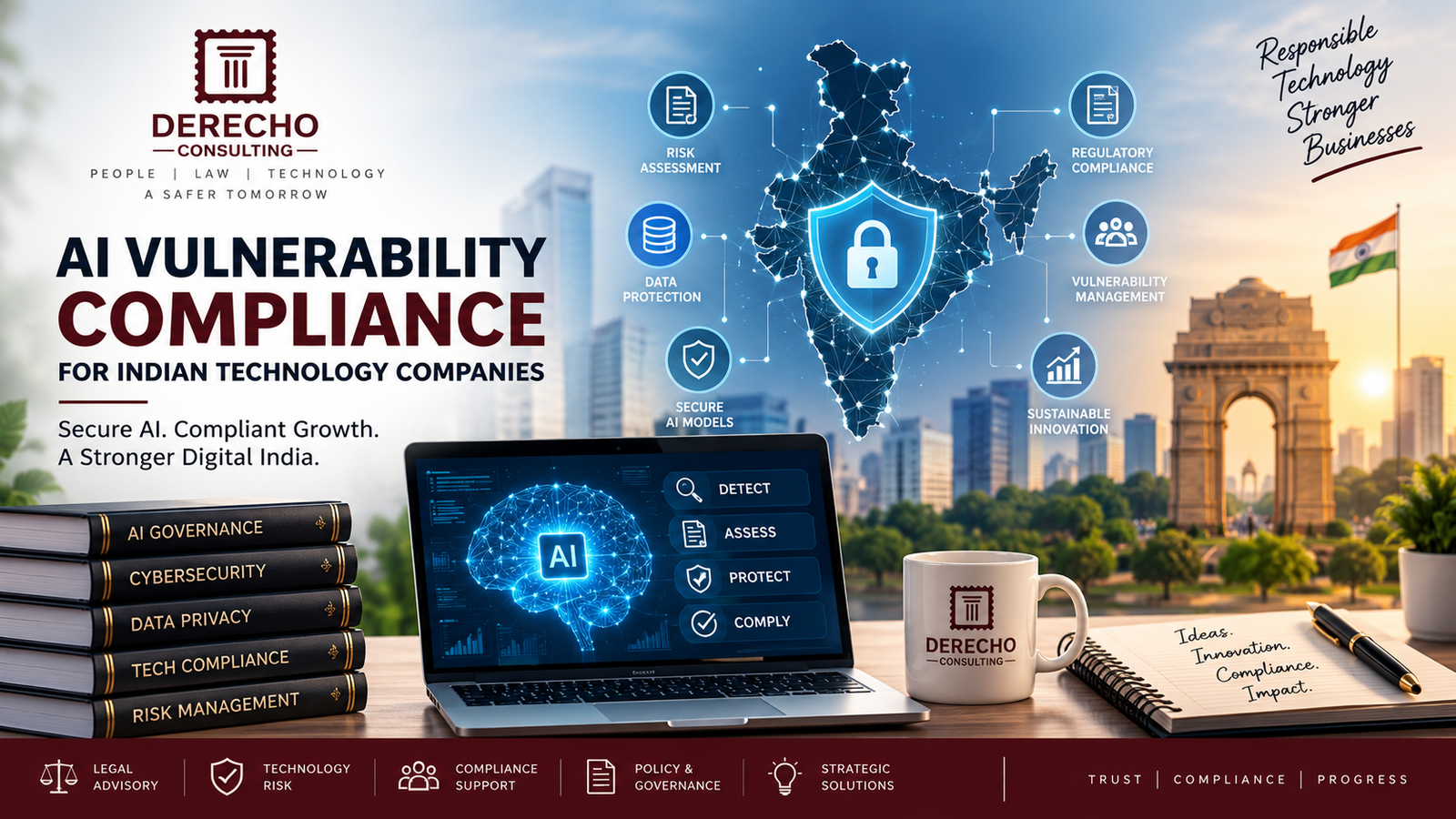
Introduction
AI Vulnerability Compliance is becoming an important consideration for Indian technology companies that develop, deploy, integrate, or provide artificial intelligence and machine-learning systems. As AI becomes increasingly connected to applications, APIs, cloud infrastructure, software development environments, enterprise systems, and customer-facing platforms, vulnerabilities in AI systems can create cybersecurity, data-protection, intellectual-property, contractual, and operational risks.
AI systems can be exposed to risks such as prompt injection, data poisoning, model manipulation, insecure integrations, credential compromise, malicious inputs, vulnerable dependencies, and unauthorised access. These risks can become more serious when AI systems are connected to business-critical applications or permitted to perform actions automatically.
CERT-In published a Blueprint for Reducing Exposure and Defending Against AI-Assisted Vulnerabilities Exploitation in Digital Infrastructure on 25 May 2026. CERT-In also issued June 2026 guidelines concerning AI-accelerated vulnerability protection and response for OEMs and technology providers.
CERT-In’s April 2026 advisory on frontier AI-driven cyber risks further highlighted the ability of advanced AI systems to accelerate vulnerability discovery, reconnaissance, exploit development, credential compromise, and multi-stage cyber activity.
This guide explains AI Vulnerability Compliance for Indian Technology Companies, including AI security assessments, vulnerability management, data protection, model security, software dependencies, third-party AI providers, incident response, governance, documentation, and practical compliance measures for 2026.
Why AI Vulnerability Compliance Matters
AI systems introduce security considerations that can differ from those found in traditional software systems. Companies need to understand how AI models, training data, APIs, applications, cloud services, and connected infrastructure interact and where weaknesses may arise.
Understanding AI Vulnerability Compliance can help technology companies:
- Identify vulnerabilities in AI systems.
- Protect AI models and supporting infrastructure.
- Reduce exposure to AI-assisted cyberattacks.
- Protect sensitive business and customer information.
- Strengthen software and model security.
- Manage third-party AI technology risks.
- Improve vulnerability detection and remediation.
- Establish effective incident-response procedures.
- Maintain appropriate security documentation.
- Strengthen organisational AI governance.
CERT-In’s 2026 guidance recommends heightened monitoring, reduced internet exposure, rapid vulnerability remediation, threat intelligence, AI-enabled defensive security tools, and stronger cyber resilience in response to emerging AI-driven threats.
Key Areas of AI Vulnerability Compliance
1. AI System Risk Assessment
The first step in AI Vulnerability Compliance is identifying the AI systems used or developed by the organisation and assessing their potential security exposure.
The review may include:
- AI models.
- Machine-learning systems.
- Training environments.
- AI APIs.
- AI-powered applications.
- Cloud infrastructure.
- Data pipelines.
- Model repositories.
- Connected enterprise systems.
- External AI services.
A risk assessment should consider how the AI system can be attacked, what information it can access, and what consequences could result from compromise.
2. AI Model and Application Security
AI models should be protected throughout their lifecycle, from development and testing through production deployment.
Potential controls may include:
- Secure model development.
- Access controls.
- Model authentication.
- Secure deployment.
- Input validation.
- Output validation.
- Security testing.
- Model monitoring.
- Segmentation.
- Logging and audit trails.
Companies should establish security controls proportionate to the risks associated with the particular AI application.
3. AI-Assisted Vulnerability Exploitation
AI is increasingly capable of identifying weaknesses in software and infrastructure at greater speed and scale. CERT-In’s April 2026 advisory identified risks including automated vulnerability discovery, accelerated exploit development, automated reconnaissance, credential harvesting, and multi-stage attack orchestration.
Technology companies should therefore strengthen:
- Vulnerability scanning.
- Patch management.
- Threat monitoring.
- Attack-surface management.
- Security testing.
- Detection capabilities.
- Incident-response readiness.
- Continuous security assessment.
Companies should treat critical vulnerabilities in widely deployed technologies as potentially urgent rather than waiting for traditional remediation cycles.
4. Data Security and Training Data Protection
AI systems often depend on large quantities of data during development, training, testing, and operation.
The review may include:
- Training data.
- Customer information.
- Employee information.
- Proprietary datasets.
- Source code.
- Confidential documents.
- Personal data.
- Third-party datasets.
- Data-processing pipelines.
Businesses should establish controls to prevent unauthorised access, manipulation, leakage, or misuse of data used by AI systems.
5. Prompt Injection and Malicious Inputs
AI applications can be exposed to malicious or manipulated inputs designed to influence model behaviour or bypass security controls.
Potential issues may involve:
- Prompt injection.
- Indirect prompt injection.
- Malicious instructions.
- Untrusted external content.
- Data exfiltration through model interactions.
- Manipulated inputs.
- Unauthorised tool use.
Businesses should implement input controls, access restrictions, output validation, monitoring, and testing appropriate to the system’s risk profile.
6. AI APIs and External Integrations
AI systems are frequently connected to APIs, databases, cloud platforms, software tools, and external services.
The review may include:
- API authentication.
- API authorisation.
- Third-party integrations.
- Connected databases.
- Cloud services.
- Plugins and extensions.
- External AI models.
- Service accounts.
- API keys.
Companies should minimise unnecessary permissions and ensure that connected AI services cannot access more information or perform more actions than required.
7. Software Dependencies and AI Supply Chain
AI applications can depend on open-source libraries, machine-learning frameworks, third-party models, APIs, container images, cloud services, and other external components.
Potential risks may arise from:
- Vulnerable libraries.
- Outdated dependencies.
- Malicious packages.
- Compromised models.
- Unverified third-party components.
- Insecure containers.
- Weak software-development practices.
CERT-In maintains technical guidance concerning SBOM, QBOM, CBOM, AIBOM and HBOM, helping organisations approach component visibility across software and technology environments.
Technology companies should maintain an accurate inventory of important AI and software dependencies and establish procedures for identifying and remediating vulnerabilities.
8. Access Control and Identity Management
Unauthorised access to an AI platform can expose models, datasets, credentials, prompts, tools, and connected systems.
Businesses should consider:
- Role-based access.
- Multi-factor authentication.
- Privileged-access controls.
- Service-account management.
- Credential rotation.
- Least-privilege permissions.
- User activity monitoring.
- Separation of development and production environments.
Access should be granted according to legitimate business requirements and reviewed regularly.
9. Monitoring, Logging and Incident Response
AI systems should be monitored for unusual activity and security events.
Records may include:
- Login activity.
- API requests.
- Model interactions.
- Administrative actions.
- System changes.
- Security alerts.
- Failed authentication attempts.
- Unusual access patterns.
- Data-transfer events.
CERT-In’s April 2026 advisory recommends increased monitoring and review of system logs, as well as preservation of logs when suspicious activity is identified and applicable reporting requirements arise.
Businesses should maintain an incident-response process covering containment, investigation, evidence preservation, notification, remediation, and recovery.
10. Third-Party AI Providers
Many organisations rely on external AI providers for models, APIs, cloud infrastructure, analytics, or specialised AI services.
Due diligence should review:
- Security practices.
- Data-processing arrangements.
- Confidentiality.
- Data retention.
- Sub-processors.
- Vulnerability management.
- Incident notification.
- Audit rights.
- Access controls.
- Business continuity.
- Termination and data deletion.
Contracts should clearly allocate responsibilities between the technology company and the AI provider.
11. Responsible Vulnerability Disclosure
Technology companies should establish procedures for receiving and managing vulnerability reports from researchers, customers, vendors, and other external parties.
CERT-In maintains a Responsible Vulnerability Disclosure and Coordination Policy and provides a process through which product and software vulnerabilities can be reported.
An internal vulnerability-management process should establish:
- Reporting channels.
- Severity assessment.
- Responsible teams.
- Remediation timelines.
- Vendor coordination.
- Disclosure procedures.
- Evidence management.
- Closure and verification.
12. AI Governance and Compliance Documentation
AI security should be integrated into broader technology governance rather than managed only as an IT issue.
Documentation may include:
- AI inventories.
- Risk assessments.
- Security policies.
- Vulnerability reports.
- Model documentation.
- Vendor assessments.
- Incident-response plans.
- Access-control records.
- Security-test reports.
- Remediation records.
Good documentation can help demonstrate that the organisation has established a structured approach to managing AI-related security risks.
Common AI Vulnerability Compliance Risks for Indian Technology Companies
Technology companies may face AI Vulnerability Compliance risks due to:
- Unidentified AI vulnerabilities.
- Weak model-security controls.
- Insecure APIs.
- Excessive system permissions.
- Prompt-injection attacks.
- Data poisoning.
- Compromised training data.
- Vulnerable software dependencies.
- Outdated AI components.
- Unsecured AI development environments.
- Third-party AI-provider weaknesses.
- Poor logging and monitoring.
- Inadequate vulnerability remediation.
- Weak incident-response procedures.
- Insufficient employee security training.
- Incomplete AI governance documentation.
- Excessive internet exposure.
- Unauthorised access to AI systems.
These weaknesses can result in data breaches, service disruption, intellectual-property exposure, financial losses, operational disruption, and regulatory or contractual consequences.
Best Practices for AI Vulnerability Compliance
Indian technology companies should consider the following practices:
- Maintain an inventory of AI systems and components.
- Conduct regular AI security and vulnerability assessments.
- Apply security updates and patches quickly.
- Reduce unnecessary internet-exposed services.
- Use strong authentication and access controls.
- Protect AI models and training data.
- Validate AI inputs and outputs.
- Conduct adversarial and security testing.
- Maintain accurate AI and software dependency inventories.
- Review third-party AI providers.
- Implement continuous monitoring and logging.
- Establish vulnerability-disclosure procedures.
- Maintain an AI-specific incident-response process.
- Train employees on AI-enabled cyber risks.
- Conduct periodic security and compliance audits.
- Maintain evidence of remediation and risk reviews.
CERT-In’s 2025 advisory on vulnerabilities associated with generative-AI solutions specifically notes risks to AI applications arising from flaws in data processing, machine-learning models, and AI interaction mechanisms.
A structured security programme can therefore help organisations strengthen AI Vulnerability Compliance while supporting responsible AI adoption.
2026 AI Vulnerability Compliance Considerations
AI Vulnerability Compliance is particularly important in 2026 as advanced AI systems become increasingly capable of discovering vulnerabilities, analysing code, conducting reconnaissance, and supporting complex cyber operations.
CERT-In published its Blueprint for Reducing Exposure and Defending Against AI-Assisted Vulnerabilities Exploitation in Digital Infrastructure in May 2026. It also published June 2026 guidelines concerning AI-accelerated vulnerability protection and response requirements for OEMs and technology providers.
Technology companies should therefore pay particular attention to:
- AI-assisted vulnerability exploitation.
- AI model security.
- Automated attack detection.
- Internet-facing attack-surface reduction.
- Rapid critical-vulnerability remediation.
- AI-enabled security monitoring.
- Zero Trust architecture.
- Third-party AI risk.
- AIBOM and software-component visibility.
- AI-driven phishing and impersonation.
- Employee awareness of AI-enabled threats.
- Security logging and evidence preservation.
- Incident-response readiness.
CERT-In’s April 2026 advisory recommends elevated vigilance, additional monitoring, attack-surface reduction, rapid patching, threat intelligence, AI-enabled defensive security tools, Zero Trust approaches, and cyber drills in response to frontier AI-driven cyber risks.
Technology companies should therefore regularly review their AI security architecture, vulnerability-management processes, third-party arrangements, employee training, and incident-response procedures rather than relying on traditional cybersecurity controls alone.
How Derecho Consulting Can Help
Derecho Consulting can help Indian technology companies address AI Vulnerability Compliance through AI risk assessments, technology-contract review, cybersecurity legal advisory, third-party AI due diligence, data-protection assessment, AI governance-policy development, vulnerability-management governance, incident-response planning, regulatory analysis, and compliance documentation.
A proactive approach can help businesses:
- Identify AI-related legal and security risks.
- Review AI governance frameworks.
- Assess third-party AI providers.
- Strengthen contractual protections.
- Review data and privacy implications.
- Establish appropriate AI security policies.
- Support vulnerability-management governance.
- Develop incident-response and compliance processes.
- Align AI adoption with broader technology-risk management.
Derecho Consulting can also assist technology companies in periodically reviewing their AI governance and compliance frameworks as AI capabilities, cybersecurity threats, and regulatory expectations continue to evolve.
Conclusion
AI Vulnerability Compliance for Indian Technology Companies is becoming an important component of modern technology-risk management. As AI systems become more connected to business applications, data, APIs, cloud infrastructure, and enterprise environments, vulnerabilities can have consequences that extend beyond the AI model itself.
By assessing AI systems, protecting training and operational data, securing APIs and integrations, managing software dependencies, controlling access, monitoring systems, reviewing third-party providers, and maintaining effective vulnerability-management and incident-response processes, technology companies can reduce their exposure.
A proactive and well-documented approach to AI Vulnerability Compliance can help Indian technology companies improve cyber resilience, protect valuable information and technology assets, respond more effectively to emerging AI-assisted threats, and support responsible AI adoption in 2026 and beyond.