
Protecting the Land That Protects the Nation
Agricultural land is not merely a piece of property. For millions of farming families, it represents generations of hard work, financial security, cultural identity, and the foundation of their livelihood.
A farmer’s land provides:
- Food production
- Family income
- Economic stability
- Social security
- A legacy passed from one generation to another
However, one of the biggest challenges faced by landowners, especially farmers, is illegal occupation of agricultural land.
Across rural areas, disputes frequently arise due to:
- Unauthorized possession
- Boundary violations
- Fake ownership claims
- Illegal construction
- Forced occupation
- Land grabbing
- Manipulation of land records
For a farmer, losing control over agricultural land can mean losing not only property but also the primary source of livelihood.
The legal system recognizes the seriousness of such violations and provides multiple remedies to protect lawful owners and restore their rights.
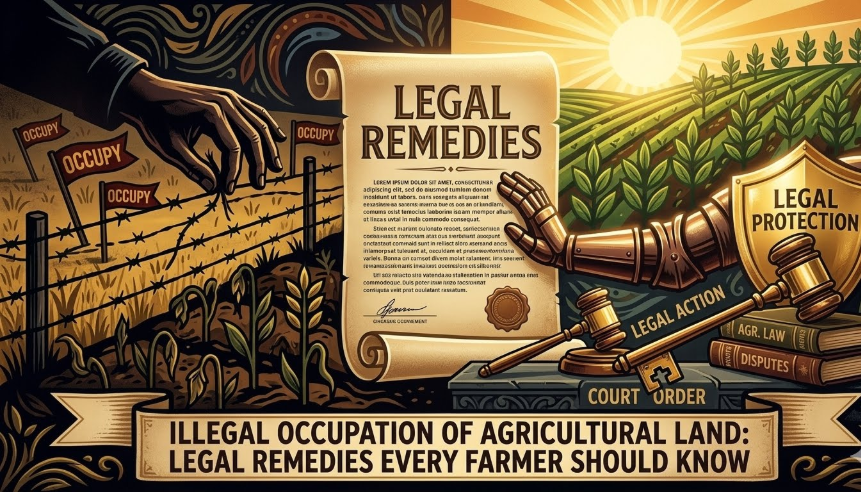
What Is Illegal Occupation of Agricultural Land?
Illegal occupation occurs when a person enters, uses, controls, or claims rights over agricultural land without lawful permission or legal authority.
The occupation may happen through:
- Physical takeover of land
- Unauthorized cultivation
- Construction of structures
- Changing boundary markers
- Blocking access routes
- False documentation
- Long-term unauthorized possession
An illegal occupant attempts to create a claim over property that legally belongs to someone else.
The law does not recognize unlawful possession as a valid replacement for ownership.
Why Agricultural Land Encroachment Is a Serious Legal Issue
Agricultural land disputes have consequences beyond private ownership.
Illegal occupation affects:
Farmer Livelihood
When land is occupied illegally, farmers may lose:
- Crop income
- Agricultural opportunities
- Access to irrigation facilities
- Seasonal production cycles
Rural Economy
Agriculture supports millions of families and contributes significantly to economic development.
Unresolved land disputes reduce:
- Agricultural investment
- Productivity
- Financial stability
Social Harmony
Land conflicts can create:
- Family disputes
- Community tensions
- Long-term legal battles
Therefore, protecting agricultural land is not only a property issue but also a social and economic necessity.
Legal Foundation: Right to Property Under the Constitution
Although the Right to Property is no longer a Fundamental Right, it remains a constitutional protection.
Article 300A of the Constitution of India
Article 300A states:
“No person shall be deprived of his property save by authority of law.”
This principle establishes that:
- Property cannot be taken arbitrarily.
- Legal authority is required for deprivation.
- Ownership rights receive constitutional protection.
Illegal occupation directly challenges this constitutional principle because the occupier has no lawful authority.
Importance of Agricultural Land Documents
Strong documentation is the first line of protection against illegal occupation.
Farmers should maintain:
Ownership Documents
Examples include:
- Registered sale deeds
- Gift deeds
- Partition documents
- Inheritance records
Revenue Records
Important records include:
- Land ownership entries
- Mutation records
- Survey documents
- Tax payment receipts
Physical Evidence
Farmers should preserve:
- Boundary records
- Photographs
- Cultivation records
- Agricultural activity proof
Proper documentation helps establish legal ownership and possession.
Bharatiya Nyaya Sanhita and Criminal Protection Against Trespass
The criminal law framework provides protection against unlawful entry and interference with property.
The Bharatiya Nyaya Sanhita (BNS), 2023 replaced the earlier criminal law framework and continues to recognize offences related to unlawful entry and interference with possession.
Criminal Trespass Concept
Criminal trespass generally involves:
- Entering another person’s property without permission
- Remaining on property unlawfully
- Intending to commit an offence
- Intending to intimidate, insult, or annoy the person in possession
When someone illegally enters agricultural land with wrongful intention, criminal liability may arise.
Criminal Remedies Available to Farmers
A farmer facing illegal occupation may consider criminal remedies such as:
Filing a Police Complaint
The affected person may approach law enforcement authorities with:
- Ownership documents
- Evidence of occupation
- Details of the illegal activity
Investigation by Authorities
Authorities may investigate:
- Ownership claims
- Nature of occupation
- Intent of the accused
Criminal Proceedings
Where offences are established, legal proceedings may follow.
Criminal law acts as a deterrent against unlawful land grabbing.
Civil Remedies Under the Specific Relief Act, 1963
While criminal law focuses on punishment, civil law focuses on protecting property rights and restoring possession.
The Specific Relief Act, 1963 provides important remedies for property owners.
Suit for Recovery of Possession
When a farmer has lost possession of agricultural land due to illegal occupation, a civil suit may be filed seeking recovery.
The objective is:
- Restoration of lawful possession
- Removal of unauthorized occupation
- Protection of ownership rights
A court may examine:
- Ownership documents
- Possession history
- Evidence presented by both parties
Injunction: Preventing Illegal Interference
One of the most important legal remedies is an injunction.
An injunction is a court order restricting a person from performing certain actions.
Farmers may seek protection against:
- Entering the land
- Damaging crops
- Constructing illegal structures
- Interfering with farming activities
Temporary Injunction
A temporary injunction provides immediate protection while a case is pending.
It is useful when:
- Encroachment is happening quickly.
- Construction activities have started.
- Crops are being damaged.
- Immediate protection is required.
The purpose is to maintain the existing situation until the court decides the dispute.
Permanent Injunction
After examining the case, the court may grant a permanent injunction.
This prevents the wrongdoer from interfering with the farmer’s rights permanently.
It provides long-term legal protection.
Mandatory Injunction
In certain cases, courts may order a person to perform a specific action.
Examples:
- Removing illegal structures
- Restoring original conditions
- Removing unauthorized occupation
This remedy helps correct the consequences of illegal occupation.
Difference Between Ownership and Possession
A common misunderstanding in land disputes is confusing ownership with possession.
Ownership
Ownership represents legal title over property.
Possession
Possession represents physical control or occupation.
A person may illegally possess land without becoming the lawful owner.
The law provides remedies to protect both ownership and lawful possession.
Boundary Disputes and Survey Rights
Many agricultural disputes begin due to unclear boundaries.
Common problems include:
- Incorrect measurements
- Missing boundary stones
- Land record errors
- Neighboring disputes
Farmers can request:
- Official land surveys
- Boundary verification
- Revenue authority assistance
Accurate measurement helps prevent future conflicts.
Role of Revenue Authorities
Apart from courts, administrative authorities play an important role.
Farmers may approach:
- Revenue officers
- Tahsildars
- District authorities
- Survey departments
Authorities may assist with:
- Record verification
- Boundary disputes
- Mutation corrections
- Land inspections
Administrative remedies can sometimes resolve disputes faster.
Challenges Faced by Farmers
Despite legal protections, many farmers face difficulties.
Lack of Legal Awareness
Many landowners are unaware of available remedies.
Delayed Proceedings
Property disputes may take significant time to resolve.
Documentation Issues
Missing or outdated records create challenges.
Financial Limitations
Legal proceedings can involve expenses.
Awareness and timely action are critical.
Preventive Steps Every Farmer Should Take
Prevention is better than prolonged litigation.
Farmers should:
Maintain Updated Records
Ensure ownership records are accurate.
Monitor Land Regularly
Periodic inspection helps identify unauthorized activities early.
Protect Boundaries
Clearly marked boundaries reduce disputes.
Avoid Informal Agreements
Important land arrangements should be legally documented.
Seek Legal Guidance Early
Early action often prevents larger problems.
The Importance of Digitization of Land Records
Modern technology is transforming land management.
Digital records help improve:
- Transparency
- Ownership verification
- Record accessibility
- Dispute prevention
Technology-based land systems reduce opportunities for fraudulent claims.
Protecting Agricultural Land for Future Generations
Agricultural land represents a connection between generations.
Protecting land today ensures:
- Future farming opportunities
- Economic stability
- Family security
- Rural development
Strong property rights encourage farmers to invest in:
- Better cultivation methods
- Irrigation
- Machinery
- Sustainable agriculture
Conclusion
Illegal occupation of agricultural land is not simply a boundary dispute. It is a serious violation that affects livelihood, economic security, and social stability.
Indian law provides multiple protections through:
- Constitutional safeguards
- Bharatiya Nyaya Sanhita provisions
- Specific Relief Act, 1963
- Civil remedies
- Revenue procedures
However, legal protection becomes effective only when landowners understand their rights and take timely action.
For farmers, awareness is the strongest defense against illegal occupation.
Agricultural land is not just property recorded in documents—it represents years of effort, family heritage, and the foundation of rural life.
“Protecting agricultural land means protecting the hands that feed the nation. Law provides the shield, but awareness gives farmers the power to use it.”