
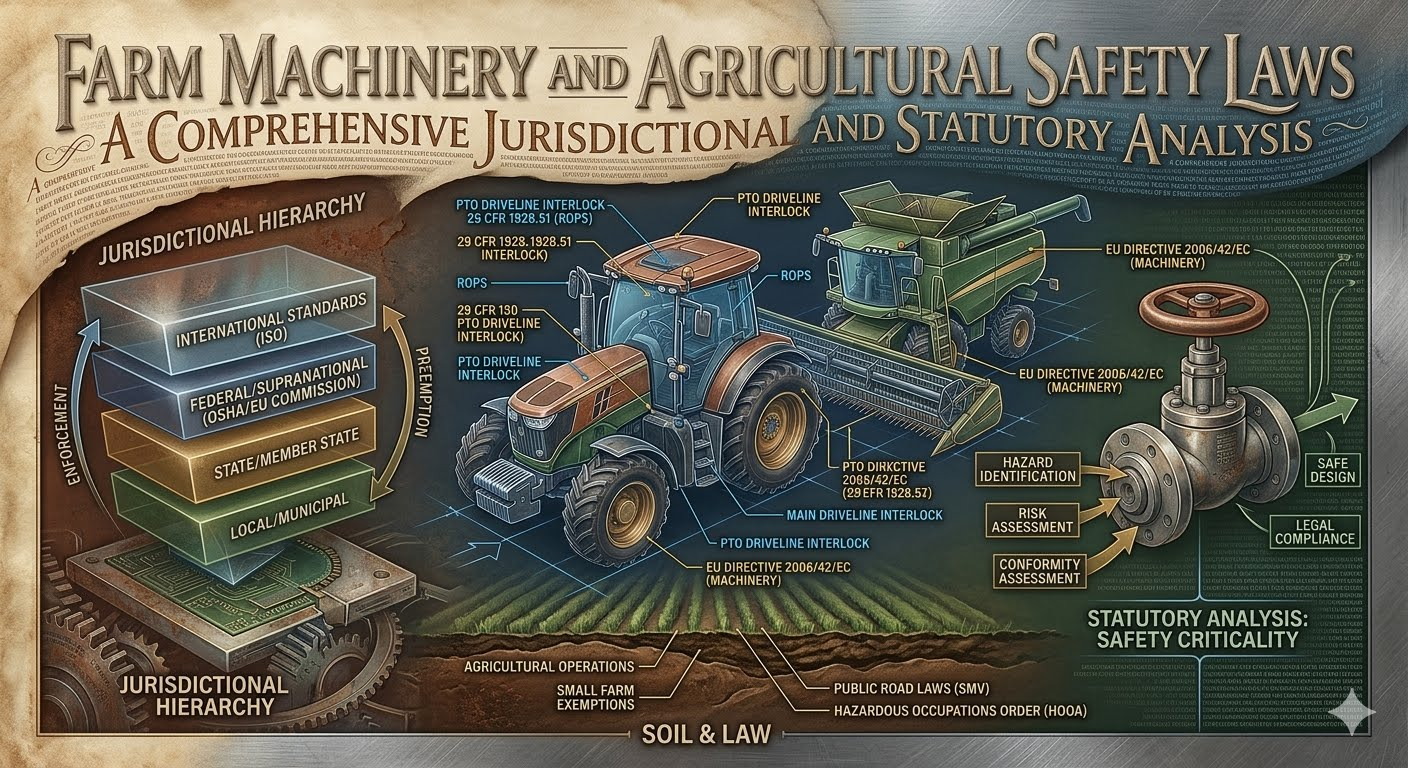
Understanding the Legal Framework Behind Safe Agricultural Operations
Agriculture is one of the oldest and most essential professions in human civilization. From traditional farming practices to modern mechanized agriculture, technology has transformed the way food is produced. Today, tractors, harvesters, threshers, irrigation equipment, pesticide sprayers, and advanced agricultural machines have become essential tools for improving productivity and reducing physical labour.
However, with increasing mechanization comes increasing responsibility.
A machine that improves agricultural efficiency can also become a source of serious danger when it is improperly operated, poorly maintained, or used without adequate safety measures.
Every year, agricultural workers face risks arising from:
- Tractor accidents
- Machinery failures
- Improper equipment handling
- Exposure to chemicals
- Lack of protective equipment
- Unsafe working environments
This is where agricultural safety laws play a critical role.
The law does not view farm machinery as merely a private tool. It recognizes that agricultural equipment affects human life, workplace safety, public roads, and environmental protection.
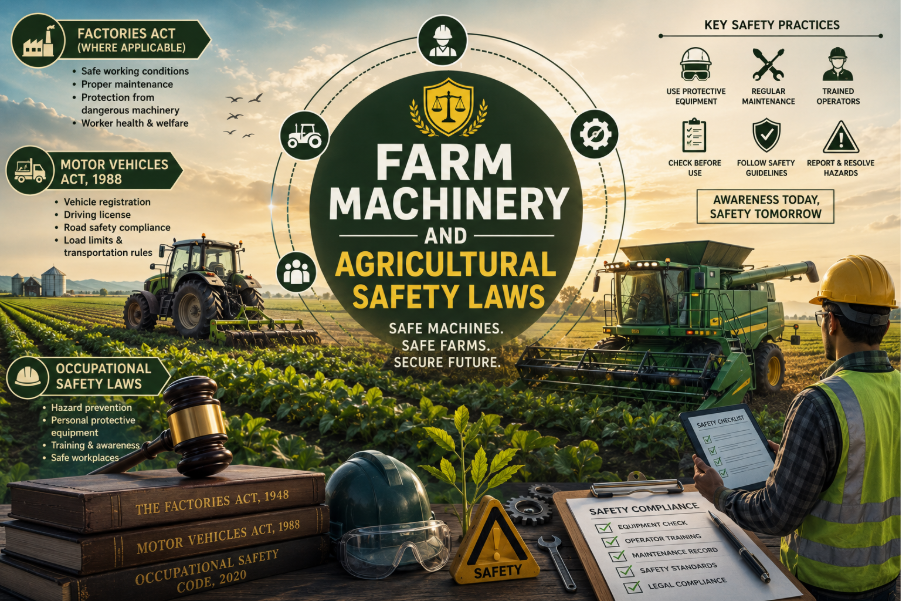
Therefore, multiple legal frameworks regulate agricultural machinery, including:
- Factories Act, 1948 (where applicable)
- Motor Vehicles Act, 1988
- Occupational Safety, Health and Working Conditions Code, 2020
- Environmental and safety regulations
- State agricultural machinery rules
These laws collectively create a safety framework designed to protect farmers, agricultural workers, and society.
The Importance of Agricultural Safety Laws
Farming Is an Economic Activity With Legal Responsibilities
Many people consider farming only as a traditional occupation. However, modern agriculture involves:
- Heavy machinery
- Commercial production
- Industrial processes
- Transportation activities
- Chemical usage
- Labour management
As agriculture becomes more commercialized, legal responsibilities also increase.
Safety laws ensure that productivity does not come at the cost of human life.
Farm Machinery: From Traditional Tools to Modern Technology
Agricultural machinery has dramatically changed farming practices.
Modern equipment includes:
- Tractors
- Combine harvesters
- Power tillers
- Rotavators
- Seed drills
- Sprayers
- Irrigation pumps
- Threshing machines
These machines provide several benefits:
Increased Productivity
Machines allow farmers to cultivate larger areas within shorter periods.
Reduced Physical Labour
Mechanization reduces dependency on manual labour.
Improved Efficiency
Modern equipment improves:
- Seed placement
- Harvesting accuracy
- Irrigation management
- Crop processing
However, every machine also introduces potential hazards.
Understanding Risks Associated With Farm Machinery
Tractor-Related Accidents
Tractors are among the most commonly used agricultural machines.
Major risks include:
- Tractor overturning
- Loss of control
- Improper attachment usage
- Overloading
- Unsafe transportation
A tractor is a powerful machine capable of performing heavy agricultural tasks, but improper operation can result in severe injuries.
Mechanical Failures
Poor maintenance can lead to:
- Brake failure
- Steering problems
- Engine malfunction
- Equipment breakdown
Regular inspection and servicing are essential safety practices.
Lack of Operator Training
Many agricultural accidents occur because operators lack proper knowledge regarding:
- Machine operation
- Safety procedures
- Emergency handling
Training is not only a practical necessity but also an important safety responsibility.
Factories Act, 1948 and Agricultural Machinery Safety
Applicability of the Factories Act
The Factories Act, 1948 primarily applies to industrial establishments. However, agricultural activities involving processing units, manufacturing operations, or facilities meeting the definition of a factory may fall under its provisions.
Examples include:
- Food processing units
- Agricultural equipment manufacturing facilities
- Large-scale agricultural processing operations
The Act focuses on protecting workers from workplace hazards.
Important Safety Principles Under the Factories Act
Protection Against Dangerous Machinery
The Act provides provisions relating to machinery safety.
Employers must ensure:
- Dangerous parts are properly guarded.
- Workers are protected from moving machinery.
- Equipment is operated safely.
This principle is highly relevant wherever agricultural processing involves mechanical equipment.
Maintenance of Machinery
Machines must be:
- Properly maintained
- Regularly inspected
- Operated under safe conditions
A poorly maintained machine creates risks not only for operators but also for surrounding workers.
Worker Safety Responsibilities
The Act establishes responsibilities for employers, including:
- Providing safe working conditions
- Training workers
- Preventing workplace hazards
- Maintaining safety standards
Safety is therefore a shared responsibility between management and workers.
Motor Vehicles Act, 1988 and Agricultural Vehicles
Why Does Motor Vehicle Law Apply to Farming?
Many people assume agricultural machinery is outside transportation laws.
However, agricultural vehicles often operate on public roads.
Examples:
- Tractors travelling between farms
- Agricultural trailers carrying goods
- Machinery transported through highways
When agricultural vehicles use public roads, compliance with motor vehicle laws becomes important.
Vehicle Registration Requirements
Under the Motor Vehicles Act, vehicles operating on public roads generally require legal authorization.
This includes:
- Registration
- Required documentation
- Compliance with transport regulations
Registration provides:
- Vehicle identification
- Ownership records
- Legal accountability
Driver Licensing and Tractor Operation
Operating agricultural vehicles requires appropriate knowledge and competence.
A tractor driver must understand:
- Vehicle control
- Road safety
- Load management
- Traffic rules
A powerful machine operated without proper skills creates risks for:
- Operators
- Pedestrians
- Other road users
Overloading of Agricultural Vehicles
One common issue involving farm vehicles is excessive loading.
Examples:
- Carrying excessive agricultural produce
- Unsafe trailer loading
- Overloaded tractor attachments
Overloading can result in:
- Reduced braking efficiency
- Loss of control
- Road accidents
- Infrastructure damage
Transportation laws therefore establish limits to ensure safe operation.
Occupational Safety, Health and Working Conditions Code, 2020
Modern Workplace Safety Framework
India introduced the Occupational Safety, Health and Working Conditions Code, 2020 to consolidate workplace safety laws.
The objective is to create:
- Safer working conditions
- Worker protection
- Health standards
- Employer responsibilities
Where agricultural operations fall within applicable workplace definitions, safety obligations become relevant.
Importance of Safety Training
Safety training is one of the strongest methods of accident prevention.
Workers should understand:
- Machine operation
- Emergency procedures
- Protective equipment usage
- Hazard identification
A trained worker is better prepared to prevent accidents.
Protective Equipment in Agricultural Operations
Agricultural workers may require protection against:
- Dust
- Chemicals
- Noise
- Mechanical hazards
Safety equipment may include:
- Gloves
- Protective footwear
- Masks
- Eye protection
- Ear protection
Protective equipment reduces the severity of workplace injuries.
Agricultural Machinery and Environmental Responsibility
Modern agricultural safety is not limited to human protection.
Machines and agricultural activities can affect:
- Soil quality
- Water resources
- Air quality
Legal regulations encourage responsible use of:
- Fuel
- Chemicals
- Machinery emissions
Environmental responsibility has become an important part of sustainable agriculture.
Legal Responsibility of Farm Owners
Farm owners and operators have important responsibilities.
They should ensure:
- Machinery is maintained
- Operators are trained
- Safety instructions are followed
- Defective equipment is repaired
Ignoring safety obligations can create legal consequences.
Manufacturer Responsibilities
Agricultural machinery manufacturers also play a critical role.
Manufacturers should provide:
- Safe machine designs
- Operating manuals
- Safety warnings
- Quality components
A machine should be designed with user safety as a fundamental consideration.
Compensation and Liability in Agricultural Accidents
When accidents occur, legal questions may arise regarding:
- Negligence
- Responsibility
- Compensation
- Insurance claims
Possible responsible parties may include:
- Machine owners
- Operators
- Employers
- Manufacturers
Determining liability depends on the circumstances of each case.
Insurance Protection for Agricultural Machinery
Insurance can provide financial protection against:
- Accidental damage
- Third-party liability
- Equipment losses
For expensive agricultural machinery, insurance helps reduce financial risks.
Technology and Future of Agricultural Safety
Technology is transforming agricultural safety.
Modern solutions include:
- GPS-based monitoring
- Automatic safety systems
- Smart tractors
- Machine sensors
- Digital maintenance tracking
Technology allows farmers to increase productivity while reducing risks.
Challenges in Implementing Agricultural Safety Laws
Despite legal protections, challenges remain.
These include:
- Lack of awareness
- Limited training facilities
- Financial constraints
- Poor maintenance practices
- Rural enforcement difficulties
Improving agricultural safety requires cooperation between:
- Farmers
- Government agencies
- Manufacturers
- Training institutions
Building a Culture of Safety in Agriculture
Safety should become an integral part of farming practices.
Farmers should focus on:
Regular Maintenance
Preventive maintenance reduces machinery failures.
Proper Training
Operators should understand equipment before use.
Following Legal Requirements
Compliance protects both people and property.
Using Safety Equipment
Small precautions can prevent major accidents.
Conclusion
Farm machinery has revolutionized agriculture by improving productivity, efficiency, and economic opportunities. However, technological advancement must always be accompanied by safety responsibility.
The Factories Act, Motor Vehicles Act, and Occupational Safety Laws provide an important legal foundation for protecting farmers, workers, and the public.
These laws are not barriers to agricultural progress. They are safeguards that ensure modernization happens responsibly.
A tractor, harvester, or agricultural machine is more than equipment—it is a powerful tool that must be operated with knowledge, care, and respect for human safety.