
Introduction
The aviation industry serves as the backbone of global connectivity, facilitating trade, tourism, and economic development across borders. Every day, millions of passengers travel internationally, while airlines transport high-value cargo through intricate networks spanning multiple jurisdictions.
Despite the global nature of aviation, taxation remains largely governed by domestic laws and regional agreements. One of the most significant and often misunderstood aspects of airline taxation is the application of Value-Added Tax (VAT) to international flights.
Unlike standard consumer goods and services, international air transport enjoys various exemptions, zero-rating provisions, and special treatments under VAT regimes worldwide. However, these benefits are neither universal nor straightforward.
Airlines, travel agencies, corporate travelers, and tax authorities frequently encounter challenges related to:
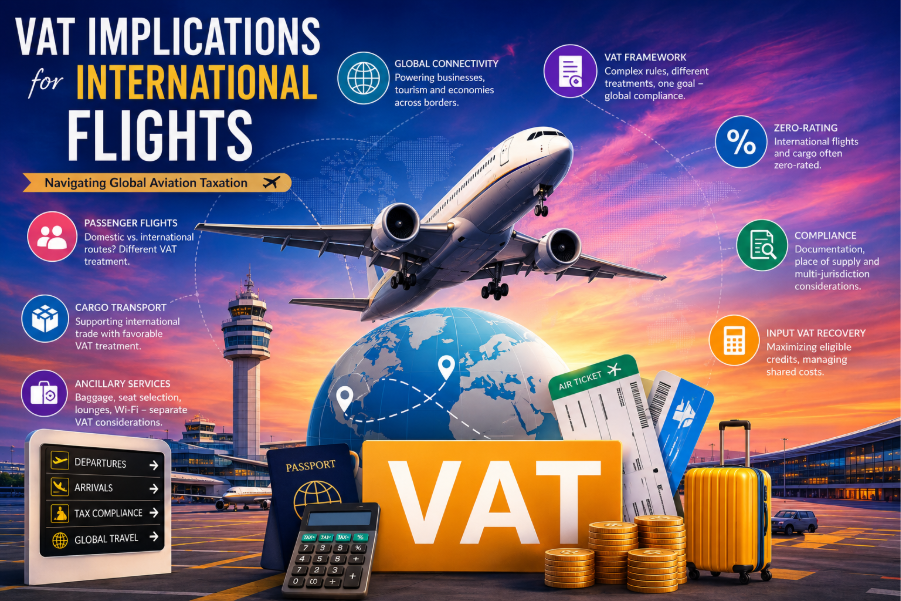
- Determining the place of supply
- Distinguishing domestic and international segments
- Recovering input VAT
- Managing multi-jurisdictional compliance
- Addressing digital booking platforms and ancillary services
As governments continue to modernize tax systems and increase scrutiny over cross-border transactions, understanding VAT implications for international flights has become a strategic necessity.
This article explores the principles, regulations, challenges, and future trends surrounding VAT in international aviation.
Understanding VAT in the Aviation Industry
Value-Added Tax is a consumption-based indirect tax imposed at each stage of the supply chain where value is added.
Ultimately, VAT is borne by the end consumer, while businesses collect and remit taxes to governments.
Key characteristics of VAT include:
- Tax on consumption rather than income
- Input tax credit mechanism
- Multi-stage taxation system
- Destination-based principle
In most industries, VAT applies uniformly to goods and services. However, aviation represents a unique sector due to its inherently international nature.
Without special rules, airlines could face multiple taxation events across various countries during a single journey.
To avoid double taxation and encourage international trade and tourism, many jurisdictions provide favorable VAT treatment for international air transport.
Why International Flights Receive Special VAT Treatment
International aviation contributes significantly to economic growth by enabling:
- Tourism development
- Cross-border investment
- International trade
- Employment generation
- Global business mobility
Recognizing these benefits, governments often exempt or zero-rate international flights to:
- Maintain competitiveness
- Avoid cascading taxes
- Reduce travel costs
- Facilitate global commerce
- Promote connectivity
Furthermore, bilateral air service agreements and international conventions have historically supported minimizing indirect taxation on international air transport.
The result is a complex framework where VAT treatment varies based on:
- Passenger versus cargo operations
- Domestic versus international routes
- Departure and arrival locations
- Nature of ancillary services
- Status of the customer
Zero-Rating vs. VAT Exemption: Understanding the Difference
One of the most important distinctions in aviation taxation is the difference between zero-rating and exemption.
Zero-Rated Services
Under a zero-rated regime:
- VAT is charged at 0%
- Airlines can reclaim input VAT paid on purchases
- Input tax credits remain available
Examples include:
- International passenger transportation
- International cargo transportation
- Certain airport and ground handling services
Exempt Services
Under a VAT exemption:
- No VAT is charged to customers
- Businesses cannot recover input VAT
This creates hidden costs because unrecoverable VAT becomes part of operating expenses.
Why It Matters
For airlines, zero-rating is generally preferable because it preserves input tax recovery.
An airline purchasing:
- Aircraft parts
- Fuel
- Maintenance services
- Technology systems
- Catering services
can reclaim VAT if its services qualify for zero-rating.
However, if flights are exempt instead of zero-rated, these input costs become non-recoverable.
VAT Treatment of International Passenger Flights
Most jurisdictions either exempt or zero-rate international passenger transportation.
However, specific rules vary significantly.
European Union
Under the VAT framework followed by many European countries:
- International passenger transport is generally exempt from VAT.
- Domestic flights are typically subject to VAT.
- Member states may apply reduced rates for certain routes.
For example:
- A flight from Paris to Rome may qualify for VAT relief.
- A flight from Paris to Nice may attract domestic VAT.
Complexities arise when itineraries combine domestic and international segments.
Example:
Hyderabad → Delhi → London
Questions include:
- Is the domestic leg taxable?
- Can the entire itinerary qualify as international transport?
- How should revenue be allocated?
The answers depend on local legislation.
India
In India, international passenger transport by air generally attracts a zero rate under the Goods and Services Tax framework for qualifying services.
Domestic air travel, however, remains taxable at prescribed GST rates.
Airlines operating mixed domestic and international routes must carefully allocate input tax credits and maintain appropriate documentation.
United Kingdom
Following Brexit, the United Kingdom retained zero-rating provisions for international passenger transport.
Domestic flights remain subject to VAT unless specific exemptions apply.
Gulf Cooperation Council (GCC) Countries
Several GCC countries have introduced VAT regimes in recent years.
International transportation services are commonly zero-rated, although eligibility criteria differ across jurisdictions.
Airlines must ensure compliance with country-specific documentation requirements.
VAT Implications for International Cargo Flights
International cargo transportation often receives more favorable VAT treatment than passenger transportation.
Reasons include:
- Support for international trade
- Export promotion objectives
- Supply chain efficiency
Typical VAT treatment includes:
- Zero-rated exports
- Input tax recovery eligibility
- Reduced compliance burden
However, determining VAT liability may involve analyzing:
- Origin and destination points
- Ownership transfer terms
- Incoterms
- Place-of-supply rules
- Customer location
Cargo operators must maintain accurate records to support VAT positions during audits.
Required documentation often includes:
- Air waybills
- Customs declarations
- Export invoices
- Shipping manifests
- Delivery confirmations
VAT on Ancillary Airline Services
While ticket sales may benefit from favorable VAT treatment, ancillary services often follow separate rules.
Examples include:
- Excess baggage fees
- Seat selection charges
- In-flight Wi-Fi
- Lounge access
- Priority boarding
- Travel insurance
- Change fees
- Cancellation charges
The VAT treatment depends on whether the service is:
- Part of the transportation service
- Separately invoiced
- Delivered electronically
- Consumed domestically or internationally
For example:
An airline may zero-rate an international ticket but charge VAT on lounge access sold separately.
Similarly, digital services purchased through airline applications may trigger different place-of-supply rules.
As ancillary revenue becomes increasingly important, airlines must ensure proper tax classification.
Input VAT Recovery Challenges for Airlines
Airlines incur substantial expenses across multiple jurisdictions.
Major cost categories include:
- Aircraft acquisition and leasing
- Maintenance, repair, and overhaul (MRO)
- Fuel purchases
- Airport charges
- IT systems
- Professional services
- Marketing expenses
- Catering contracts
Recovering input VAT can be challenging because airlines often conduct both taxable and exempt activities.
Key issues include:
Partial Exemption Calculations
When airlines operate both domestic and international routes, they may need to allocate input VAT using apportionment methods.
Cross-Border VAT Refunds
Foreign VAT paid on expenses may be recoverable through refund mechanisms.
However, obtaining refunds requires:
- Detailed documentation
- Timely submissions
- Country-specific registrations
Documentation Requirements
Tax authorities increasingly demand robust evidence, including:
- Invoices
- Passenger manifests
- Flight schedules
- Route information
- Contractual agreements
Failure to maintain proper records can result in denied input credits.
Place-of-Supply Rules and Multi-Jurisdictional Complexity
One of the biggest VAT challenges in aviation involves determining where a service is supplied.
Questions commonly include:
- Where was the ticket sold?
- Where does the journey begin?
- Where is the customer located?
- Where is the service consumed?
Different jurisdictions use different approaches.
Examples include:
- Origin principle
- Destination principle
- Distance-based allocation
- Customer location rules
For multi-leg journeys, airlines may need to split revenue among jurisdictions.
Example:
Mumbai → Dubai → Frankfurt → New York
Potential considerations include:
- Transit rules
- Stopover duration
- Interline agreements
- Code-share arrangements
Failure to determine the correct place of supply can result in:
- Double taxation
- Penalties
- Interest charges
- Compliance disputes
Impact of Digitalization on VAT Compliance
The rise of digital platforms has transformed airline distribution models.
Tickets are now sold through:
- Airline websites
- Mobile applications
- Online travel agencies
- Global distribution systems
- Third-party aggregators
Digitalization creates new VAT challenges.
Key issues include:
Determining Supplier Responsibility
Questions arise regarding whether VAT obligations belong to:
- Airlines
- Online travel agencies
- Marketplace operators
Electronic Invoicing
Many countries are introducing:
- Real-time reporting
- E-invoicing mandates
- Digital audit trails
Data Management
Airlines must integrate:
- Reservation systems
- Accounting platforms
- Tax engines
Accurate data mapping is essential for VAT compliance.
Emerging Trends in Aviation VAT Policy
The future of VAT in international aviation will likely be influenced by several factors.
Environmental Objectives
Governments increasingly seek to reduce aviation emissions.
Potential measures include:
- Removal of tax exemptions
- Green levies
- Carbon pricing mechanisms
Digital Tax Administration
Tax authorities are adopting advanced technologies for:
- Automated audits
- Data analytics
- Continuous transaction monitoring
International Harmonization
Industry bodies continue advocating for:
- Consistent VAT treatment
- Simplified refund processes
- Uniform documentation standards
Increased Regulatory Scrutiny
Cross-border information sharing between tax authorities is expanding.
Airlines should expect:
- More frequent audits
- Greater transparency requirements
- Stricter compliance obligations
Best Practices for Airlines and Travel Businesses
To manage VAT risks effectively, organizations should:
- Conduct periodic VAT health checks
- Review route structures regularly
- Automate tax determination processes
- Maintain robust documentation
- Train finance and operations teams
- Monitor legislative developments
- Engage aviation tax specialists
- Implement integrated compliance systems
Proactive tax governance reduces financial exposure and enhances operational efficiency.
Conclusion
VAT treatment of international flights represents one of the most complex areas of indirect taxation.
While many jurisdictions provide exemptions or zero-rating to promote global connectivity, the rules governing international aviation remain fragmented and constantly evolving.
Airlines must navigate challenges involving:
- Place-of-supply determinations
- Input VAT recovery
- Ancillary services
- Digital sales channels
- Multi-jurisdictional compliance
As governments modernize tax systems and reconsider aviation’s environmental impact, VAT policies are likely to undergo significant changes.
Organizations that invest in technology, strengthen internal controls, and adopt proactive tax strategies will be better positioned to manage risks and maintain compliance.
In an industry defined by global movement, understanding VAT implications is no longer merely a finance function—it is a strategic imperative.