
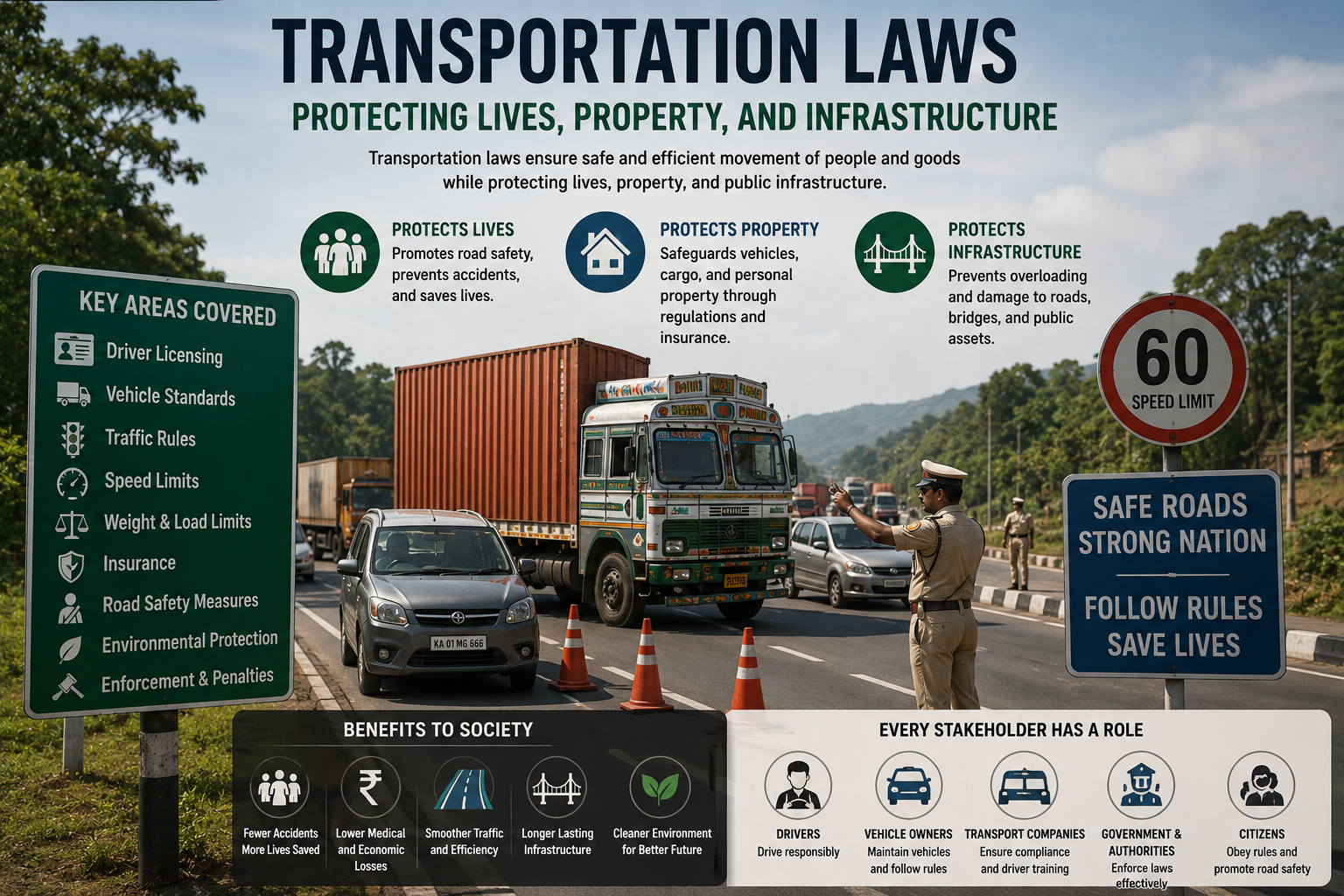
Every day, millions of people travel on roads, highways, railways, waterways, and air routes. Goods worth billions of dollars move across cities, states, and nations, connecting producers to consumers and enabling economic growth. Transportation has become so deeply integrated into modern life that most people rarely stop to consider the legal framework that makes safe and efficient movement possible.
Behind every truck on a highway, every bus carrying passengers, every commercial shipment, and every transport company lies an extensive system of laws designed to protect lives, safeguard property, and preserve public infrastructure.
Transportation laws are often viewed as technical regulations or administrative requirements. In reality, they represent one of the most important mechanisms through which governments protect public safety and maintain economic stability. Without these laws, transportation systems would become chaotic, dangerous, and unsustainable.
The primary objective of transportation law is simple yet profound: to ensure that people and goods move safely while protecting society from avoidable risks and costs.
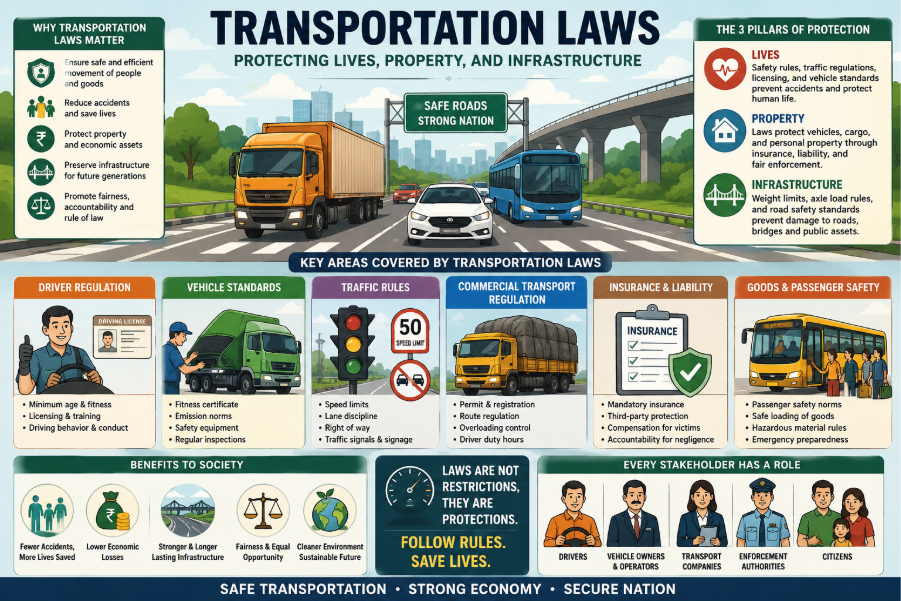
Why Transportation Laws Matter
Transportation is not merely a private activity. Every vehicle operating on public roads shares space with countless other road users.
When a driver ignores safety regulations, the consequences may extend far beyond that individual. A single violation can affect:
- Drivers
- Passengers
- Pedestrians
- Property owners
- Businesses
- Government infrastructure
- Entire communities
Transportation laws exist because transportation activities create responsibilities toward others.
The law recognizes that freedom of movement must be balanced with accountability and public safety.
Protecting Human Lives
Safety as the Highest Priority
The most important purpose of transportation laws is the protection of human life.
Road accidents remain one of the leading causes of death and injury worldwide. Every year, thousands of lives are lost due to speeding, reckless driving, vehicle defects, overloading, drunk driving, and failure to comply with traffic regulations.
Transportation laws seek to reduce these risks through:
- Driver licensing requirements
- Vehicle fitness standards
- Speed regulations
- Weight restrictions
- Insurance mandates
- Safety equipment requirements
- Traffic management systems
Each rule serves a common objective: preventing accidents before they occur.
Driver Licensing Laws
A motor vehicle can become a dangerous machine when operated by an unqualified individual.
For this reason, transportation laws require drivers to:
- Meet minimum age requirements
- Demonstrate driving competence
- Pass examinations
- Maintain valid licenses
- Follow operational restrictions
Commercial vehicle drivers are often subject to even stricter standards because of the increased risks associated with larger vehicles.
Licensing laws ensure that individuals entrusted with operating vehicles possess the skills necessary to do so safely.
Prevention Rather Than Punishment
One of the defining characteristics of transportation law is its preventive nature.
Most regulations are designed not to punish individuals after accidents occur but to reduce the likelihood of accidents altogether.
Examples include:
- Mandatory seat belts
- Helmet requirements
- Speed limits
- Vehicle inspections
- Driver rest periods
The law seeks to create conditions that minimize danger before harm occurs.
Protecting Property
Transportation and Economic Assets
Transportation involves significant economic investment.
Vehicles, cargo, warehouses, fuel stations, logistics networks, and infrastructure represent enormous financial resources.
Accidents can destroy property worth millions of rupees within seconds.
Transportation laws therefore play a critical role in protecting:
- Private vehicles
- Commercial fleets
- Cargo shipments
- Business assets
- Public facilities
- Residential properties
By reducing accidents and promoting safe practices, transportation laws help preserve valuable resources.
Insurance Requirements
One of the most effective legal tools for property protection is mandatory insurance.
Insurance laws ensure that victims receive compensation when accidents occur.
These laws protect:
- Vehicle owners
- Passengers
- Businesses
- Third parties
- Property owners
Without insurance requirements, accident victims might face devastating financial losses with little possibility of recovery.
Liability and Accountability
Transportation laws establish legal responsibility when harm occurs.
When accidents result from negligence, the law identifies who must bear the consequences.
Potentially liable parties may include:
- Drivers
- Vehicle owners
- Employers
- Transport companies
- Maintenance providers
This accountability encourages greater care and professionalism throughout the transportation industry.
Protecting Public Infrastructure
Roads Are Public Assets
Roads, bridges, tunnels, highways, and transport corridors represent some of the largest public investments made by governments.
These assets are funded through taxpayer contributions and are intended to serve society as a whole.
Transportation laws help ensure that public infrastructure remains functional and safe.
Overloading and Infrastructure Damage
One of the greatest threats to transportation infrastructure is vehicle overloading.
Overloaded trucks can cause:
- Pavement cracking
- Surface deformation
- Bridge deterioration
- Structural fatigue
- Increased maintenance costs
This is why transportation laws impose strict limits on vehicle weight and axle loads.
These restrictions are not merely technical requirements; they are essential measures for preserving public investments.
Protecting Future Generations
Infrastructure protection is also a matter of intergenerational responsibility.
When roads and bridges are damaged prematurely due to non-compliance, future taxpayers must bear the cost of repairs and reconstruction.
Transportation laws help ensure that infrastructure remains available and functional for future generations.
Transportation Laws and Economic Development
Enabling Commerce
Some people view regulations as obstacles to economic growth.
In reality, effective transportation laws are essential for sustainable economic development.
Businesses depend on:
- Reliable roads
- Safe transport networks
- Predictable regulations
- Efficient logistics systems
Without legal standards, transportation systems would become unreliable and costly.
The law creates stability that enables commerce to flourish.
Fair Competition
Transportation laws also promote fairness within the marketplace.
When some operators ignore safety standards to reduce costs, they gain unfair advantages over businesses that comply with legal requirements.
Regulations ensure that competition is based on efficiency and service quality rather than unsafe practices.
Environmental Protection Through Transportation Law
Modern transportation laws increasingly address environmental concerns.
Governments impose standards relating to:
- Vehicle emissions
- Fuel quality
- Noise pollution
- Hazardous materials transport
These regulations recognize that transportation activities affect not only road users but also communities and ecosystems.
Environmental compliance is therefore an essential component of responsible transportation governance.
Technology and Modern Enforcement
Technology has transformed transportation regulation.
Authorities now use:
- Automated weigh stations
- GPS tracking systems
- Electronic permits
- Traffic monitoring cameras
- Digital compliance platforms
These innovations improve enforcement while reducing opportunities for non-compliance.
Technology enables transportation laws to become more effective, transparent, and efficient.
The Rule of Law on the Nation’s Roads
Transportation laws represent a practical expression of the rule of law.
The rule of law means that everyone—individuals, businesses, and government agencies alike—is subject to legal standards.
No driver is above traffic laws.
No transport company is exempt from safety obligations.
No commercial interest can justify conduct that endangers public welfare.
Transportation law demonstrates how legal principles operate in everyday life to protect society.
Shared Responsibility
The success of transportation laws depends upon collective responsibility.
Safe transportation requires cooperation among:
- Drivers
- Vehicle owners
- Transport operators
- Enforcement agencies
- Policymakers
- Citizens
Compliance is not merely a legal obligation; it is a civic responsibility.
Every individual who follows transportation laws contributes to safer roads, stronger infrastructure, and a more efficient economy.
Conclusion
Transportation laws are far more than administrative regulations. They are essential safeguards that protect lives, preserve property, and maintain the infrastructure upon which modern society depends.
Every licensing requirement, safety inspection, weight restriction, insurance mandate, and enforcement mechanism serves a larger purpose. Together, these laws create a transportation system that balances freedom of movement with public responsibility.
As transportation networks continue to expand and economies become increasingly interconnected, the importance of effective transportation laws will only grow. Their role is not simply to regulate movement but to ensure that movement occurs safely, responsibly, and sustainably.
A nation’s transportation system is often described as the lifeline of its economy. Transportation laws are the protective framework that keeps that lifeline strong, secure, and capable of serving generations to come.
“Transportation moves a nation forward; transportation laws ensure it moves forward safely.”