
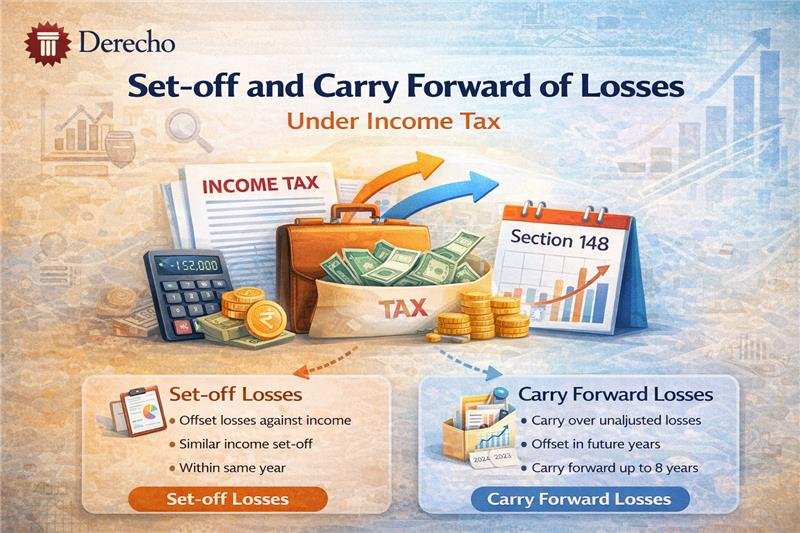
The concept of set-off and carry forward of losses allows taxpayers to adjust their losses against income, thereby reducing tax liability. It is an important tax planning tool under the Income Tax Act, 1961.
What is Set-off of Losses?
Set-off means adjusting losses against income in the same financial year.
Types of Set-off:
- Intra-head Set-off
Adjust loss from one source against income from another source under the same head
(e.g., business loss vs another business profit) - Inter-head Set-off
Adjust loss under one head against income from another head
(e.g., business loss against salary income – subject to rules)
What is Carry Forward of Losses?
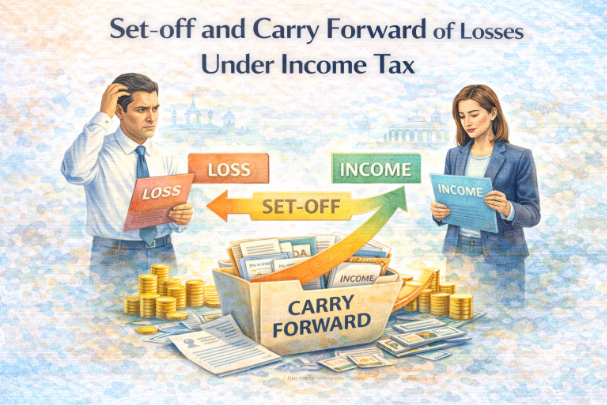
If losses cannot be fully adjusted in the same year, they can be carried forward to future years and set off against future income.
Types of Losses & Carry Forward Rules
Business Loss
- Carry forward up to 8 years
- Set off only against business income
Capital Loss
- Short-Term Capital Loss (STCL) → Can be set off against STCG & LTCG
- Long-Term Capital Loss (LTCL) → Only against LTCG
- Carry forward up to 8 years
House Property Loss
- Set off up to ₹2 lakh against other income
- Balance carried forward for 8 years
Speculative Loss
- Set off only against speculative income
- Carry forward for 4 years
Loss from Owning Race Horses
- Carry forward for 4 years
- Set off only against similar income
Key Conditions
- Return must be filed within due date
- Losses must be properly disclosed
- Maintain supporting documents
Step-by-Step Process for Set-off & Carry Forward
Step 1: Identify Type of Loss
Determine the nature of loss (business, capital, house property, etc.)
Step 2: Apply Intra-head Set-off
Adjust losses within the same head of income.
Step 3: Apply Inter-head Set-off
Set off remaining losses against other heads (if allowed).
Step 4: Calculate Remaining Loss
Determine unadjusted loss after set-off.
Step 5: File Income Tax Return on Time
Ensure timely filing to claim carry forward benefit.
Step 6: Carry Forward Eligible Loss
Carry forward remaining losses to future years.
Step 7: Set-off in Future Years
Adjust carried forward losses against eligible income.
Benefits of Set-off & Carry Forward
- Reduces tax liability
- Helps in tax planning
- Improves financial efficiency
- Utilizes losses effectively
Advantages
- Legal tax savings
- Flexibility in adjusting losses
- Supports business continuity
- Encourages investments
Consequences of Non-Compliance
- Loss of carry forward benefit
- Higher tax liability
- Penalties
- Missed tax-saving opportunities
Conclusion
Set-off and carry forward of losses is a crucial provision under income tax law that helps taxpayers optimize their tax liability. Proper understanding and timely compliance ensure maximum tax benefits.
Taxpayers should plan carefully and file returns on time to take full advantage of these provisions.