
Moving from a sole proprietorship, a partnership, or an existing entity into a newly incorporated company is a major milestone. Whether you are scaling up for investment or restructuring for tax efficiency, the transition involves more than just a new name—it requires a strategic transfer of business.
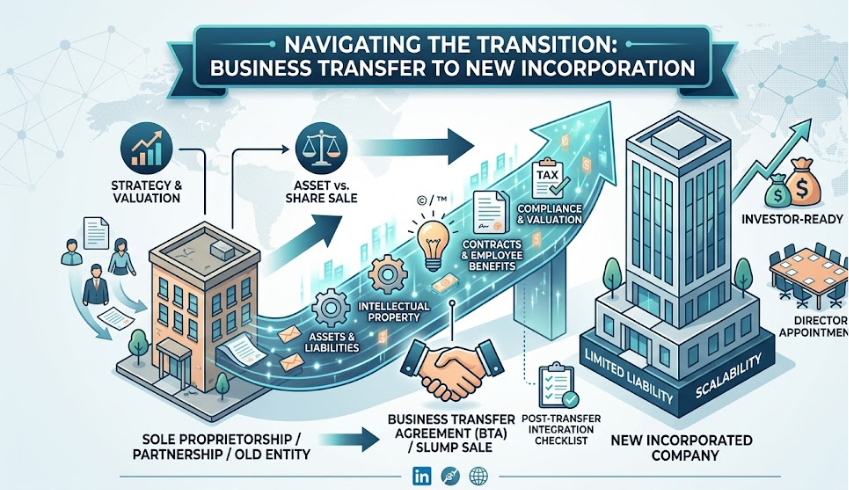
Here is a breakdown of how to navigate this evolution effectively.
1. The Strategy: Why Incorporate?
Before the paperwork begins, identify the “Why.” Incorporation offers distinct advantages that a standard business structure might lack:
- Limited Liability: Protecting personal assets from business debts.
- Capital Raising: Making the entity “investor-ready” by issuing shares.
- Perpetual Succession: Ensuring the business lives on independently of its founders.
2. The Process of Incorporation
Setting up the new entity is the first technical hurdle. This involves:
- Name Reservation: Ensuring your brand identity is unique and legally available.
- Constitutional Documents: Drafting the Memorandum and Articles of Association to define the company’s internal “laws.”
- Director Appointments: Formally assigning leadership roles and responsibilities.
3. The Mechanics of Business Transfer
Once the new company exists, you must move the “soul” of the old business into it. This is typically done through a Business Transfer Agreement (BTA) or a Slump Sale.
Key elements to transfer include:
- Assets: Tangible (machinery, inventory) and intangible (IP, trademarks).
- Liabilities: Existing debts or contractual obligations.
- Contracts: Novating agreements with suppliers and clients to the new entity.
- Employees: Ensuring continuity of service and handling benefits transitions.
4. Critical Compliance Checkpoints
A smooth transition requires a keen eye on the legal and financial fallout:
| Area | Consideration |
| Taxation | Check for Capital Gains Tax implications during the asset transfer. |
| Valuation | Assets must often be transferred at “Fair Market Value” to satisfy regulators. |
| Stamp Duty | Depending on your jurisdiction, transferring property or high-value assets may incur duties. |
| Banking | New EIN/Tax IDs mean opening new corporate bank accounts and closing old ones. |
5. Choosing the Transfer Method: Asset Sale vs. Share Sale
When moving a business into a new company, the structure of the deal changes your risk profile. You generally have two paths:
- Asset Purchase: The new company picks and chooses specific assets (equipment, customer lists) and liabilities to take over. This is great for “cherry-picking” the best parts of an old business while leaving legacy debts behind.
- Slump Sale (Business Transfer): The business is transferred as a “going concern” for a lump sum. This is often faster and can be more tax-efficient, as you aren’t valuing every individual desk and computer separately.
6. The “Human” Element: Employee Continuity
One of the most overlooked aspects of a business transfer is the Novation of Employment Contracts. Under many jurisdictions, you cannot simply “move” a person like a piece of furniture.
- Consent: Employees usually need to sign new contracts with the new entity.
- Benefits: You must decide if the new company will recognize “years of service” from the old business for things like pensions and severance.
- Culture: Use the incorporation as a moment to re-align the team with a fresh corporate vision.
7. Intellectual Property (IP) Safeguards
If your business relies on a brand, software, or a patent, the transfer is a high-risk moment.
Pro Tip: Ensure that all IP assignments are put in writing. If the old business owner (even if it’s you!) created a logo, it must be formally assigned to the new corporation. Without a written assignment, the “Chain of Title” is broken, which can kill a venture capital deal or an acquisition later on.
8. Post-Transfer Integration Checklist
After the legal ink is dry, the operational work begins. Don’t forget to:
- Update Invoicing: Ensure all clients are paying the new entity to avoid co-mingling funds.
- Insurance Policies: Transfer or “assign” your professional indemnity and general liability insurance to the new company name.
- Regulatory Permits: Check if your industry licenses (health permits, liquor licenses, construction bonds) are transferable or if you need to apply for brand-new ones.
Navigating the Transition: From Business Transfer to New Incorporation
Moving from a sole proprietorship, a partnership, or an existing entity into a newly incorporated company is a major milestone. Whether you are scaling up for investment or restructuring for tax efficiency, the transition involves more than just a new name—it requires a strategic transfer of business.
Here is a breakdown of how to navigate this evolution effectively.
1. The Strategy: Why Incorporate?
Before the paperwork begins, identify the “Why.” Incorporation offers distinct advantages that a standard business structure might lack:
- Limited Liability: Protecting personal assets from business debts.
- Capital Raising: Making the entity “investor-ready” by issuing shares.
- Perpetual Succession: Ensuring the business lives on independently of its founders.
2. The Process of Incorporation
Setting up the new entity is the first technical hurdle. This involves:
- Name Reservation: Ensuring your brand identity is unique and legally available.
- Constitutional Documents: Drafting the Memorandum and Articles of Association to define the company’s internal “laws.”
- Director Appointments: Formally assigning leadership roles and responsibilities.
3. The Mechanics of Business Transfer
Once the new company exists, you must move the “soul” of the old business into it. This is typically done through a Business Transfer Agreement (BTA) or a Slump Sale.
Key elements to transfer include:
- Assets: Tangible (machinery, inventory) and intangible (IP, trademarks).
- Liabilities: Existing debts or contractual obligations.
- Contracts: Novating agreements with suppliers and clients to the new entity.
- Employees: Ensuring continuity of service and handling benefits transitions.
4. Critical Compliance Checkpoints
A smooth transition requires a keen eye on the legal and financial fallout:
| Area | Consideration |
| Taxation | Check for Capital Gains Tax implications during the asset transfer. |
| Valuation | Assets must often be transferred at “Fair Market Value” to satisfy regulators. |
| Stamp Duty | Depending on your jurisdiction, transferring property or high-value assets may incur duties. |
| Banking | New EIN/Tax IDs mean opening new corporate bank accounts and closing old ones. |
Final Thoughts
Incorporating and transferring a business is a “level up” moment. It signals to the market that you are transitioning from a project to an institution. However, the “devil is in the details”—missing a single contract novation or tax filing can create headaches later.