
Introduction
DPDP Act compliance in India has become an important responsibility for businesses handling digital personal data. From customer contact details and employee records to financial information and online transactions, organisations collect and process personal information every day.
To protect individuals’ privacy and establish clear responsibilities for organisations, the Indian government introduced the Digital Personal Data Protection Act, 2023 (DPDP Act).
The Act provides a legal framework for processing digital personal data and establishes responsibilities for organisations that determine how and why personal information is processed.
With the Digital Personal Data Protection Rules, 2025, notified in November 2025, businesses must prepare for the phased implementation of the new requirements. Most substantive operational obligations are scheduled to commence on 13 May 2027.
For startups, small businesses, large enterprises and service providers, understanding these requirements is essential.
In this guide, we explain the DPDP Act, important compliance requirements, business responsibilities and a practical DPDP Act compliance checklist to help organisations prepare for 2027.
1. What Is DPDP Act Compliance in India?
The Digital Personal Data Protection Act, 2023, is India’s legislation governing the processing of digital personal data.
The primary objective of the Act is to protect individuals’ personal information while allowing organisations to process such information for lawful purposes.
It applies to digital personal data processed within India and can also apply to processing outside India when such processing relates to offering goods or services to individuals in India.
The Act aims to:
- Protect individuals’ digital personal information.
- Establish transparency in personal data collection and processing.
- Introduce clear consent requirements.
- Give individuals rights concerning their personal information.
- Define responsibilities for organisations processing personal data.
- Establish penalties for specified non-compliance.
Understanding DPDP Act compliance in India helps organisations identify their responsibilities and develop appropriate data protection practices.
2. Who Needs to Comply With the DPDP Act?
The DPDP Act is relevant to organisations that collect or process digital personal data within its scope.
Businesses should review their data collection and processing activities to understand their responsibilities under the law.
Organisations that may need to comply include:
- Startups collecting customer information through websites and applications.
- E-commerce businesses processing customer details and delivery addresses.
- IT companies handling employee and client information.
- Financial service providers processing customer records.
- Healthcare organisations managing digital patient information.
- Educational institutions maintaining student and parent records.
- Marketing agencies collecting customer and prospect information.
- Employers maintaining employee personal information.
The Act also recognises organisations that process personal data on behalf of another organisation.
Businesses should assess their roles and responsibilities before implementing their compliance strategy.
3. Important Roles Under the DPDP Act
Before preparing for DPDP Act compliance in India, businesses should understand the important terms used in the legislation.
Data Principal
A Data Principal is the individual to whom the personal data relates.
For example, a customer providing their contact information while purchasing a product is a Data Principal.
Data Fiduciary
A Data Fiduciary is the person or organisation that determines the purpose and means of processing personal data.
For example, an online shopping company collecting customer information to process orders acts as a Data Fiduciary.
Data Processor
A Data Processor processes personal data on behalf of a Data Fiduciary.
For example, a third-party cloud service provider storing customer information for a business may act as a Data Processor.
Consent Manager
A Consent Manager is a registered entity that enables Data Principals to give, manage, review and withdraw their consent through an accessible platform.
Understanding these roles helps organisations identify their legal responsibilities and manage personal information appropriately.
4. Key Requirements for DPDP Act Compliance in India
Effective DPDP Act compliance in India requires organisations to review their data collection, processing, storage and security practices.
The following are some important requirements businesses should understand.
A. Clear and Informed Consent
Where consent is the applicable basis for processing personal data, businesses must obtain valid consent from individuals.
Consent should be:
- Free and informed.
- Specific to the stated purpose.
- Unconditional and unambiguous.
- Given through a clear affirmative action.
- Limited to personal data necessary for the specified purpose.
Businesses should avoid unclear consent statements and unnecessary data collection.
The Act also recognises certain legitimate uses for processing personal data, so consent is not the only permitted basis.
B. Transparent Privacy Notices
Organisations must provide individuals with clear information about how their personal data will be processed.
Privacy notices should explain:
- What personal data is being collected.
- Why the information is being collected.
- How individuals can withdraw consent, where consent is the basis.
- How individuals can exercise their rights.
- How individuals can raise complaints.
A clear privacy notice helps individuals understand how organisations handle their personal information.
C. Data Security Measures
Businesses must implement reasonable security safeguards to protect personal data.
Recommended security practices include:
- Implementing access controls and role-based permissions.
- Using encryption where appropriate.
- Securing data storage and transmission.
- Conducting regular security assessments.
- Monitoring and logging access to sensitive systems.
- Providing employee security awareness training.
- Maintaining backup and recovery procedures.
Businesses should make data security an essential part of their DPDP Act compliance in India strategy.
D. Personal Data Breach Management
Organisations should establish procedures to identify, respond to and report personal data breaches.
The DPDP Rules prescribe breach notification requirements, including notification to affected Data Principals without delay and an initial intimation to the Data Protection Board without delay, followed by detailed information within the prescribed timeline.
A documented incident response plan should identify:
- How security incidents are detected.
- Who is responsible for managing incidents.
- How affected individuals are notified.
- How regulatory reporting is handled.
- How incidents are documented and reviewed.
E. Data Retention and Deletion
Businesses should not retain personal data indefinitely without a valid purpose.
Organisations should:
- Define appropriate data retention periods.
- Identify information that is no longer required.
- Establish secure deletion procedures.
- Review stored personal information regularly.
- Maintain deletion records where appropriate.
Retention and deletion practices must also account for applicable legal requirements and permitted retention periods.
F. Rights of Data Principals
The DPDP Act provides individuals with important rights concerning their personal information.
These include:
- Right to access information about personal data.
- Right to correction and erasure.
- Right to grievance redressal.
- Right to nominate another individual to exercise rights in certain circumstances.
Businesses should establish clear procedures for receiving and responding to these requests.
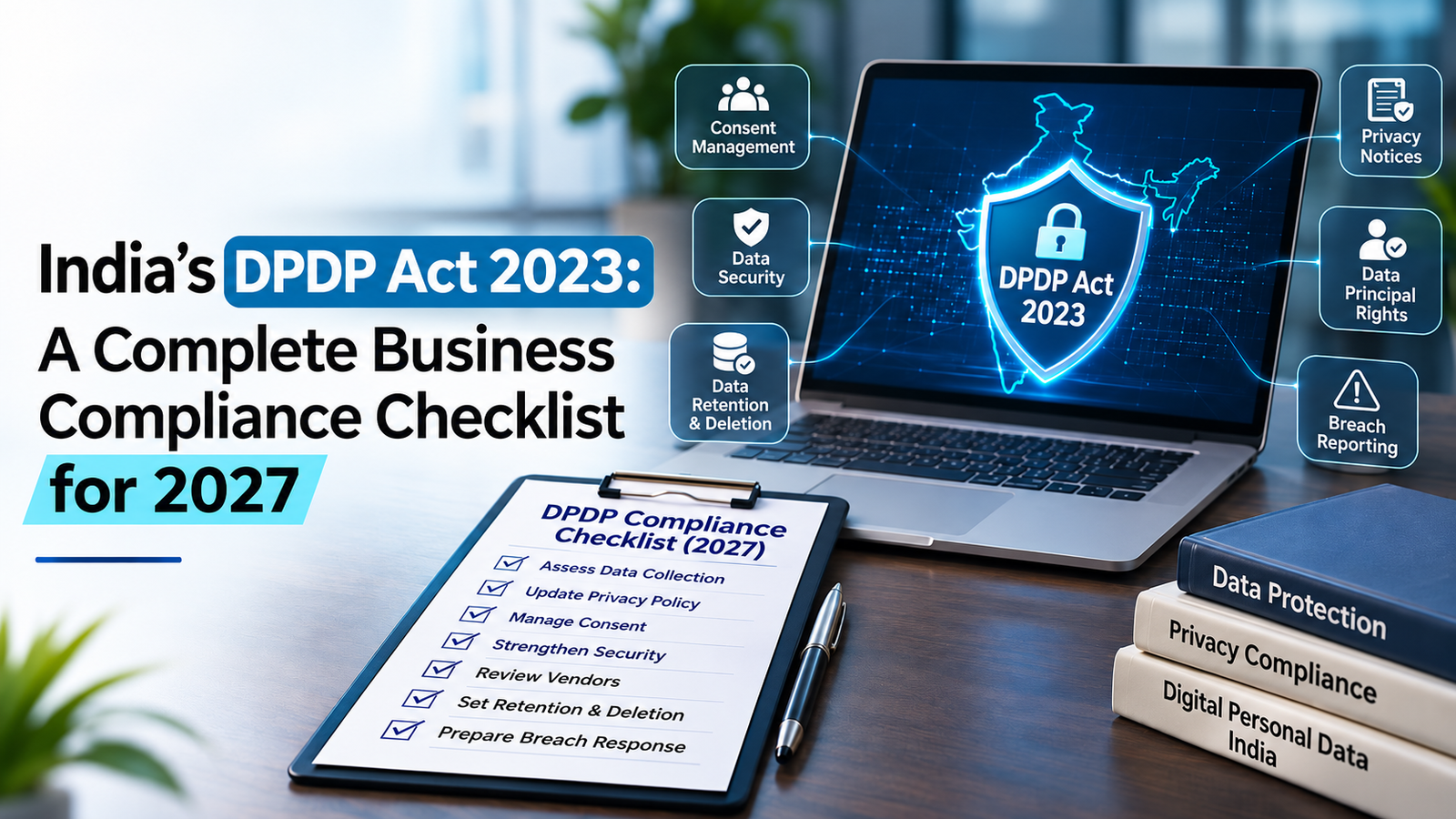
5. DPDP Act Compliance Checklist for Businesses in 2027
Preparing for DPDP Act compliance in India requires more than updating a privacy policy. Organisations should review their entire personal data lifecycle.
Here is a practical checklist that businesses can follow.
Step 1: Identify the Personal Data You Collect
Start by identifying all personal information collected across your organisation.
Review:
- Customer registration forms.
- Website contact forms.
- Employee databases.
- Marketing platforms.
- Mobile applications.
- Customer relationship management systems.
- Third-party software platforms.
Maintain an inventory of personal data and identify where it is stored and processed.
Step 2: Review Your Privacy Policy
Ensure that your privacy policy accurately explains your data processing practices.
Check whether it includes:
- Types of personal data collected.
- Purposes of processing.
- Applicable consent and withdrawal mechanisms.
- Individual rights and grievance procedures.
- Contact details for privacy-related queries.
Step 3: Review Consent Collection Mechanisms
Examine how your organisation obtains and manages consent.
Make sure that:
- Consent requests are clearly presented.
- Consent is specific to the stated purpose.
- Individuals can withdraw consent easily.
- Consent records are maintained.
- Unnecessary personal data is not collected.
Step 4: Strengthen Data Security
Review your existing technical and organisational safeguards.
Consider implementing:
- Strong authentication mechanisms.
- Role-based access restrictions.
- Encryption and secure storage.
- Regular vulnerability assessments.
- Security monitoring.
- Employee cybersecurity training.
Step 5: Establish Data Breach Response Procedures
Create a documented incident response plan.
Your plan should define:
- How breaches are identified.
- Who is responsible for handling incidents.
- How affected individuals are notified.
- How regulatory reporting is managed.
- How incidents are documented and reviewed.
Step 6: Review Third-Party Data Processors
Identify all external service providers that access or process your organisation’s personal data.
Review:
- Vendor agreements.
- Data processing responsibilities.
- Security practices.
- Data access permissions.
- Incident notification obligations.
- Data deletion and return procedures.
Step 7: Establish Data Retention and Deletion Policies
Create clear retention and deletion procedures.
Ensure that personal data is not retained beyond the period required for its specified purpose, unless retention is necessary for legal or other permitted purposes.
Step 8: Create a Grievance Redressal Process
Provide individuals with a clear channel to raise privacy-related complaints.
Establish internal responsibilities and procedures for addressing grievances within the applicable timelines.
Step 9: Train Employees
Employees play an important role in protecting personal information.
Conduct regular awareness sessions covering:
- Responsible data handling.
- Privacy and security policies.
- Recognising phishing attempts.
- Reporting data breaches.
- Handling customer information.
Step 10: Conduct Regular Compliance Reviews
DPDP compliance should be treated as an ongoing business responsibility.
Review your policies, systems, vendor agreements and security practices periodically to identify and address compliance gaps.
A structured approach to DPDP Act compliance in India can help organisations prepare for applicable requirements and improve their overall data protection practices.
6. DPDP Rules 2025: Important Compliance Timelines
The Digital Personal Data Protection Rules, 2025, were notified on 13 November 2025. The Act and Rules follow a phased commencement schedule.
Businesses should understand the following important milestones.
13 November 2025 – Initial Provisions
Certain provisions of the Act and Rules came into force upon publication of the Gazette notifications.
These include provisions relating to definitions, the Data Protection Board framework and other institutional and administrative matters.
13 November 2026 – Consent Manager Provisions
The provisions relating to Consent Manager registration and associated requirements are scheduled to commence one year after publication of the Rules.
This milestone is particularly relevant to entities seeking to operate as registered Consent Managers.
13 May 2027 – Most Substantive Compliance Requirements
Most substantive provisions concerning Data Fiduciary responsibilities, individual rights, data processing, security safeguards, breach notifications and additional obligations are scheduled to commence eighteen months after publication.
Businesses should begin their preparation well before this date.
Understanding these timelines is important because different provisions become applicable at different stages.
7. Penalties for Non-Compliance Under the DPDP Act
The DPDP Act provides financial penalties for specified contraventions.
Depending on the nature of the violation, penalties can be significant.
Some examples include:
- Failure to take reasonable security safeguards to prevent personal data breaches: penalty may extend to ₹250 crore.
- Failure to notify the Data Protection Board or affected Data Principals of a personal data breach: penalty may extend to ₹200 crore.
- Non-fulfilment of additional obligations by a Significant Data Fiduciary: penalty may extend to ₹150 crore.
- Violation of other obligations under the Act: penalties may extend to ₹50 crore for specified contraventions.
The actual penalty depends on the nature and circumstances of the contravention and the applicable statutory provisions.
These provisions highlight why businesses should take data protection and regulatory compliance seriously.
8. Common DPDP Compliance Mistakes Businesses Should Avoid
While preparing for DPDP Act compliance in India, organisations should avoid the following common mistakes.
- Collecting unnecessary personal information: Collect only information required for the specified purpose.
- Using outdated privacy policies: Review and update privacy notices to reflect actual business practices.
- Ignoring consent withdrawal: Provide an effective mechanism for withdrawing consent.
- Overlooking third-party vendors: Establish appropriate contractual and security arrangements with Data Processors.
- Keeping personal data indefinitely: Define suitable retention and deletion procedures.
- Ignoring employee awareness: Train employees to handle personal information responsibly.
- Lacking a breach response plan: Prepare a clear process for responding to personal data breaches.
- Delaying compliance preparation: Start reviewing your processes before the applicable commencement dates.
Avoiding these mistakes can help organisations build a stronger approach to privacy and data protection.
9. How Derecho Consulting Can Help With Data Protection Compliance
Preparing for the DPDP Act involves understanding legal requirements, reviewing existing business practices and implementing suitable compliance measures.
Businesses may need professional assistance to assess their current data handling practices and identify areas that require attention.
Derecho Consulting can support organisations through relevant legal and compliance advisory services, including:
- Reviewing existing privacy policies and related documentation.
- Assessing business processes against applicable data protection requirements.
- Identifying potential compliance gaps.
- Advising on consent and privacy notice requirements.
- Reviewing relevant third-party contractual arrangements.
- Supporting the development of data protection policies and procedures.
- Providing guidance on regulatory compliance and risk management.
With appropriate professional guidance, businesses can develop a structured approach to data protection and strengthen customer trust.
10. Frequently Asked Questions About DPDP Act Compliance in India
1. What is the DPDP Act 2023?
The Digital Personal Data Protection Act, 2023, is India’s legislation governing the processing of digital personal data. It establishes responsibilities for organisations and provides rights to individuals regarding their personal information.
2. When will the DPDP Act compliance requirements become applicable?
The Act and Rules have a phased commencement schedule. Most substantive operational requirements are scheduled to commence on 13 May 2027. Businesses should review the applicable commencement notifications to identify which provisions apply at each stage.
3. Does the DPDP Act apply to startups and small businesses?
Yes. Startups and small businesses that process digital personal data may fall within the scope of the Act, subject to its applicable provisions and exemptions.
4. Is consent mandatory for every type of personal data processing?
No. Consent is one recognised basis for processing personal data. The Act also permits processing for certain legitimate uses specified under the law.
5. What are the penalties under the DPDP Act?
The Act provides financial penalties for specified contraventions. Depending on the violation, penalties can extend to ₹250 crore.
6. Does the DPDP Act apply to employee data?
Digital personal data relating to employees can fall within the scope of the Act, subject to applicable provisions and permitted uses.
7. What should businesses do before May 2027?
Businesses should identify the personal data they process, review privacy notices, strengthen security safeguards, establish appropriate consent and grievance mechanisms, review vendor agreements and prepare data breach response procedures.
Conclusion
The Digital Personal Data Protection Act, 2023, represents an important development in India’s digital and regulatory landscape. It places greater responsibility on organisations to handle personal information transparently, securely and responsibly.
For businesses, DPDP Act compliance in India should not be treated as just another legal formality. It is an opportunity to strengthen data governance, improve security practices and build trust with customers, employees and business partners.
With most substantive operational requirements scheduled to commence in May 2027, organisations should begin reviewing their existing practices and preparing an effective compliance strategy now.
Whether you operate a startup, a growing enterprise or an established organisation, taking proactive steps towards data protection can help reduce regulatory risks and support long-term business growth.
Need guidance on preparing your business for DPDP compliance? Connect with Derecho Consulting for professional legal and corporate compliance assistance.
Disclaimer: This article is intended for general informational purposes only and does not constitute legal advice. The applicability of specific requirements depends on the facts, business activities, statutory provisions, exemptions and commencement notifications. Businesses should obtain professional legal advice before making compliance decisions.
Be Part of Something Bigger!
Whether you’re exploring new ideas, learning something new, or looking for opportunities, Enigma Community brings you closer to a world of possibilities.
Join Us: https://www.enigmacommunity.com/