
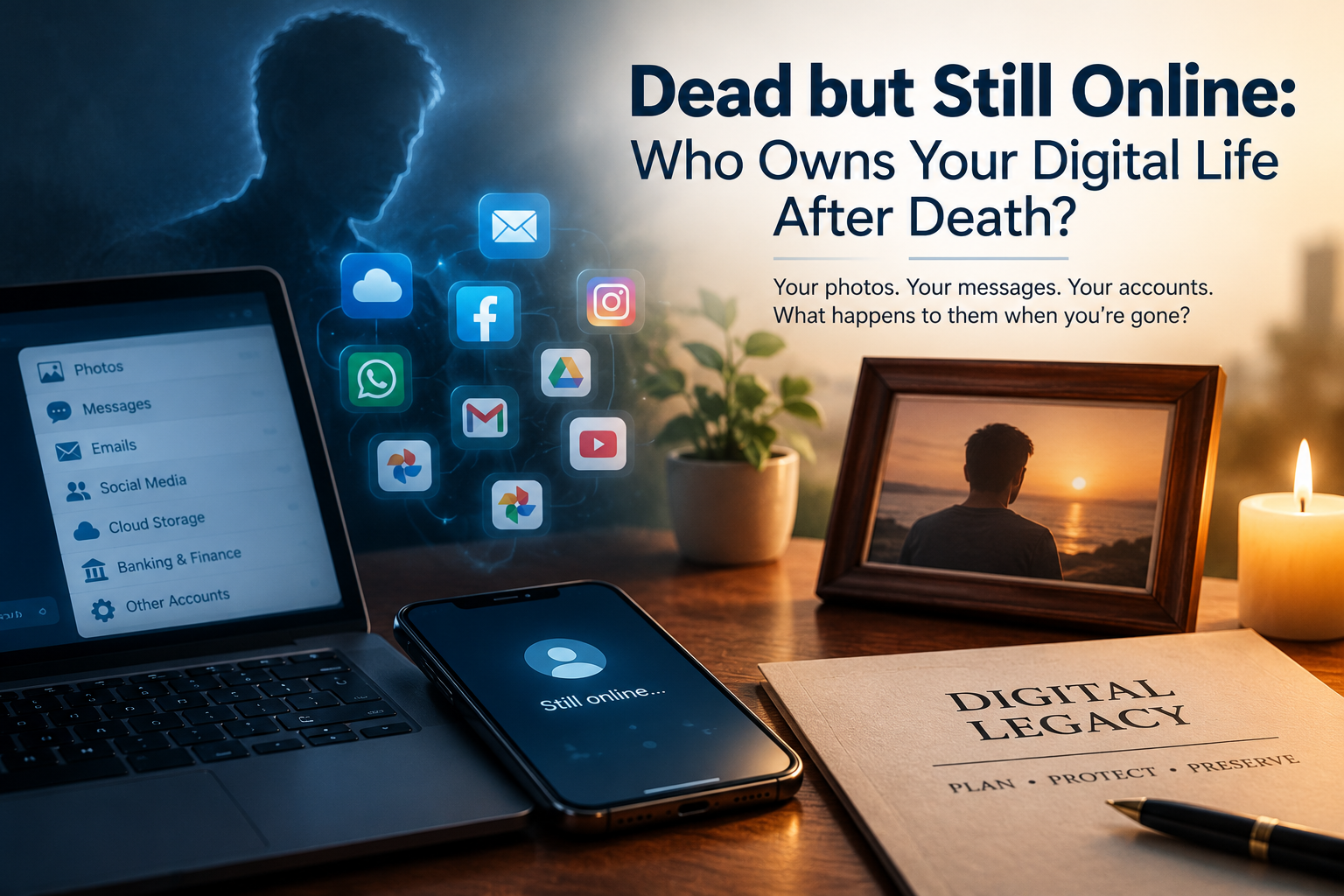
Your digital life after death does not simply disappear. Photos sit in the cloud. Emails stay in an inbox. Crypto wallets, social profiles, and subscriptions keep existing long after you are gone. Someone has to decide who gets access. In India, the answer is still unclear. A 2026 court ruling has started to change that. Here is who owns your digital life after death, and what you can do about it today.
What Counts as Your Digital Life After Death?
Your digital life is bigger than most people think. It includes more than social media. A typical person leaves behind:
- Photos, videos, and voice notes stored in the cloud.
- Email and messaging accounts.
- Social media profiles.
- Cryptocurrency and online wallets.
- Online banking, investments, and subscriptions.
- Documents, files, and business accounts.
Some of these assets have money value. Others have only emotional value. Yet families often want access to both. Consequently, a grieving household can hit a legal wall within days of a death.
Why Digital Life After Death Is a Legal Gray Zone in India
India has no comprehensive law on digital inheritance. The Indian Succession Act, 1925 covers movable and immovable property. However, it does not explicitly mention digital assets. The Information Technology Act, 2000 deals mainly with cybercrime and unauthorised access. It says little about inheritance.
That leaves a patchwork. Platform rules, privacy law, and old succession law all pull in different directions. As a result, the company that holds your data often decides what happens to it.
The Gandhinagar Ruling on Digital Life After Death
A May 2026 case in Gandhinagar brought the issue into focus. A man named Shaishav Dineshbhai Shah died in 2025 without a will. His wife and daughter were his only legal heirs. They inherited his physical belongings. However, they could not open his Apple iCloud account, which held years of photos, videos, and voice notes.
Apple said it needed a court order appointing a legal administrator. So the daughter went to court. The judge appointed her as administrator of the estate. He also directed Apple to help recover the data to the extent technically feasible.
The court held that data in the iCloud account forms part of the deceased’s estate. Therefore, it can be administered under succession law. The court also held that privacy is a personal right that ends with the person. It cited the maxim actio personalis moritur cum persona, which means a personal right of action dies with the person.
This ruling matters. Still, it came from a trial court. It does not bind other courts, and it does not create a national rule.
What the DPDP Act Says About Digital Life After Death
- The Digital Personal Data Protection Act, 2023 touches the issue briefly. Section 14 lets you nominate someone to exercise your data rights if you die or become incapable. That person can handle things like access and deletion.
However, two limits apply. First, Section 14 is not yet in force. The government is phasing in the Act, and the remaining provisions are scheduled for around May 2027. Second, Section 14 deals with data rights. It does not decide who inherits your digital assets.
For financial digital assets, experts say a nominee usually acts as a custodian. Ownership still rests with the legal heirs under succession law.
What Big Tech Lets Your Family Do
Tech companies have built their own tools. These tools work only if you set them up while alive.
Apple offers a Legacy Contact. A person you name can access chosen iCloud data after your death. They need an access key and a death certificate. Without a nomination, your family needs a court order. Passwords and licensed media stay locked either way.
Google offers the Inactive Account Manager. You choose what happens after a period of inactivity. You can share data with up to 10 trusted contacts or delete the account. Some data cannot be shared.
Meta lets families memorialise Facebook and Instagram accounts. A legacy contact can manage limited profile functions, such as pinned posts. They cannot read private messages or log in. Families can also request deletion with proof of death.
X offers far fewer options. Families generally have only limited deletion routes.
Crypto and Other Assets With Real Money Value
Money-bearing assets raise sharper problems. In 2025, the Madras High Court held in Rhutikumari v. Zanmai Labs that cryptocurrency can be treated as property. Indian tax law also classes crypto and NFTs as virtual digital assets.
Even so, a court can only decide who owns an asset. It cannot always unlock it. If nobody holds the private keys, heirs may never reach the funds. Therefore, planning matters more for crypto than for almost any other asset.
How Other Countries Handle Digital Life After Death
Other countries have moved faster. Germany’s Federal Court ruled in 2018 that digital accounts pass to heirs like physical property. Many US states follow the Revised Uniform Fiduciary Access to Digital Assets Act. It allows access if the deceased consented in a will or in platform settings. France lets users leave binding instructions to delete, transfer, or keep their data.
India is moving in the same direction. A Bill pending in Parliament proposes changes to the IT Act. It would define digital assets and introduce ideas like a “digital asset will” and a “digital executor.” Nothing has become law yet.
How to Protect Your Digital Life After Death
You do not need to wait for Parliament. A few steps help right now.
- Make a list. Note every account, wallet, and subscription you hold.
- Name digital assets in your will. State who should receive or manage each category, subject to platform terms and legal limits.
- Use the platform tools. Set up Apple Legacy Contact, Google Inactive Account Manager, and Facebook Legacy Contact.
- Use a password manager. Share its emergency access with a trusted person.
- Separate the plan from the keys. Let your executor know the plan. Give out credentials only as your lawyer advises.
- Back up what matters. Download photos and documents to a drive your family can reach.
- Review yearly. Accounts and passwords change often.
Linking Digital Death to Digital Privacy
Death is only one part of the privacy puzzle. The living face related problems, such as old records that stay online foreve. For a closer look at how Indian courts handle that issue, read our full guide to the right to be forgotten in India.
Final Thought
Your digital life after death belongs, in practice, to whoever planned for it. Indian law does not yet give heirs an automatic right to your accounts. The Gandhinagar ruling is a strong step, but it is only one trial court’s decision. Platform rules still fill much of the gap, and they only help people who set them up in advance. A short will, a few legacy settings, and a password manager can spare your family months of legal stress. Parliament may fix the law someday. Until then, planning is the safest way to decide who owns your digital life after death.
This article gives general information, not legal advice. Succession law is complex, so consult a qualified lawyer about your own estate.